Tuesday, May 10, 2011

Life and the Cosmos, Word by Painstaking Word


By CLAUDIA DREIFUS

Published: May 9, 2011

TEMPE, Ariz. — Like Einstein, he is as famous for his story as for his science.At the age of 21, the British physicist Stephen Hawking was found to have amyotrophic lateral sclerosis, Lou Gehrig’s disease. While A.L.S. is usually fatal within five years, Dr. Hawking lived on and flourished, producing some of the most important cosmological research of his time. 

In the 1960s, with Sir Roger Penrose, he used mathematics to explicate the properties of black holes. In 1973, he applied Einstein’s general theory of relativity to the principles of quantum mechanics. And he showed that black holes were not completely black but could leak radiation and eventually explode and disappear, a finding that is still reverberating through physics and cosmology.

Dr. Hawking, in 1988, tried to explain what he knew about the boundaries of the universe to the lay public in “A Brief History of Time: From Big Bang to Black Holes.” The book sold more than 10 million copies and was on best-seller lists for more than two years.

Today, at 69, Dr. Hawking is one of the longest-living survivors of A.L.S., and perhaps the most inspirational. Mostly paralyzed, he can speak only through a computerized voice simulator.

On a screen attached to his wheelchair, commonly used words flash past him. With a cheek muscle, he signals an electronic sensor in his eyeglasses to transmit instructions to the computer. In this way he slowly builds sentences; the computer transforms them into the metallic, otherworldly voice familiar to Dr. Hawking’s legion of fans.

It’s an exhausting and time-consuming process. Yet this is how he stays connected to the world, directing research at the Center for Theoretical Cosmology at the University of Cambridge, writing prolifically for specialists and generalists alike and lecturing to rapt audiences from France to Fiji.

Dr. Hawking came here last month at the invitation of a friend, the cosmologist Lawrence Krauss , for a science festival sponsored by the Origins Project of Arizona State University. His lecture, “My Brief History,” was not all quarks and black holes. At one point, he spoke of the special joys of scientific discovery.

“I wouldn’t compare it to sex,” he said in his computerized voice, “but it lasts longer.” The audience roared.

The next afternoon, Dr. Hawking sat with me for a rare interview. Well, a kind of interview, actually.

Ten questions were sent to his daughter, Lucy Hawking, 40, a week before the meeting. So as not to exhaust her father, who has grown weaker since a near-fatal illness two years ago, Ms. Hawking read them to him over a period of days.

During our meeting, the physicist played back his answers. Only one exchange, the last, was spontaneous. Yet despite the limitations, it was Dr. Hawking who wanted to do the interview in person rather than by e-mail.

Some background on the second query, the one about extraterrestrials. For the past year, Lucy Hawking was writer in residence at the Origins Project at Arizona State University. As part of her work, she and Paul Davies, a physicist at Arizona State, started a contest, “Dear Aliens,” inviting Phoenix schoolchildren to write essays about what they might say to space beings trying to contact Planet Earth.

Q. Dr. Hawking, thank you so much for taking time to talk to Science Times. I’m wondering, what is a typical day like for you?

A. I get up early every morning and go to my office where I work with my colleagues and students at Cambridge University. Using e-mail, I can communicate with scientists all over the world.

Obviously, because of my disability, I need assistance. But I have always tried to overcome the limitations of my condition and lead as full a life as possible. I have traveled the world, from the Antarctic to zero gravity. (Pause.) Perhaps one day I will go into space.

Q. Speaking of space: Earlier this week, your daughter, Lucy, and Paul Davies, the Arizona State University physicist, sent a message into space from an Arizona schoolchild to potential extraterrestrials out there in the universe. Now, you’ve said elsewhere that you think it’s a bad idea for humans to make contact with other forms of life. Given this, did you suggest to Lucy that she not do it? Hypothetically, let’s say as a fantasy, if you were to send such a message into space, how would it read?


A. Previously I have said it would be a bad idea to contact aliens because they might be so greatly advanced compared to us, that our civilization might not survive the experience. The “Dear Aliens” competition is based on a different premise.

It assumes that an intelligent extraterrestrial life form has already made contact with us and we need to formulate a reply. The competition asks school-age students to think creatively and scientifically in order to find a way to explain human life on this planet to some inquisitive aliens. I have no doubt that if we are ever contacted by such beings, we would want to respond.

I also think it is an interesting question to pose to young people as it requires them to think about the human race and our planet as a whole. It asks students to define who we are and what we have done.

Q. I don’t mean to ask this disrespectfully, but there are some experts on A.L.S. who insist that you can’t possibly suffer from the condition. They say you’ve done far too well, in their opinion. How do you respond to this kind of speculation?

A. Maybe I don’t have the most common kind of motor neuron disease, which usually kills in two or three years. It has certainly helped that I have had a job and that I have been looked after so well.

I don’t have much positive to say about motor neuron disease. But it taught me not to pity myself, because others were worse off and to get on with what I still could do. I’m happier now than before I developed the condition. I am lucky to be working in theoretical physics, one of the few areas in which disability is not a serious handicap.


Q. Given all you’ve experienced, what words would you offer someone who has been diagnosed with a serious illness, perhaps A.L.S.?

A. My advice to other disabled people would be, concentrate on things your disability doesn’t prevent you doing well, and don’t regret the things it interferes with. Don’t be disabled in spirit, as well as physically.

Q. About the Large Hadron Collider, the supercollider in Switzerland, there were such high hopes for it when it was opened. Are you disappointed in it?


A. It is too early to know what the L.H.C. will reveal. It will be two years before it reaches full power. When it does, it will work at energies five times greater than previous particle accelerators.

We can guess at what this will reveal, but our experience has been that when we open up a new range of observations, we often find what we had not expected. That is when physics becomes really exciting, because we are learning something new about the universe.

Q. I’m wondering about your book “A Brief History of Time.” Were you surprised by the enormous success of it? Do you believe that most of your readers understood it? Or is it enough that they were interested and wanted to? Or, in another way: what are the implications of your popular books for science education?

A. I had not expected “A Brief History of Time” to be a best seller. It was my first popular book and aroused a great deal of interest.

Initially, many people found it difficult to understand. I therefore decided to try to write a new version that would be easier to follow. I took the opportunity to add material on new developments since the first book, and I left out some things of a more technical nature. This resulted in a follow-up entitled “A Briefer History of Time,” which is slightly briefer, but its main claim would be to make it more accessible.

Q. Though you avoid stating your own political beliefs too openly, you entered into the health care debate here in the United States last year. Why did you do that?

A. I entered the health care debate in response to a statement in the United States press in summer 2009 which claimed the National Health Service in Great Britain would have killed me off, were I a British citizen. I felt compelled to make a statement to explain the error.

I am British, I live in Cambridge, England, and the National Health Service has taken great care of me for over 40 years. I have received excellent medical attention in Britain, and I felt it was important to set the record straight. I believe in universal health care. And I am not afraid to say so.

Q. Here on Earth, the last few months have just been devastating. What were your feelings as you read of earthquakes, revolutions, counter-revolutions and nuclear meltdowns in Japan? Have you been as personally shaken up as the rest of us?

A. I have visited Japan several times and have always been shown wonderful hospitality. I am deeply saddened for my Japanese colleagues and friends, who have suffered such a catastrophic event. I hope there will be a global effort to help Japan recover. We, as a species, have survived many natural disasters and difficult situations, and I know that the human spirit is capable of enduring terrible hardships.

Q. If it is possible to time-travel, as some physicists claim, at least theoretically, is possible, what is the single moment in your life you would like to return to? This is another way of asking, what has been the most joyful moment you’ve known?

A. I would go back to 1967, and the birth of my first child, Robert. My three children have brought me great joy.

Q. Scientists at Fermilab recently announced something that one of our reporters described as “a suspicious bump in their data that could be evidence of a new elementary particle or even, some say, a new force of nature.” What did you think when you heard about it? A. It is too early to be sure. If it helps us to understand the universe, that will surely be a good thing. But first, the result needs to be confirmed by other particle accelerators.

Q. I don’t want to tire you out, especially if doing answers is so difficult. But I’m wondering: The speech you gave the other night here in Tempe, “My Brief History,” was very personal. Were you trying to make a statement on the record so that people would know who you are?


A. (After five minutes.) I hope my experience will help other people.

(Reference - http://www.nytimes.com)

Contrite Cisco Regroups Before Skeptical Wall Street

By VERNE G. KOPYTOFF

Published: May 8, 2011

SAN FRANCISCO — John T. Chambers, one of the best salesmen in Silicon Valley, has been having trouble selling anyone on his company’s future.

Cisco Systems, where he is chief executive, is in a slump. The management system he put in place slowed decision-making and innovation. The company’s growth has slowed and its profits are falling.

His latest sales pitch is that he can revive Cisco — a technology colossus that makes computer networking equipment — by pruning its sprawling business and refocusing on its strengths.

But investors, Wall Street analysts and customers are a little bit skeptical of Mr. Chambers’s promises. No major improvement in Cisco’s finances is expected when it reports third quarter earnings on Wednesday. Given Cisco’s size, the scope of the overhaul and the increasing competition that is eroding the company’s market share, a turnaround could take time.

Last week, Cisco said it would reduce bureaucracy by eliminating a crazy-quilt management structure that had executives responsible for geographic regions as well as serving on “councils” that were supposed to encourage cooperation between the different groups. Instead, it slowed decision-making.

Last month, Mr. Chambers, who declined to be interviewed for this article, took his first step to fix Cisco by suddenly shutting down its Flip video camera business. Only two years earlier, Cisco had acquired Flip’s parent company for $590 million to expand its nascent consumer products division. The camera was popular and, indeed, the company was days away from release of the latest version of the video camera.

“This isn’t simply a midcourse correction,” said Jeffrey Kvaal, an analyst with Barclays Capital. “They’re facing challenges that are multi-year.”

The doubt in Mr. Chambers’s sales pitch began last year when Cisco’s sales started to show weakness that Mr. Chambers initially attributed to the sour economy. When profits continued to wither quarter after quarter, Mr. Chambers alternately blamed a decline in government spending and a “transition” after the introduction of new switches for computer networks.

In the last 12 months, its shares have fallen 31 percent as the Nasdaq index gained 22 percent. While Cisco’s shares fell, those of its rivals like Juniper Networks rose 35 percent. Alcatel-Lucent’s shares doubled.

In April, in a memo to employees, Mr. Chambers acknowledged systematic problems at Cisco. He blamed slow decision-making and a lack of accountability. “We have disappointed our investors and we have confused our employees,” Mr. Chambers wrote. “Bottom line, we have lost some of the credibility that is foundational to Cisco’s success — and we must earn it back.”

The contrition is unusual for Mr. Chambers, who is known for his unwavering optimism during his 16 years leading Cisco. He has paused his cheerleading only once before — during the dot-com crash more than a decade ago, when Cisco was unprepared for customers sharply cutting back orders. Cisco had been one of the hottest companies of the Internet boom of the 1990s with a high-flying stock to match. Much of the blame for its shortcomings fell on Mr. Chambers, much as it does today.

The last few years should have been golden for Cisco. Telecommunications companies worldwide were rapidly expanding their infrastructure to accommodate growing traffic from online streaming and mobile phones.

But Cisco failed to keep pace with changes in the network switching and routing equipment, which accounts for nearly half its revenue. The industry has shifted from more standardized technology — a landscape in which Cisco thrived — to specialized equipment for various niche markets.

For example, Cisco’s market share in edge routers, used by Internet providers to route traffic near the edges of their networks, dropped 11 percentage points over three years to 42.2 percent in 2010, according to the Dell’Oro Group, a market research firm.

“They’ve been lagging,” said Shin Umeda, an analyst with the Dell’Oro Group. “As a result, the competitors have been able to move in.”

Rivals like Alcatel-Lucent and Juniper Networks grabbed market share from Cisco in edge routers. Meanwhile upstarts like F5, based in Seattle, have chipped away at Cisco in other specialized markets like the equipment for controlling the load on Web servers in data centers.

Analysts said Cisco stumbled because Mr. Chambers distracted the company by trying to push into new businesses like videoconferencing, smart meters for monitoring electricity use, television set-top boxes, video screens for stadiums and even a tablet computer for businesses. These initiatives, called “adjacencies” within the company, were supposed to be the foundation of future growth.

Some of them have gained momentum, like Cisco’s corporate voice-over-Internet telephone systems and WebEx, the business videoconferencing service it acquired four years ago. But others, like the consumer products and digital signs, failed to catch on or are so far afield from the company’s main focus that analysts say Cisco is better off without them.

In addition to cutting Flip, Cisco folded its Umi home videoconferencing into its business-oriented unit. Eos, a service for media and entertainment companies to manage online content, will most likely be discontinued as a stand-alone product or sold. So far, Cisco has cut 550 jobs, but it has also offered voluntary buyouts to some of its employees in the United States and Canada.

Despite Cisco’s troubles, the company remains a powerful force with $40 billion in annual revenue and nearly 73,000 employees.

Still, more reorganization at Cisco is expected. The Linksys unit, which sells routers for home networking, is among the most likely targets because of its lower profit margins, analysts said. Cisco is expected to pay closer attention to its main router and switching businesses.

In his memo, Mr. Chambers largely signaled as much by saying that Cisco will “compete to win in the core.”

He added that the company’s breadth of products gave it a big advantage.

However, achieving the long-term goals of up to 17 percent annual revenue growth is no easy feat for a company so big. Indeed, Mr. Kvaal, the Barclays analyst, said that he would be happy if Cisco simply shored up its business and kept up with the networking industry’s growth.

Sales of switches are expected to be flat this year, but grow 6 percent the following three years, according to the Dell’Oro Group. Router sales are supposed to grow 9 percent annually over that period.

“Cisco doesn’t have to be a market-share gainer, they just have to hold onto the share they have,” Mr. Kvaal said. “They have taken the first step, but it’s not the only step.”

(Reference - http://www.nytimes.com)

Monday, May 9, 2011

Siti Nurhaliza di Malam Gala SimplySiti UiTM Shah Alam

Pada 9hb julai 2011 ini akan berlangsung konsert Datuk Siti Nurhaliza di Dewan Agong Tuanku Canselor, UiTM Shah Alam sempena setahun produk SimplySiti yang diasaskan oleh Dato’ Siti Nurhaliza berada di pasaran, beberapa orang artis ternama akan turut bersama Datuk Siti Nurhaliza menjayakan Malam Gala SimplySiti untuk menghiburkan para hadirin dan pelanggan produk SS pada malam tersebut.

Malam Gala SimplySiti ini menjadi lebih istimewa dengan kerana ia akan turut menyaksikan suatu kolaborasi unik di antara SimplySiti dan sebuah institusi pengajian tinggi yang ulung tanahair kita. Buat julung-julung kalinya.

Tetamu Kehormat :


Y. Bhg. Dato’ Prof Ir Dr Sahol Hamid Abu Bakar, Naib Canselor UITM, Y.Bhg Dato’ Siti Nurhaliza, Presiden SimplySiti dan Y.Bhg Dato’ Sri Khalid Mohamad Jiwa.

Selamat ulangtahun pertama SIMPLYSITI. Tahniah buat semua warga kerja, staff dan juga peminat yang menjayakannya. Tahniah Dato’ Siti Nurhaliza. Semoga SimplySiti terus berkembang maju untuk tahun yang mendatang.

Siti Nurhaliza

Sunday, May 8, 2011

Analysis: Skype, better with Facebook than Google?

NEW YORK | Fri May 6, 2011 7:33am EDT

(Reuters) - As two Internet powerhouses slug it out to tie the knot with Skype, Facebook looks likely to be a more aggressive suitor than Google, and the world's largest social network may make for a better fit.

Reuters reported Wednesday that Facebook and Google are separately weighing partnerships with Skype, the popular web video telephony service used by millions around the globe for communication.

Talks with Facebook and Google are still preliminary, but any deal could involve an outright takeout or a joint venture partnership, two sources told Reuters.

A deal involving Skype, which is readying for an IPO, could be valued at $3 billion to $4 billion, the first source said. Skype's public offering is expected to raise about $1 billion, several other sources said.

Analysts and technology observers are betting on Facebook, in the belief the two make better companions and that Skype completes Facebook by providing assets it does not have.

"It's not surprising to me that both these companies are interested," said Eric Jackson, founder and manager of the investment firm Ironfire Capital. "It's a much more valuable asset to Facebook than to Google."

Google already has voice chat and video capabilities, though Skype is a more robust product, said Rory Maher, an analyst with Hudson Square Research.

It could incorporate Skype into Google Voice, and even get some social-media credibility after it failed in an attempt to do so with Buzz.

"There are benefits that Google has from combining Skype, but I think it's less clean than it is for Facebook," says Maher.

Conversely, Facebook has that much more incentive to snap up Skype because it would encourage people to spend more time on the site than they already do -- virtually the social network's raison d'etre.

"Communication is core to what Facebook users do," said Mo Koyfman, a principal at the venture capital firm Spark Capital. "Owning that platform would be very interesting."

Google, Facebook and Skype declined to comment.

THE ART OF SKYPE

Skype is still on track for an IPO later in 2011, raising as much as $1 billion by some estimates. That it has become the belle of the ball, attracting the interest of the Internet's two most dominant powers, bodes well for its debut.

Last year, Skype boasted about 124 million connected users every month by the end of June. But just 8.1 million were paying customers, using Skype to make calls to traditional phones at discounted rates.

The company was founded in 2003 and bought by eBay two years later for $3.1 billion. Ebay then sold a majority stake in Skype to an investor group in 2009, while keeping about a third of the company.

Now, both Skype and Facebook could tap new users worldwide while Facebook stands to gain a new revenue stream, Koyfman said.

Facebook had net income of $355 million in the first nine months of 2010 on revenue of $1.2 billion. It is one of a handful of Internet companies including Twitter, Groupon and Zynga that have stoked interest from investors eager to jump on the social media bandwagon.

And it has also put the big Internet guns -- including Google -- on alert.

Indeed, some speculate that Google could be bidding for Skype just to keep it out of the hands of other companies.

"Any deal that takes a great asset away from Facebook is a win for Google," suggested Ironfire Capital's Jackson.

(Reporting by Jennifer Saba; Editing by Edwin Chan and Steve Orlofsky)

(Reference : http://www.reuters.com)

Saturday, May 7, 2011

An Open Letter To Dr. Richard Stallman (Free Software Foundation Founder)

Dear Dr. Stallman,

Thank you for coming to Penn and giving a talk on A Free Digital Society; it was an honor meeting you. You mentioned that what you expected of us was to help the Free Software Foundation however we could; I'd like to take you up on that and offer both yourself and the FSF the following advice:

Stop marginalizing yourself

You make a number of very valid points. When a program is distributed without its source code, users don't have as much control as they would otherwise. Internet censorship is on the rise and presents a serious and credible threat to society. DRM is an example of false scarcity and doesn't make sense in the long run. But every time you use the word Big Brother or call the Kindle "Swindle," or make an aside like "even if you believe that the government had nothing to do with the attacks of September 2001," you go from making an interesting argument about freedom to being the crazy guy shouting at cars on the side of the road.

Impeach_vs_swindle

Most FSF marketing materials follow this "you're not listening to us, so we're going to make increasingly outlandish claims" approach. The closest comparison that I can make between the FSF would have to be the Lyndon LaRouche movement.

Global_warming_vs_ms7sins

There are numerous arguments in support of Free Software that I can think of that do not have to involve a conspiratorialist tirade. When you talk about the risk of software as a service, you can mention that the US gov't is attempting to collect identifying user data from the Wikileaks Twitter account, or the recent domain name seizures of PokerStars and other online gambling websites. These are practical consequences of a lack of Free Software and, arguably, places where the government has been overstepping its bounds. These are the arguments I would have loved to hear from you, presented in an even tone and without the usual snark.

Baby steps

In today's world, it's not realistic to ask most users to completely abandon all proprietary software immedialy. Proprietary software is usually better, especially when it comes to UI Design and User Experience. When a student confronted you with this, you responded that if we truly valued freedom we would not mind the inconvenience of (for example) emailing copies of documents around instead of collaborating via Google Docs.

Dr. Stallman, Google Docs is really useful. I imagine you're unlikely to have tried the service yourself, abstaining as you have from proprietary software for the past several decades. It may be worth trying the service out, if only to better relate to your target audience.

Dr. Stallman, you like to use the argument that proprietary software is like a drug, so let me extend that analogy: today's proprietary stuff isn't marijuana; it's heroin, and it's really, really good. You don't get somebody off heroin by lecturing them about how they should value their freedom; you switch them over to methadone for a while and let them slowly detox.

To that end, please stop accusing users unwilling to shift to inferior software as haters of freedom; all you are doing is insulting us and inviting us to ignore you. Instead, consider offering practical alternatives and first steps for products that you would recommend. We live in a world where having the technological edge makes the difference between success and failure; asking us to just give up that edge for a theoretical idea of freedom is not going to work.

Do what you do best

Dr. Stallman, I have a tremendous amount of respect for your contributions to GNU, emacs and gdb amongst others. You are a man of considerable intellect and programming ability. That said, I nor the people that I spoke with about your talk found you to be a particularly charismatic or persuasive speaker. The only people that seemed convinced by your speech were the ones who had already been leaning towards your point of view to start with. Several friends of mine who had not heard of the FSF before left half way through because they were so put off by some of conspiratorial rhetoric above.

I wonder whether the Free Software movement might be better served if you spent more of your time mentoring up-and-coming hackers and writing free software that matches in elegance and quality some of the software that you have written in the past. When we asked, you mentioned that you do not write much code anymore. That's a shame.

(From - http://alexeymk.com/dear-dr-stallman-an-open-letter)

Friday, May 6, 2011

Convergence Enterprise Communications. Information Technology (IT) and The Cloud

Over the last ten years, there has been a rapidly accelerating series of convergences in the communications world. The world of telephony has changed forever, from its roots in traditional Plain Old Telephone (POT) voice through an initial convergence with IP networks.

The TDM PBX was self-contained and comfortable – a separate network, proprietary hardware, proprietary devices, specialist communications personnel. The argument for moving to IP telephony has been focused towards reducing costs and offering new functionality by utilising data networks to carry voice traffic.

While it is true that rationalization of two separate networks into a single infrastructure has simplified the corporate network architecture, the reality has been the replacement of one set of proprietary appliances with another. Maintaining high quality voice calls over a shared data network has also provided an additional challenge. Communications application suites designed to enhance the user experience with IP telephony systems often have been no more sophisticated than similar applications used with TDM systems.

IP telephony has delivered on some of its promises but the overall benefits to the enterprise have been questionable. In many ways the status quo has been preserved, with ownership transferred from telecoms personnel to the data networking groups within the IT department. However it has transported telephony away from its isolated silo and connected it to the IT world, laying the foundation for subsequent rounds of convergence and further potential benefits to the enterprise.

The concept of ‘unified communications’ is compelling, the convergence of all methods of communicating between two or more people, from any application, using any device, at any location, via the most appropriate route, enabling effective collaboration with business-grade security.

But what does it really mean? Over the last few years there has been an avalanche of vendor product announcements, hijacking and redefining the term ‘unified communications’ to reflect the feature sets of their products. To make matters worse, there has been a singular lack of emphasis on the key message – explaining the real benefits of unified communications. Sadly, the concept has been diluted and hugely devalued in the process. Unified communications ‘products’ from different vendors often have little in common with each other, other than some degree of presence management and instant messaging.

As a reaction to this, some vendors are starting to rebrand their products as ‘collaboration’ rather than the somewhat out of favour ‘unified communications’.

At the same time, mobile devices have become smart. We have come a long way from the early mobile phones – dumb handsets with primitive features. Today’s generation of intelligent mobile devices are some of the most sophisticated technology items aimed at the individual and often a fashion accessory at the same time. Little wonder that some of these devices make traditional phones seem antiquated.

But the fixed and mobile worlds are now converging at a phenomenally fast speed, offering advantages to the increasingly flexible and mobile workforce of today. It is now perfectly feasible and becoming more commonplace to use a mobile phone instead of a desk phone. In some cases this is the result of simply replacing the enterprise PBX with mobile phones. However, more sophisticated variants allow seamless handover from mobile carrier networks to enterprise networks, using wireless LAN infrastructure or femtocell technology. These are focused at reducing call costs by moving communications traffic in one of two different directions: towards the enterprise communications system or alternatively towards the carrier network.

More recently, many IT vendors have become aware of the growing opportunity arising from the convergence of the IT and communications worlds. The opportunity is to integrate communications totally within IT systems. This disruptive yet exciting development heralds the dawn of a new age of communications.

The traditional approach from the communication vendor community has been to deploy user-facing applications to control functionality on the communications platform. The approach adopted by the IT community, primarily by software vendors, has been to develop some communications functionality within their applications. Often the two worlds have been connected by gateways or middleware to try and deliver a seamless experience.

As these have been enhanced, we are seeing the emergence of early communications-enabled applications, often the desktop applications commonly used by workers. But the underlying technologies are still not well integrated.

The melting pot of the converging IT and communications worlds is now becoming a noisy place. Unfortunately as the hype increases in volume, it is becoming more confusing for the enterprise to understand the real differences between the various approaches. Significantly, vendors from all sides are struggling to escape from the confines of their traditional products.

‘Communications-enabled business processes’ (CEBP) is being used by some to try and show that they are thinking out of the box. But scratch the surface a little and it becomes very clear that most vendors are unable to explain what this means. Businesses processes have always required communication and collaboration between people. CEBP suggests that this becomes more automated in some way. But where are the examples?

Ignoring the hype, this leaves us with a converged IT and communications zone that is very flat and uninspiring, in many ways two-dimensional.

In order to understand how to move beyond this dead zone, it is fundamentally important to consider communications as a part of the overall IT strategic plan of an organization.

Let’s look at one of the top issues for a CIO – virtualization. What is the primary driver here? In the current economic situation, reducing costs is not optional. It is mandatory. It is not just servers that can be virtualized, but also PCs, storage, applications. Virtualization allows costs to be reduced in many ways, reducing hardware investment, reducing power consumption, reducing management complexity – the list is a long one.

Some communications vendors have jumped on the server virtualization bandwagon but this is not innovative – it is an IT imperative driven by critical business needs. All communications activity needs to be capable of being virtualized, just like any other application. Communications servers and applications need to be virtualized, and capable of being deployed over thin client virtual desktops – the business benefit being not only to reduce costs but also to facilitate new, flexible working models.

Network bandwidth is increasing all the time. What we do today was unthinkable a couple of years ago, from both a technology and commercial perspective. Tomorrow’s networks will be even faster and cheaper.

Virtualization (which implies centralized IT architectures) and high speed networks are two fundamental components that take us to a tipping point in IT architectural terms. The enterprise and the worker become less interested in where their platforms and applications are being hosted. The concept of services from the cloud becomes reality. Centralized systems connected to remote locations using high-speed networks allow cloud services to be provided quickly. Centralization brings cost savings leading to new utility pricing and deployment models.

Thursday, May 5, 2011

MEMARTABATKAN EKOSISTEM KEGEMILANGAN ILMU - oleh Menteri Pengajian Tinggi Malaysia.

1. Menjadikan rakyat Malaysia sebagai modal insan untuk negara.

- Menentukan usaha melahirkan modal insan (graduan) yang berkualiti.

- Melahirkan graduan yang menguasai 4 C iaitu Critical thinking and problem solving, effective Communication, Collaboration and team bulding dan Creativity and innovation)

- Melahirkan graduan yang seimbang.

2. Penyelidikan untuk negara bukan universiti semata-mata.

- Tujuan dan matlamat penyelidikan mesti melampaui kepentingan di universiti iaitu untuk kepentingan negara dan rakyatnya.

3. Hubungan baharu universiti dan masyarakat.

- Universiti tidak boleh lagi bersifat ‘menara gading’ iaitu terasing daripada masyarakat, tetapi menjadi satu daripada ekosistem masyarakat.

- Mengkebangsaankan ahli akademik iaitu menggalakkan mobiliti ahli akademik.

- Universiti mesti menggalakkan mobiliti para akademiknya dan dalam masa yang sama, mengiktirat sumbangan mereka di luar.

4. Mengurus bakat di universiti dengan baik.

- Pengurusan bakat di universiti untuk keperluan pelapisan kepimpinan dan peralihan kuasa.

5. Autonomi memacu kecemerlangan universiti.

- Menggalakkan kecemerlangan akademik menjadi lebih inovatif dan kreatif.

6. Persekitaran yang menyuburkan percambahan idea.

- Universiti harus menyediakan ruang yang pelbagai untuk membolehkan warga termasuk mahasiswa menyuarakan pandangan.

- Namun perlu diingatkan, bukan semua perkara boleh dirasionalisasikan tanpa berpijak dan berpegang kepada nilai-nilai utama.

7. Peranan UKM khusus dalam memartabatkan Bahasa Melayu.

- Mendukung jati diri kebangsaan negara.

- Institusi mercu tanda bagi pendidikan kebangsaan.

Tuesday, May 3, 2011

Killing Bin Laden: Tactical Success BUT Strategic Failure

Washington’s ten-year quest to neutralize Osama bin Laden has finally born fruit. Even before the infamous author of the 9-11 attacks was cornered and killed this weekend, his terrorist organization had been gradually dismembered by Predator strikes and special-forces operations. The search for bin Laden is a case study in perseverance, one that demanded extraordinary sacrifice from many thousands of warfighters and intelligence operatives, and cost many billions of dollars.

But precisely for that reason, it is hard to take comfort from news that Osama bin Laden is dead. It has taken the world’s greatest military power a decade to track down the tallest man in Afghanistan (and Pakistan), sending an implicit message to like-minded zealots that terrorism is a remarkably effective tool for changing the world. The on-going impact of Al Qaeda’s thinly resourced foot-soldiers on global security has to be a worrisome sign in a world where new technology is empowering extremists of every stripe.

Within minutes after it was disclosed that bin Laden had been taken down in an affluent neighborhood 35 miles from Pakistan’s capital, pundits were already asking the question of how much the Pakistani intelligence service knew about his whereabouts, and for how long. We’ll probably never know the answer to that question, but the fact that recriminations between partners in the counter-terror campaign are likely to persist long after bin Laden is gone underscores the effectiveness of ruthless, elusive actors in undermining democratic governments. It turns out that democracies just aren’t very good at dealing with enemies who refuse to play by the rules.

But the damage that bin Laden’s tactics have done to America’s ties with other governments pales in comparison with what we have allowed him to do to our own economy and society. The years before 9-11 now look like a golden age of American affluence and influence that collapsed with startling rapidity in the aftermath of the terrorist attacks. We cannot blame Al Qaeda for the dot.com bust, the sub-prime meltdown, and the fact that America’s share of global economic output has fallen from a third to a quarter of the total in only ten years, but there is good reason to believe that the distraction of policymakers by overseas threats had something to do with Washington’s economic mis-steps in the first decade after what had come to be called the American Century. And we most definitely can blame Al Qaeda for a sizable chunk of the federal government’s debt, since the war in Afghanistan was a direct response to 9-11 and the war in Iraq would have been politically unsalable without it.

Beyond that, the fear that has informed America’s domestic security arrangements and self-image since 9-11 reflects just how hard it is to maintain an open society when a handful of committed crazies are determined to force change. Every month brings us new images of how the threat of extremist violence has torn our social fabric, from the photos of tortured detainees at Abu Graib prison to the viral video of a small child being frisked as she boarded a recent airline flight. In general, we have managed to maintain our humanity and respond to provocations both at home and abroad in a measured, proportional way, but there is little doubt the terrorists have changed how we think and how we behave.

So while I share the widespread admiration for the skill and precision with which Navy Seals managed to dispatch the world’s most notorious terrorist, I’m also dismayed by how long it took to get him and disturbed by the message that the resilience of his organization sends to the rest of the world. We have defeated a terrorist in the tactical sense but failed in the strategic sense by allowing him to demonstrate the limits of American power. When future historians recount what happened to America in the first decade of the new millennium, they will point to the attacks Osama bin Laden mounted on 9-11 as a turning point in global history, and see in Washington’s response a partial explanation for the nation’s subsequent decline.

(Reference : http://blogs.forbes.com)

Monday, May 2, 2011

Bin Laden is DEAD: Celebrations across America as U.S. special forces shoot dead terror chief in mansion hideaway in Pakistan

Osama Bin Laden has been killed by the U.S. military after a decade-long hunt to avenge the 9/11 attacks, President Barack Obama revealed today.

The leader of al Qaeda was dramatically killed today in a firefight with American special forces in a $1million mansion hideout about 60 miles north of Islamabad in Pakistan.

U.S. military chiefs used facial recognition techniques to identify the slain leader and performed DNA tests, the results of which will be available in the coming days.

In a dramatic statement President Obama said the U.S. military had recovered the body and confirmed to the world he had finally been killed.

Sunday, May 1, 2011

Top 50 Portable Open Source Apps

If you travel frequently, it can be frustrating to have to use a system that doesn’t have your favorite open source software already installed. Fortunately, many of the most popular open source applications come in portable versions that you can take with you on a USB thumb drive or other portable media.

What makes an application portable? These apps can run from any portable device (a thumb drive, CD, DVD, portable hard drive or other device) without needing to be installed directly on the hard drive of the system you're using. They also don't leave behind any files on the host system, and they don't interfere with other software installed on that system.

For this list, we've compiled some of the best portable open source applications available. Some of these were originally designed by the project owner to be portable. Others are open source applications that have been re-packaged for portability by a third party

Several groups, notably PortableApps.com and winPenPack, have created suites of portable open source applications. Others offer directories with many individual portable apps. Because these collections and directories are so helpful, we put them at the top of our list. Other individual portable applications come next, organized by category.

As always, feel free to mention other portable open source applications in the Comments section below.

Collections/Suites

1) PortableApps.com PortableApps.com is probably the best known suite of open-source apps that you can download and run from a USB drive. The basic suite consists of twelve apps, including portable versions of Firefox, Thunderbird, ClamWin, KeePass, PNotes and others. In addition, the site includes a huge directory of portable versions of other software that integrates with the platform. Operating System: Windows.

2) winPenPack While its not as well-known as PortableApps.com, winPenPack also offers dozens of open source apps in portable versions. You can download the apps individually or you can get the Full or the Essential suite. Operating System: Windows.

3) Democrakey If you're worried (or paranoid) about privacy and censorship, Democrakey bundles together open source applications for secure Web browsing, secure e-mail, secure chat, encryption, file shredding and anti-virus. You can download it to your own USB drive from the link above or purchase a USB drive with Democrakey installed from Democrakey.com. Operating System: Windows.

4) Tor Browser Bundle Like Democrakey, the Tor Browser Bundle packages together several apps that you can use from a thumb drive to protect your privacy while surfing. It includes Tor, Vidalia, Polipo, Firefox, and Torbutton. Operating System: Windows.

Directories

5) Portable Apps Directory In addition to the collection of software included in the standard PortableApps.com suite, the site also lists more than one hundred other apps that have been packaged to work from a thumb drive. Choose from accessibility tools, development tools, games, educational apps, multimedia software, Internet software, office productivity tools, security apps and utilities. Note that while all of the apps on this list are free, not all are open source. Operating System: Windows.

6) OS X Portable Applications This site includes twenty-two free portable applications, many of which are open-source, that can be used on any Mac. The list includes Adium, Audacity, Gimp and more. Operating System: OS X.

7) Pendriveapps.com Pendriveapps.com has an exceptionally large library of portable applications, many of which are open source. It provides reviews and downloads for software in dozens of different categories. Operating System: Various.

8) PortableLinuxApps.org This site offers more than 150 apps that can be downloaded to a USB drive and used from any Linux system running Ubuntu 10.04 (Lucid Lynx) 32-bit, OpenSUSE 11.3 (GNOME) 32-bit , or Fedora 12 (GNOME) 32-bit. Well-known titles on the site include the VLC media player, TrueCrypt encryption software, Pidgin instant messaging, LibreOffice and many others. Operating System: Linux.

Audio Player

9) Songbird Similar to iTunes, Songbird helps you organize your music collection, and it plays your audio files. It's also available in a mobile version for Android. Operating System: Windows.

Backup

10) Create Synchronicity When zipped, this extremely lightweight backup utility occupies just 180KB. It offers a simple, very intuitive interface and fast performance. Operating System: Windows, Linux.

Browsers

11)Firefox Portable Any PC you use will likely have a browser installed, but if you bring your own browser with you, you can also get access to your bookmarks, passwords and customization settings. Firefox portable is included in the PortableApps.com Suite or you can download it separately from the link above. Operating System: Windows.

12) X-Chromium If you prefer Google's browser, this app is based on the same open source project that is the basis for Chrome. It also allows you to carry your bookmarks and personalization preferences with you. Operating System: Windows.

13) Qt Web Browser Based on Nokia's Qt framework and Apple's WebKit rendering engine, this browser was designed to be lightweight, secure and portable. It's just 6MB, and it offers a highly customizable interface and a long list of privacy-protection features. Operating System: Linux, OS X.

Compresson Tools

14) PeaZip This helpful archiving tool can create 7 different file types and extracts 129 different file types. It offers encryption and the ability to create self-extracting files, and it comes in a portable version. Operating System: Windows, Linux.

15) Unrar Extract and Recover If you need to extract a lot of RAR archive files and you're not exactly sure what all the passwords are, this tool can help. It "handles password-protected, multi-part and encrypted archives with ease," and it requires no installation. Operating System: Windows, Linux.

Developer Tools

16) GVim Portable This project packages the vim text editor so that you can use it from a thumb drive on any Windows system. Vim is an updated version of the vi text editor for Unix. Operating System: Windows.

17) ATPad This Notepad replacement includes a number of features for developers, like a tabbed interface, line numbering, word wrapping, text coloring and more. It's won a number of awards. Operating System: Windows.

18) Notepad++ Like the regular version of Notepad++, this portable version features a tabbed interface, syntax highlighting, auto-completion, macros, and more. Supported programming languages include C, C++, HTML, ASP, Java, Pascal and CSS. Operating System: Windows.

File Manager

19) TuxCommander This Linux-only file manager requires no installation, so it's completely portable. It offers a tabbed, two-panel graphic interface and support for files larger than 4GB. Operating System: Linux.

Games

20) Big Solitaires 3D Portable This collection includes 40 different popular solitaire card games, including Forty Thieves, FreeCell, Golf, Klondike, Russian, Scarab, Spider, Yukon and others. Choose one of the built-in deck images or load one of your own. Operating System: Windows.

21) PokerTH Portable This classic Texas Hold 'Em style poker game lets you play against up to ten networked or computer-generated players. It offers an attractive and highly customizable interface. Operating System: Windows.

22) Battle for Wesnoth Portable This popular open source turn-based fantasy strategy game offers a range of different sagas to play or you can create one of your own. Both single- and multiple-player options are available. Operating System: Windows.

23) T^3 Portable Play Tetris in 3D! It's simple, familiar and fun. Operating System: Windows.

24) WinBoard Portable Play the standard chess game you know or one of the variants like xiangqi (Chinese chess), shogi (Japanese chess), Makruk, Losers Chess, Crazyhouse, Chess960 and Capabanca Chess. You can play on your own or connect to other players on the Internet. Operating System: Windows.

25) Get Sudoku Portable Stumped by a Sudoku puzzle? Enter the values you know into this app and it will help you keep track of the possible answers for all of the other boxes. Operating System: Windows.

Graphics

26) Gimp Portable Similar to Photoshop, Gimp offers professional-quality photo editing tools. You can use it as a painting program, to re-touch photos and more. Operating System: Windows.

27) Inkscape Portable Inkscape offers professional-quality vector graphics editing, similar to CorelDraw or Illustrator. The features are advanced, but the interface is still relatively easy to use. Operating System: Windows.

Instant Messaging

28) Miranda This lightweight IM client fits easily on a USB drive (or even on an old-school floppy disk). It supports AIM, Facebook, Gadu-Gadu, IAX, ICQ, IRC, Jabber, MSN, Yahoo, and other networks. Operating System : Windows.v

Note Taking

29) The Guide This tool lets you organize your notes in a hierarchical, tree-based format. It's similar to a mind mapper, but not as complex. Operating System: Windows.

Office Productivity

30) LibreOffice Portable This fork of the OpenOffice.org suite allows you to create documents, spreadsheets, presentations, databases, drawings and more that are compatible with Microsoft Word and other office productivity software. Note that this is a larger portable application – 382-582MB. Operating System: Windows.

31) AbiWord Portable If you only need a word processor, AbiWord gives you a more lightweight alternative to a full office productivity suite. It's just 15 MB installed, and it supports Word, WordPerfect and OpenOffice.org file formats. Operating System: Windows.

32) X-OOo4Kids OpenOffice.org for Kids offers a simplified version of OpenOffice.org designed to be used by those aged 7-12. The advantage of this version, even if you're not a kid, is that it loads and runs very quickly and requires very little space on your portable drive. Operating System: Windows.

Operating System

33) Damn Small Linux Just 50MB, Damn Small Linux (DSL) was designed to boot from a USB drive or a business card CD. It's based in part on Debian code and includes applications like Firefox, XMMS, Ted, XPDF and a surprising number of others. Operating System: Linux.

PDF Reader

34) Sumatra PDF This lightweight PDF reader requires just one file, so it's easy to run from a USB drive. It's very fast, thanks in part to a minimalist design with only the most necessary features. Operating System: Windows.

Personal Finance Manager

35) YAPBAM Short for "Yet Another Bank Account Manager," YAPBAM is a simple financial management program that can run from a USB drive. Key features include import and export capabilities, budgeting, alerts and more. Operating System: Windows, Linux, OS X.

Screenwriting

36) Portable Celtx Celtx makes it easier to format text so that it meets the standards for screenwriting submissions. This version runs from thumb drives and other portable devices. Operating System: Windows.

Security

37) TrueCrypt Downloaded more than 14 million times, TrueCrypt can protect your entire hard drive or thumb drive. Check the documentation area of the website for information on how to use portable mode. Operating System: Windows.

38) Portable PGP This Java-based encryption tool lets you encrypt, decrypt, sign and verify text and files. It's easy to use and very lightweight. Operating System: Windows, Linux.

39) Portable KeePass KeePass stores all of your passwords in an encrypted database so that you only have to remember one master password. The portable version lets you take your passwords with you wherever you go. Operating System: Windows, Linux, OS X.

40) ClamWin Portable Take your anti-virus protection with you, with ClamWin Portable. Note that this app doesn't provide real-time scanning or a scheduled system scan capability – you'll need to select files to be scanned manually. Operating System: Windows.

Server Software

41) EasyPHP If you're a PHP developer, you can use EasyPHP to set up a WAMP (Windows, Apache, MySQL and PHP) server on a thumb drive. It also includes de-bugging and development tools like PhpMyAdmin and Xdebug. Operating System: Windows.

42) Z-WAMP Another option for creating a portable WAMP stack, Z-WAMP aims to be lightweight and easy to install. Additional applications included in the package include Adminer, MongoDB Admin, MemCached, SQLite, eAccelerator, and Alternative PHP Cache (APC). Operating System: Windows.

Sticky Notes

43) PNotes Bring your virtual sticky notes with you with PNotes. This app requires no installation and includes features like spoken notes, scheduling, password protection and encryption. Operating System: Windows.

Time Tracking

44) Rachota Just 609 KB, this portable time tracking app offers an intuitive interface and plenty of reporting features. It's Java-based, so it will work on just about any system. Operating System: OS Independent.

To Do List

45) Task Coach This portable scheduling tool gives you the ability to break large tasks into smaller sub-tasks and mark them off when completed. It's also compatible with Outlook and Thunderbird—allowing you to drag and drop tasks from one app to the other. Operating System: Windows, Linux, OS X.

Utilities

46) BleachBit Portable Take this app with you to protect your privacy when using someone else's PC. It cleans up your cache, temporary files, cookies and Internet history, and it includes a shredder to eliminate all traces of erased files. Operating System: Windows.

47) Portable Keyboard Layout If you learned a different keyboard layout or want to try an alternative to the QWERTY keyboard to prevent carpal tunnel and repetitive motion injury, this app is for you. Just plug it into your system and it will transform your keyboard into the one you've set up on your thumb drive. Operating System: Windows.

48) Folder Menu This handy tool makes it easier to jump to your favorite files and folders. It works with Windows Explorer, open/save dialog boxes, or the command prompt. Operating System: Windows.

49) Appetizer Appetizer is a dock-style application launcher for Windows (2000, XP or Vista). It supports the PortableApps.com file format, so it will automatically detect any other portable apps you have on your thumb drive and include them on the dock. Operating System: Windows.

Vulnerability Assessment

50) BackTrack Linux The "most widely adopted penetration testing framework in existence," BackTrack includes a complete Linux distribution with an up-to-date set of tools for penetration testing. Easy instructions for downloading it to a USB drive are included on the site. Operating System: Linux.

(Reference : http://itmanagement.earthweb.com)

The latest numbers of internet users, text messages & more from ITU Statshot.

ICT development has been astonishing in every region of the world over the past five years.

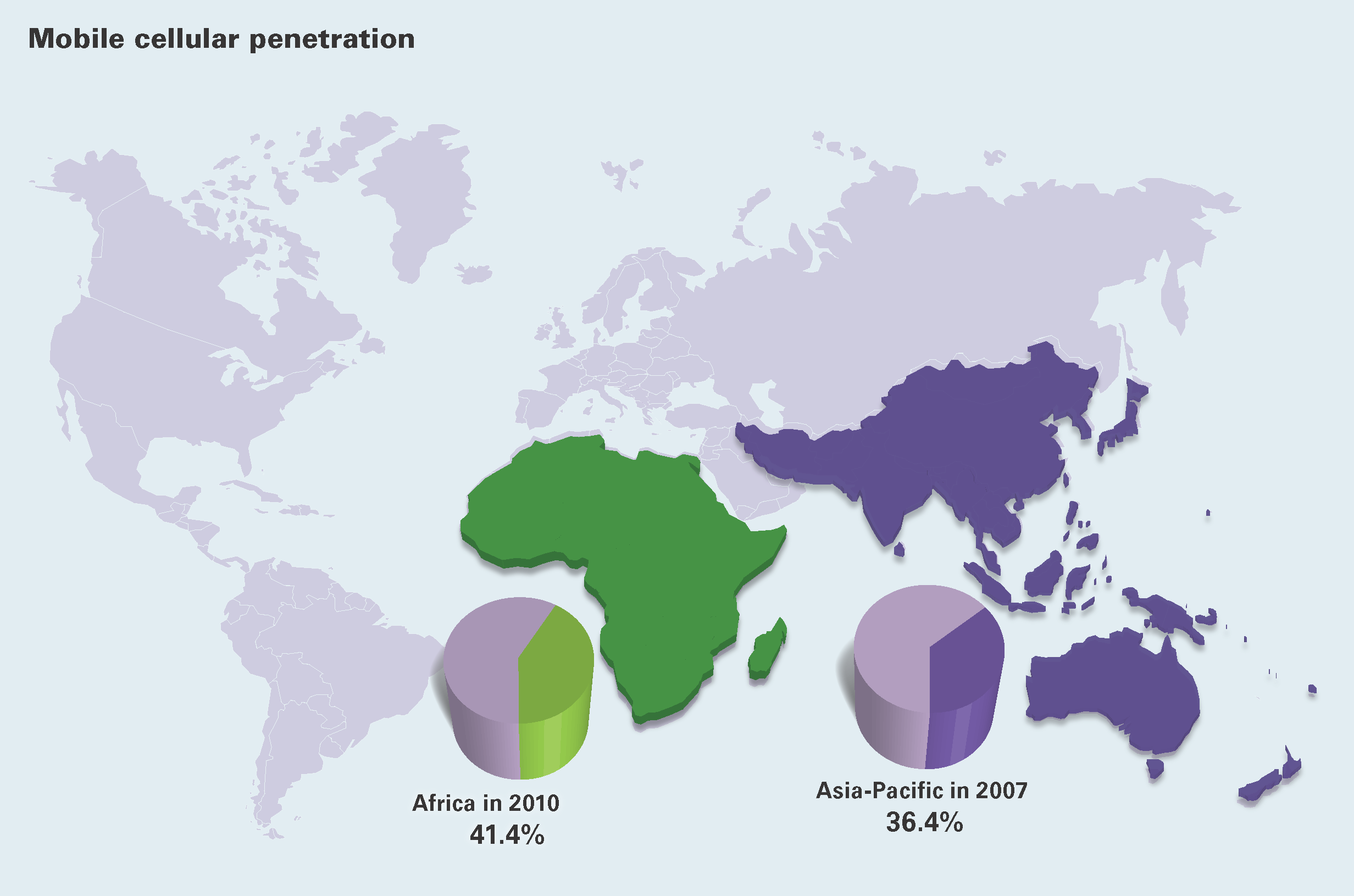
  • In Africa, mobile cellular penetration, at 41.4% in 2010, was higher than it had been in Asia-Pacific three years earlier – where it reached 36.4% in 2007.

    Increased Competition

  • The Commonwealth of Independent States has the highest mobile cellular penetration of any region in the world, reaching over 130% in 2010.
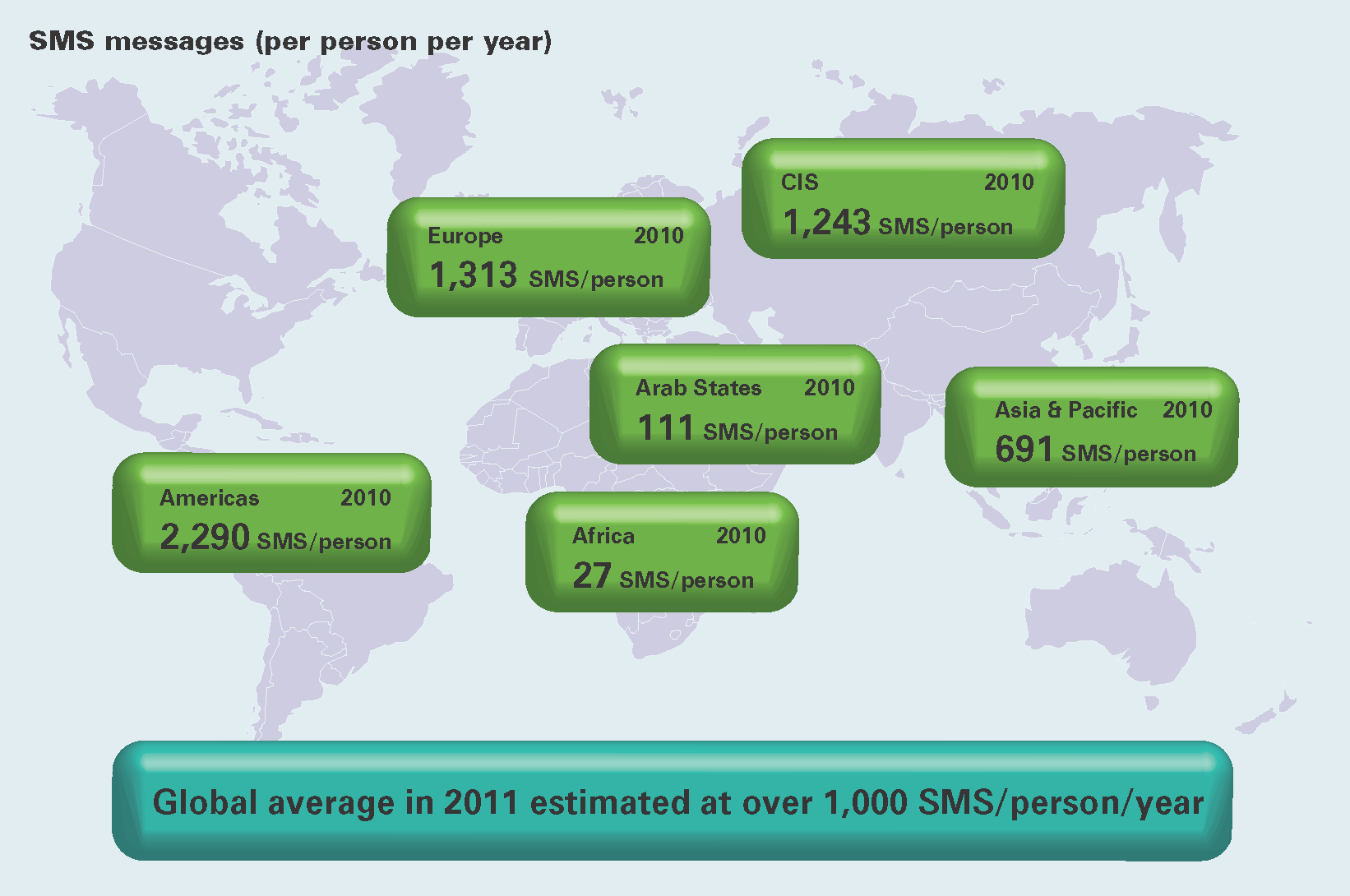
  • 40 billion SMS messages were sent in the Arab States in 2010, up from under 10 billion in 2005.
  • There are more than 400 million Internet users in Europe. With two thirds of the population online, Europe is the region with the highest Internet penetration in the world.
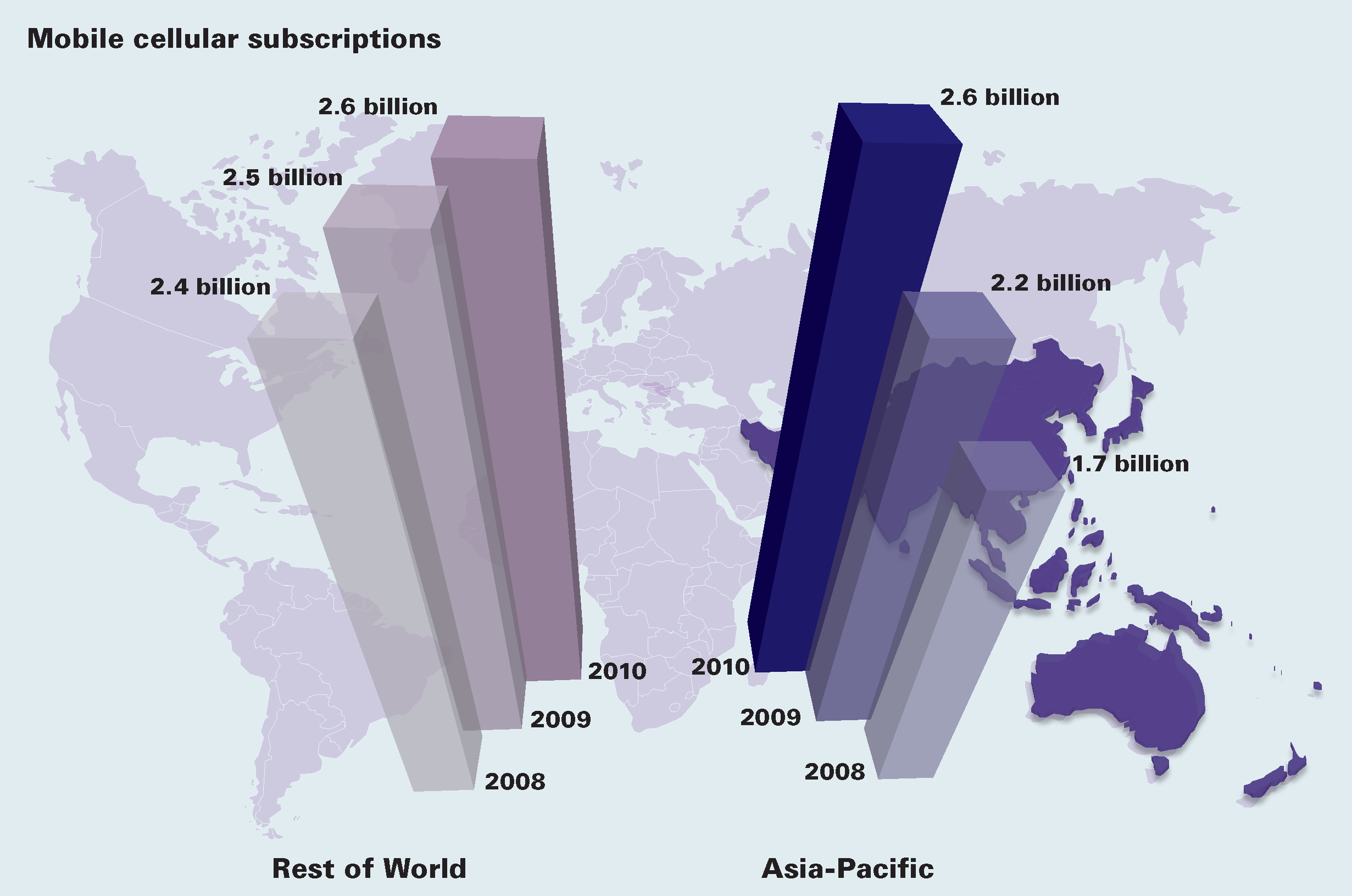
  • Most of 2010’s mobile growth was in Asia-Pacific, which saw the number of mobile cellular subscriptions grow by 490 million (of 630 million globally), to reach 2.6 billion.

    Mobile Cellular Subscriptions

  • For the first time, Asia-Pacific now has over half the world’s mobile cellular subscriptions.
  • In Africa, mobile broadband subscriptions grew almost 15-fold over the last three years – from 2 to 29 million. Despite strong growth, however, Africa remains easily the least Internet-enabled continent, with fewer than one in ten Africans online, and mobile broadband penetration below 4%.
The developing world – catching up…
  • There were as many fixed broadband subscriptions in the developing world in 2010 as there were in the developed world in 2008, just two years earlier (251 million vs 253 million). China alone accounts for around half of all the developing world’s fixed broadband subscriptions.
  • There were more mobile broadband subscriptions in the developing world in 2010 (309 million) than there were in the whole world in 2007 (307 million), just three years earlier.
  • There were almost as many mobile cellular subscriptions in the developing world in 2010 (3.8 billion) as there were in the whole world in 2008 (4 billion), and half a billion more than there were in the developed world in 2007.
  • By 2010, developing world Internet users accounted for 58% of the global total, with 1.2 billion in the developing world, compared to 900 million in the developed world. But with most of the world’s population living in developing countries, only a fifth of people there are online, compared to almost three quarters in richer nations.
Keep texting…
  • At current growth rates, there will be well over a thousand SMS messages sent in 2011 for every person on the planet (there were 2.8 trillion SMS messages sent in 2008; 4.3 trillion in 2009; and 6.1 trillion in 2010).

SMS Messages

Data and analysis in this ITU Statshot are drawn from the ITU World Telecommunication/ICT Indicators database.

Further ICT statistics are available online at ITU’s ICT Eye:
http://www.itu.int/ITU-D/icteye/Default.aspx

ITU also publishes a full range of current statistics and analyses. For further information see:
http://www.itu.int/ITU-D/ict/publications

Saturday, April 30, 2011

The naming of parts: Time for “Linux Inside”?

by Glyn Moody

Names matter in free software. Just think of the number of electrons that have been spilt arguing over whether it's “Linux” or “GNU/Linux”.

The naming of parts came up when I interviewed Linus back in 1996. I had asked him about his relations with Richard Stallman, and this is what Linus said:

I've had some, not very much. At first he wasn't too interested, because Linux was so PC-centric – just two years ago, it didn't run on anything else. And I suspect Richard really dislikes PCs. So he wasn't really interested in that sense. Lately, when it's become obvious how portable it is and how well it works on other architectures too, I think Richard in that sense looks at Linux in a different light.

One problem we've had, well, problem, kind of clash of personalities, is that Linux has gotten so much press and GNU has gotten so little. So for Richard, he's not pragmatic, he really has this idealistic world-view, he'd really like the system to be called GNU/Linux or something like this. Personally I don't think GNU Linux flies as a name, it should be catchy.

But is “Linux” catchy? The fact that few people have heard of it outside the rather specialised world of free software suggests not. Indeed, far more people have probably come across “Ubuntu”, which has taken on the role of the public face of GNU/Linux to a certain extent. That's good, in the sense that it has done valuable work promoting free software to the general public; but it's also unfortunate in that it has pushed the “Linux” name even further into the background.

Some might ask why that is even a problem. After all, does it really matter what the kernel is called? I'd argue yes, for the slightly counter-intuitive reason that Linux is becoming so successful, particularly in two areas: mobile phones and embedded systems.

The rise and rise of Android has made that particularly name a household word – well, in more affluent countries at least, although once cheap Android-based phones start appearing it will become a global brand. Embedded systems, by contrast, often run Linux without anyone being aware of the fact: one of its strengths is that it doesn't crash, so there are no tell-tale Blue Screens of Death (BSOD) to announce its presence to the world. Instead, it just carries on working reliably and invisibly.

The problem, then, is the fact that Linux can be powering more and more of the digital devices that fill our lives and also be behind the international success that is Android, and yet few outside the computer world are aware of the connection.

Imagine, now, a situation where all these growing successes were perceived as part of a single, larger movement: the rise of Linux, and with it the spread of free software. Once people start to realise that many of their most beloved and faithful gadgets have at their heart the same software, they might begin to look a little differently on this “Linux” thing; they might, for example, begin to seek it out in other devices...maybe even on the desktop.

That is, if we could make people aware of just how widely used Linux is in smartphones and consumer electronics, say, it might even kickstart the use of free software in other domains.

So, the question becomes: how might we do this?

The idea of some kind of “Linux Inside” campaign has been raised before, but the situation is rather different now, largely thanks to Android smartphones. These are probably the first mass-market devices running Linux that people in the street are passionate about; this offers a unique opportunity to tap into that goodwill and transfer some of it to Linux.

To do that, we need a neutral organisation to oversee the project – the Linux Foundation is the obvious candidate – not least because Linus is an employee. As well as being widely respected among the open source community, it already has many of the leading companies that use Linux in their products as members. More recently, it has become more active in the embedded sector, which could be invaluable in gaining support for the idea here too.

Those same companies could help fund advertising campaigns to raise people's awareness of “Linux Inside” or whatever brand were chosen. As well as the efficiency of banding together to promote something for their mutual benefit, there's also the fact that they have – and ought to feel – a moral obligation to support something that they use for free. A few judicious remarks by Linus along those lines ought to work wonders, since it would be a PR disaster for major companies to be seen snubbing his polite request for help in this way.

Of course, for the thousands of smaller manufacturers that use Linux in their consumer devices, that may not be such a convincing argument for them to contribute money to the campaign. But, at the very least, it's in their own interests to stick some “Linux Inside” logo on their boxes – after all, it lets them tap into the generic marketing that would be going on around it, as well as allowing them to claim that the software in their otherwise somewhat anonymous products was “official” (provided, of course, that they made available all their source code....).

In a way, the idea behind “Linux Inside” or equivalent is the same as one of the key advantages of open source: that by collaborating and pooling resources, more can be achieved than by working separately. At the moment, the marketing around devices using Linux is fragmented, each manufacturer pushing a proprietary brand that reveals nothing about its underlying connection to Linux. By creating a strong umbrella brand alongside them, manufacturers would be helping the Linux ecosystem of which they form part – and hence helping themselves.

(Reference - http://www.h-online.com)

Friday, April 29, 2011

UM hall damaged by fire

PETALING JAYA: Universiti Malaya's Balai Ungku Aziz caught fire yesterday, with an estimated 80 per cent of its roof destroyed. The fire was believed to have started on the roof of the dental faculty in the hall about 4.50pm and students had to be evacuated. Pantai Fire and Rescue Department chief Hamid Daud said they received a distress call at 4.54pm and arrived there within five minutes. “Three fire trucks with 19 personnel from the Pantai and Taman Desa fire stations took two hours to put out the fire," he said. The cause of the fire and losses are being investigated.

(Reference :http://mmail.com.my)

Thursday, April 28, 2011

Sony's PlayStation Network Disaster: What Happens Next?

By Matt Peckham, PCWorld Apr 27, 2011 7:50 AM

It's been a full week since Sony's PlayStation Network went belly up. For five of those days, the outage appeared to be just what Sony said--an outage. Yesterday all that changed when Sony admitted the "external intruder(s)" that prompted them to take the PSN down on Wednesday, April 20th, had in fact grabbed reams of personal information, and possibly (though unconfirmed) financial data such as credit card info. With upwards of 75 million PSN users affected, some are calling it the largest breach of confidential user information in history. Where does Sony go from here?

Yahoo Sells Delicious To You Tube Founders

Yahoo's Delicious, which was reportedly slated to be shuttered, will live on thanks to YouTube co-founders Chad Hurley and Steve Chen, who have agreed to purchased the site.

“We’re excited to work with this fantastic community and take Delicious to the next level,” said Hurley said in a statement. “We see a tremendous opportunity to simplify the way users save and share content they discover anywhere on the web.”

Yahoo has finally found a buyer for long suffering Delicious. YouTube founders Chad Hurley and Steve Chen have acquired the company, says Yahoo, via a “new Internet company, AVOS.” We’re still gathering details, but here’s the official stuff:

Today YouTube founders Chad Hurley and Steve Chen announced they have acquired the Delicious technology from Yahoo!. They plan to continue the service that users have come to know and love and make the site even easier and more fun to save, share and discover the web’s “tastiest” content.

Providing a smooth transition for users is important to both companies. There will be a transition period where users can elect to sign up for a new account. Users’ public and private bookmarks will be maintained through the transition period and transferred as they are today when it is complete.

As we have said, part of our product strategy involves shifting our investment with off-strategy products to put better focus on our core strengths and fund new innovation. We believe this is the right move for the service, our users and our shareholders and look forward to watching the Delicious technology develop.

(Reference : http://techcrunch.com)

Wednesday, April 27, 2011

Asterisk powers

Asterisk is a complete PBX in software. It runs on Linux, BSD, Windows and OS X and provides all of the features you would expect from a PBX and more. Asterisk does voice over IP in four protocols, and can interoperate with almost all standards-based telephony equipment using relatively inexpensive hardware.

Asterisk provides Voicemail services with Directory, Call Conferencing, Interactive Voice Response, Call Queuing. It has support for three-way calling, caller ID services, ADSI, IAX, SIP, H.323 (as both client and gateway), MGCP (call manager only) and SCCP/Skinny. Check the Features section for a more complete list.

Asterisk needs no additional hardware for Voice-over-IP, although it does expect a non-standard driver that implements dummy hardware as a non-portable timing mechanism. A single (or multiple) VOIP provider(s) can be used for outgoing and/or incoming calls (outgoing and incoming calls can be handled through entirely different VOIP and/or telco providers).

For interconnection with digital and analog telephony equipment, Asterisk supports a number of hardware devices, most notably all of the hardware manufactured by Asterisk's sponsors, Digium. Digium has single and quad span T1 and E1 interfaces for interconnection to PRI lines and channel banks. In addition, single to quad port analog FXO and FXS cards are available and are po***r for small installations. Other vendors' cards can be used for BRI (ISDN2) or quad- and octo- port BRI based upon CAPI compatible cards or HFC chipset cards.

Lastly, standalone devices are available to do a wide range of tasks including providing fxo and fxs ports that simply plug into the LAN and register to Asterisk as an available device.

Tuesday, April 26, 2011

Design Standards Brief Manual for Royal Melbourne Institute of Technology, Australia.

The Royal Melbourne Institute of Technology is one of Australia’s original and leading educational institutions, producing some of Australia’s most employable graduates. As an innovative, global university of technology, with its heart in the city of Melbourne, RMIT has an international reputation for excellence in work-relevant education and high quality research, and engagement with the needs of industry and community.

With more than 70,000 students studying at RMIT campuses in Melbourne, in Vietnam, online, and at partner institutions throughout the world, the University is one of the largest in the country. It has built a worldwide reputation for excellence in professional and vocational education and research. A vibrant alumni community now stretches across more than 100 countries. RMIT is a member of the Australian Technology Network.

The Design Standards Brief –Version 6, August, 2009 – contains the minimum design standards for RMIT University. The Design Standards Brief is the guiding document for building works at the University. The document able to be access at url http://www.rmit.edu.au

(Reference : http://www.rmit.edu.au)

Linux patent suit ruled against Google

A Texas jury has ruled against Google in a suit that alleged some of its use of open source Linux code amounted to patent infringement, something that could have big implications for other companies using Linux technology and other open source systems. In the verdict, delivered last week, the jury decided that Google should pay US$5 million for the infringement.

The suit was filed in June 2009 by a firm called Bedrock Computer Technologies, which also named the likes of Yahoo, MySpace, Amazon, PayPal, Match.com and AOL as defendants in the suit. Bedrock, as was reported when the suit was filed, was founded by a prominent patent reform advocate (the corporation has been accused of being a patent troll) and filed suit against the defendants in question for violation of Patent 5,893,120, detailing "methods and apparatus for information storage and retrieval using a hashing technique with external chaining and on-the-fly removal of expired data".

Since it's the Linux kernel itself, the core of the open source operating system, this could have implications well beyond Google--and even beyond the other defendants in the case, for whom court decisions have not yet been determined.

"Google can easily afford US$5 million if it has to, but this patent infringement case has major implications for the IT industry in general and for Linux in particular," patent and IP activist Florian Mueller wrote on his blog. "The plaintiff identified a portion of the Linux kernel as part of the 'Accused Instrumentalities.' Many companies using Linux have already been required by the patent holder to pay royalties, and many more will now, based on this jury verdict, elect to pay."

A potentially contested turf: the Android mobile operating system, which is Linux-based and continues to grow fast, evolving into many different mutations of a mobile (and now tablet) software architecture.

Mueller points out that not only did Google attempt to declare the patent invalid, but so did Linux software maker Red Hat, which counts several of its clients among the defendants.

"Google will continue to defend against attacks like this one on the open source community," a spokesperson for the company said. "The recent explosion in patent litigation is turning the world's information highway into a toll road, forcing companies to spend millions and millions of dollars defending old, questionable patent claims, and wasting resources that would be much better spent investing in new technologies for users and creating jobs."

(Reference : http://www.zdnetasia.com)

Saturday, April 23, 2011

Skype unleashes VoIP calls over 3G for Android

The latest version of Skype for Android includes some security updates that make it more secure, however the "meat and potatoes" of the new version allows for greater VoIP (Voice over Internet Protocol) call functionality over a 3G connection should the contingency arise to WiFi in the U.S., no matter the network. Still no word on when Skype will let users make video-to-video calls.

However until at the time, Android users can now join in with other mobile devices and platforms in making Skype to Skype VoIP calls over 3G and eating up data usage on their mobile plans during conserving those precious calling minutes for

(Reference : http://www.appscout.com)

Tuesday, April 19, 2011

Momentum Around Asterisk Intensified by Digium in 2010

Strong growth in the use of Asterisk and substantial technical advances in the product has marked a successful end of the year for Digium, Inc, Diamond Sponsor of ITEXPO (News - Alert) East. Apart from releasing a major upgrade; the use of Asterisk has expanded to 170 countries. Asterisk is open source telephony software created by Digium. The company is also the primary sponsor of this software.

A new open source project, Asterisk (News - Alert) SCF has also been announced by the company in late October. Over the past year, contributions from the open source community have matched Digium’s investment in Asterisk. Asterisk has received code from over 9,800 people to date. This includes more than 200 people who worked on Asterisk 1.8 which was released in October. The increase in momentum is evident from the over two million downloads of the software in 2010. Users of Asterisk include developers, resellers, integrators and systems administrators.

An ordinary computer is converted into a communication server with Asterisk. IP PBX (News - Alert) systems, VoIP gateways, conference servers and other communication applications can be powered with this communication server. Asterisk is being used to create standards-based, feature-rich communications systems in more than 170 countries by small businesses, large enterprises, call centers, carriers and governments.

The communication systems are being created at a fraction of the cost of proprietary systems. According to Digium (News - Alert), billions of minutes of phone calls around the world are being handled by Asterisk running over one million servers.

In a press release, Bryan Johns, community director of Digium, said, “Asterisk has made an indelible impression on the voice communications industry in the 11 years since it was released. Its appeal keeps growing as businesses look for the value, flexibility, standards compliance and the technical superiority that result from the contributions of thousands of talented and visionary software developers.”

Johns added that the company is proud to sponsor Asterisk. The company is also proud of the Asterisk community, which currently has 73,000 registered members. The company has released Asterisk 1.8 this fall as it continues its focus on Asterisk development. A new open source project in Asterisk SCF has also been created by Digium, added Johns.

Friday, April 8, 2011

Enterprise WAN Router Buyer's Guide by Drew Robb

The router market is an interesting space. It is split into two broad categories: enterprise Wide Area Network (WAN) routers and branch routers. This article focuses on the former category. Enterprise WAN routers are used to communicate to and from head office to branches. Sitting in the main data center, WAN routers are part of the network backbone, dealing with transaction and processing oriented traffic. As such, they need high bandwidth capacity. "Enterprise WAN routers sit at the hub, while the branch offices are like the connecting spokes," said Dell'Oro Group routers analyst, Shin Umeda.

While generally separate from the switches that connect user devices to the network, some modern switches have also taken on some routing functions. However, they remain largely separate. Switches connect users to the Local Area Network (LAN) while routers transmit data across the WAN.

Primary features

What are the main features that users should be looking for in an enterprise WAN router? Umeda said that the most important point is to match user bandwidth requirements to the device. Some WAN routers, after all, can be relatively small with a few interfaces. The simplest come with two connections - one to the WAN and one to the LAN. This might be good enough for a small organization, but limits performance and lacks flexibility. Larger routers, of course, have far more ports and can deal with a wider range of services that are attempting to connect to the WAN? Such services might include a low-speed electrical circuit like a T1 line, a Fiber Optics circuit connecting to a carrier network, or Ethernet up to 10 Gigabit Ethernet (10GbE).

"Pay attention to the type of connectivity you require during the selection process," said Umeda. "Most decent routers are highly configurable based on the type of ports you need." Connecting to the LAN side, though, is relatively straightforward. That typically requires Ethernet ports in the range of 100 Mb or 1 Gb.

Voice only, data only or both is a question that has to be answered. The days of data only networks appear to be dwindling, but not everyone has jumped onto the Voice over IP (VoIP) bandwagon. It would be wise to check with the CIO to determine if VoIP is on the horizon. If so, plan ahead. It doesn't make any sense to buy a fresh set of data only networking products only to have to replace them a year later when the VoIP rollout commences.

Umeda calls attention to another factor in router selection: what kind of connection you have to the branch, which determines what features are needed in the WAN router. If many branches are present with slow connections, for instance, that influences the amount of bandwidth and type of WAN router that should be purchased. Take the case of an ATM-type financial transaction. This will probably need a high level of security via VPN capabilities. Not all WAN routers include such functionality. Further, if the WAN router connects to the public Internet, some kind of firewall and security features are a wise investment. Many routers fold these features into their routers for a little extra money.

As a rule of thumb, Umeda said to start with bandwidth. How much capacity do you need and how much can a specific router support? This determines how much you should pay. Huge expensive routers might give a tremendous amount of bandwidth but why buy them if you will never take advantage of it. Correct sizing, then, is key. Another decision is whether to opt for a single-vendor or multi-vendor set up.

"Some services work better when you utilize a single vendor at both ends, while with others there is no difference at all," said Omeda.

Finally, the Dell'Oro analyst mentions management. Some organizations require a high level of centralized management of devices, while others have a more distributed infrastructure. The kind of IT organization in place can determine whether a more expensive WAN router is needed at head office (replete with state-of-the-art management functions) or if a less expensive router will suffice.

Vendor Battle

While Cisco remains the major force in enterprise WAN routers, its dominance is less than in other areas. Cisco leads the field with a 60 percent share in 2010 followed by Juniper Networks with 22 percent, Chinese company Huawei with12 percent and Brocade with 4 percent according to Dell'Oro. While Huawei isn't that well known in North America, that will change over time. But for now, it mainly sells in China and even then primarily to service providers.

"We haven't seen much shift in market share numbers over the past three years," said Umeda.

However, the total size of the market has shrunk. It was $700 million each year from 2006 to 2008 and crashed to $400 million in 2009. This year it rebounded a little to half a billion. But Umeda doesn't expect it to top its 2008 total any time soon.

(Reference : http://www.enterprisenetworkingplanet.com)