Friday, June 16, 2023

Open Source And Patents: Everything You Need to Know

Open Source licenses and patents give software developers two very different ways to share their work. 

With an Open Source license, the original owner still retains distribution and sharing rights, but anybody can look at and modify a program's code and software. It's important that you understand the difference between patents, copyrights, and Open Source licenses to ensure your work is adequately protected.

What Is the Difference Between a Software Patent and Copyright?

Unlike the holder of an Open Source license, the owner of a patent has exclusive rights over the patented software. No one else can make, use, modify, or sell patented software, and the source code is not available to the public.

Patent rights give the holder control over who uses software and for what purpose. Though software developers can protect their work using both copyrights and patents, copyrights only protect the code itself. Patents, however, protect the program's functionality.

Patents are better than copyrights for software developers because they protect the program regardless of the code and language used. In comparison, copyrights aren't very practical for developers. If you want to release Open Source software while retaining some rights, a copyright only gives you power over someone who steals your work verbatim.

This is because a copyright doesn't protect the specific function of a software program. If a person finds a way to execute the same function using different code or a different language, the original creator of the software won't have any recourse with a copyright alone.

By securing copyrights and patents, software developers have some flexibility for their protections. For example, the software owner can grant users unlimited rights, some rights, or deny rights to use the software. Moreover, if a developer wants to release their work with an Open Source license, they can do so with a patent or copyright to retain some rights. This ensures that other users only access and modify the work under certain conditions.

Patents for software, however, do have their limits. Be mindful of the following before moving forward with a patent:

Patents protect the program's function but not the code.

The filer must define the process that the patent protects in the patent application.

Patents protect software only in terms of strict liability.

Also note that a copyright protects your code from being lifted by another user, but you don't have to officially register to enjoy these protections. However, people still file copyrights to enjoy other benefits, such as retaining official proof of ownership.

What Is an Open Source License?

Distributing software under an Open Source license allows anyone to view, use, and modify the code behind the computer software. Users may modify the source code without permission, but the developer can exclude them from publishing their changes or only permit additions under certain conditions.

An Open Source license may affect some patent protections, but a person can still apply for patent rights to safeguard their software. If you want to retain some patent protections while still sharing your work with others through an Open Source license, consider working with a patent attorney to confirm that you have the protections you need.

Most Open Source licenses also include a reciprocal patent agreement. This agreement outlines things like rights granted in perpetuity, whether recipients can redistribute the work, and the conditions that they must meet when they do distribute the work. It also ensures that the protections a license provides extend to the contributions that people make to a project.


What Is the Gnu Public License?

The Gnu Public License (GPL) is an Open Source license stipulating that any distributions of the licensed software are also protected.

The GPL provides a list of copyright protections to the original software developer. However, the license permits other users to copy and distribute the software and make and publish works based on the software. In turn, users must release their changes under the GPL and make the adjustments in their source code available to other users.

Many companies and popular software programs, such as the Linux operating system, use the GPL. This gives users access to a vast body of knowledge from other developers and incentivizes them to continue improving the software.

If you need help with Open Source licensing and patents, you can post your legal need on UpCounsel's marketplace. UpCounsel only accepts the top 5 percent of lawyers to its site. Lawyers on UpCounsel come from law schools such as Harvard Law and Yale Law and average 14 years of legal experience, including work with or on behalf of companies like Google, Menlo Ventures, and Airbnb.

Friday, June 9, 2023

Upgrade to OCPP 2.0.1: The key to advancing the EV charging infrastructure

As the popularity of electric vehicles grows, so does the need for reliable and easily accessible charging infrastructure. Open standards, such as the Open Charge Point Protocol (OCPP), are a crucial component in the advancement of EV charging infrastructure and play a crucial role in promoting interoperability between hardware and software providers, enabling diverse players to participate in the market.

OCPP 2.0.1 is the protocol of the future that you can't afford to ignore, with benefits for both charge point operators and EV drivers. In this blog, we'll explore the enhancements in OCPP 2.0.1 and how they can help you stay ahead of the curve in the ever-changing EV charging market.

OCPP 1.6 vs OCPP 2.0.1

Open Charge Point Protocol (OCPP) is a communication standard that ensures interoperability between the electric vehicle charging station and the central backend management system. OCPP 1.6 has been a reliable and widely adopted solution for EV charging networks for some time. However, the emergence of new technologies and the growing demand for advanced monitoring and increased stability have led to the development of OCPP 2.0.1

OCPP 2.0.1 provides advanced smart charging capabilities and control features for utilities, Charge Point Operators (CPO), and EV owners. This version includes several enhancements, such as the support of the ISO 15118 standard for secure communication between the charging point and the electric vehicle. In addition, OCPP 2.0.1 offers a wider range of smart charging functionalities, giving utilities, CPOs, and EVSE owners greater control over the charging process.

While OCPP 1.6 is a well-understood solution that is sufficient for today's use cases, OCPP 2.0.1 is seen as the protocol of the future. As most manufacturers and service providers plan to shift to OCPP 2.0.1 in the coming years, few charge point providers already market charge points based on this protocol.

Being an advanced version of the OCPP protocol, OCPP 2.0.1 provides several improvements and new features over its predecessor, OCPP 1.6, that you need to understand.

Device Model

One of the important improvements coming with OCPP 2.0.1 is the Device Model which is a game-changer for charge point operators, offering a new level of control and monitoring over charging infrastructure.

Predictive maintenance
The Device Model offers charge point operators a configurable and well-structured reporting system for charge point statuses that can be tailored to their specific needs. This is especially beneficial for larger CPOs, who can closely monitor key variables in the charge point to anticipate and prevent potential failures. With this feature, CPOs can receive notifications and promptly address any issues if the charge point's metrics, such as FanSpeed or temperature, exceed a certain limit, ensuring optimal performance.

Enhanced data monitoring
But that's not all! OCPP 2.0.1 has another exciting feature – customisable event notifications. With this feature, the central management system can subscribe to specific variables and receive updates only when there is a change in those variables. This is a vast improvement over OCPP 1.6, which can be resource-intensive since it only supports periodic notifications, and has to process all the data continuously.

It’s important to note that the Device Model’s functionality is highly dependent on manufacturer implementations. While there is a list of standardised variables and components in the appendices of OCPP 2.0.1 manufacturers have the freedom to decide what components they want to publish via the Device Model. For charge point operators, it’s essential to maintain a close collaboration with manufacturers to ensure that charge points will support the monitoring of various essential components such as fans, temperature, signal strength, and more.

Setting and displaying tariffs and costs on charging stations

Another important improvement for CPOs is the ability to set and display tariff and cost information to EV drivers in their own language at the charging stations, making charging more transparent and user-friendly. This feature simplifies the charging process for operators and drives the adoption of electric vehicles.

Configuring charging station display messages

OCPP 2.0.1 enables charge point operators to customise messages displayed on charging stations. These messages can show the applicable tariff before a driver begins charging, the cost incurred during a charging session, and the total cost. It's worth noting that in some countries, this feature will be mandatory to comply with future regulations. Therefore, it's crucial for EV charging stations to incorporate this feature to ensure they meet regulatory requirements.

Displaying tariff and cost information to EV drivers will increase transparency and trust in the charging process. By showing the applicable tariff before a driver starts charging, drivers can make informed decisions and avoid unexpected charges. Moreover, by showing the running cost during a charging transaction and the final total cost, drivers can monitor their expenses and plan accordingly.

Enabling credit card payments at charge points

This not only improves the user experience but also eliminates the need for charge point manufacturers to use credit card terminals to set prices, simplifying the charging process and reducing potential errors. It also simplifies the charging process for operators. Currently, some manufacturers use credit card terminals to set prices, which requires additional hardware and software configurations. Using OCPP 2.0.1, charge point operators can configure tariffs and costs directly from their charge point management system (CPMS).

Making EV charging effortless with ISO 15118 integration

Charging your EV will be so much easier! With OCPP 2.0.1's support for ISO 15118, EV drivers will be able to enjoy seamless and secure charging with Plug & Charge technology.

Plug & Charge

OCPP 2.0.1 plays a crucial role in the success of Plug&Charge technology by supporting ISO 15118 and its communication protocols, making EV charging more accessible and convenient for EV drivers. With the help of OCPP 2.0.1, the charging station and EV can communicate directly, eliminating the need for any external identification or authentication methods, such as RFID cards or charging apps. This allows for seamless automated communication and billing processes, making EV charging effortless and hassle-free. Plug&Charge technology, combined with OCPP 2.0.1, is not only beneficial for EV drivers and homeowners but also for public locations such as workplaces and charging stations, making EV charging more accessible and user-friendly.

Effortless prioritisation of critical loads with Smart Charging

A significant improvement in OCPP 2.0.1 is the possibility for the EV driver to receive more accurate information. By collecting data from the car, such as State of Charge (SOC), charging speed, kWh limit, and pick-up time, Smart Charging can provide more accurate estimates of charging time, when the car will be fully charged and ready to be picked up, eliminating the need for constant app-checking.

OCPP 2.0.1 also facilitates direct Smart Charging inputs from Energy Management Systems (EMS) or Distribution System Operators (DSO) to a charging station. This allows for the prioritisation of critical loads during high grid demand and supports integrated Smart Charging via ISO 15118, enhancing communication and security. With OCPP 2.0.1, EVs can communicate the requested energy amount in kWh, resulting in more grid-friendly, secure, and convenient charging.

Compared to its predecessor, OCPP 1.6, OCPP 2.0.1 has several advantages, including the ability to request a specific amount of power needed by the charging station. OCPP 1.6, on the other hand, only provides the State of Charge, which limits charging event management. With the growing demand for EV charging and the introduction of Vehicle-to-grid communication, which requires bidirectional and specific smart communication, OCPP 2.0.1 is becoming increasingly critical.

The safer protocol for EV charging communication

The OCPP 2.0.1 protocol offers improved security features compared to its predecessor, making it a more secure communication channel between EV charging management systems and charging stations. The protocol uses encryption at the protocol level, eliminating the need for a VPN connection or any third party for secure communication. New security profiles for authentication, secure firmware update, security logging, and security event log notifications provide a higher level of safety as demand for more secure communication channels increases, it's likely that charge points will soon be required to support these added security levels.

Improved data handling: Streamlined transactions and reduced data usage
As the market experiences rapid growth, efficient management of large amounts of data has become increasingly crucial. With the latest update of OCPP 2.0.1, significant improvements have been made in the data section. The transaction handling model has been simplified, resulting in a smoother user experience. Additionally, data compression is now mandatory on the server side, which benefits CPOs with charge points on mobile connections by reducing their need for data plans.

The road ahead: implementation of the OCPP 2.0.1

While the OCPP 2.0.1 protocol offers many benefits for EV charging networks, such as enhanced security, smart charging capabilities, and extensibility, it still has some limitations. For example, the protocol does not yet allow for personalised and visualised interfaces, and charging point operators cannot control the full user experience.

Despite these limitations, and the fact that OCPP 1.6 is still used in many charging systems, most manufacturers and service providers are planning to shift to OCPP 2.0.1 soon, recognising its potential to become the protocol of the future. The adoption of OCPP 2.0.1 may be slow, but its extensibility, enhanced security, and smart charging capabilities make it the better choice for EV charging networks.

Overall, as the EV market continues to grow, open communication standards like OCPP 2.0.1 that promote interoperability and innovation will be essential. While there may be some limitations, the adoption of OCPP 2.0.1 can bring significant benefits to EV charging networks, making it a step in the right direction.

Thursday, June 8, 2023

OCPP 1.6 and OCPP 2.0 – which one is better for you?


OCPP is an open protocol for communication between Charge Points and a Central System that quickly became the industry standard. It is a universal solution accommodating any type of charging technique. Since its release in 2015 OCPP 1.6 was downloaded tens of thousands of times and its successor followed in its footsteps. OCPP 2.0 launched in April 2018 was implemented by thousands of users and its popularity is still growing.

Open Charge Point Protocol powers EV charging stations

OCPP stands for Open Charge Point Protocol and it is created by the Open Charge Alliance (OCA) in 2009. Today global consortium that promotes open standards has more than 220 participants from 43 countries on 5 continents. OCPP became the EV industry standard in just 6 years.

The Open Charge Point Protocol allows communication and data exchanges between electric vehicle charging points and central control systems.

As for now, most of the modern  EV chargers are OCPP 1.6 compatible, with the raising amount of station manufacturers delivering hardware ready for OCPP 2.0.1 in order to anticipate future requirements of the e-mobility market and to prevent the money loss caused by stranded assets. That’s one of the reasons why the majority of implementations are still based on OCPP 1.6.

Open Charge Point Protocol (OCPP) 1.6. - what made it revolutionary?

Open Charge Point Protocol OCPP 1.6 was the first OCA protocol to gain world wide recognition. It’s perceived as the all-in-one solution that to this day isn’t lacking anything important despite the huge technological progress that the EV industry made.

The feature launched within OCPP 1.6. that reshaped the perception of EV charging was smart charging. It allowed sending  Charging Profiles to the charging station – basically a foundation of today’s EV charging infrastructure. Central System gains the ability to influence the charging power or current of a specific EV, or energy consumption on an entire Charger / Charge Points network.

Smart Charging has three typical use cases:

load balancing
central smart charging
local smart charging
 

LOAD BALANCING

OCPP allows the management of internal load balancing within the Charge Point that modulates the charging schedule per connector. Every Charger is preconfigured with a fixed limit, mostly the maximum current of the connection thus it allows to get the most from the deal with the power distributor without the risk of an outage. CPO has the option to set up a minChargingRate that may be used to optimize energy distribution between the connectors. Clients wouldn’t be able to charge in an inefficient way and will be automatically redirected to other services based on a fitting balancing strategy.

CENTRAL SMART CHARGING

Central smart charging enables Central System to regulate the charging schedule, per transaction. Schedules allow staying within energy usage limits imposed by any external software on the entire network by controlling each Charger.

LOCAL SMART CHARGING

Charging limits on Chargers are controlled by the Local Controller instead of the Central System. This use case of smart charging describes limiting the amount of energy that can be used by a group of Charge Points (small network like a parking garage), to a given maximum. Another scenario would be receiving information by the Local Controller about the availability of power from a DSO or a local smart grid node.

WHAT WAS INTRODUCED IN OCPP 1.6?

Switch to JSON over WebSocket , reducing data usage and enabling OCPP communication through NAT routers.
Extra statuses, giving the CPO and EV drivers more information about the current status of charging.
Extra values are added, which creates the possibility to send new information to a Central System.
The TriggerMessage message is implemented, introducing the Central System to request information from the Charge Point.
Other functionalities making the implementation of the OCPP clearer, easier and available in steps.

OCPP 1.6 vs OCPP 2.0

The easiest comparison of the two versions would be as follows: OCPP 1.6 is a very good, well-understood solution that is sufficent for today’s usecases.. The OCPP 2.0.1 is the protocol of the future and as such, its adoption is slow.

Open Charge Point Protocol OCPP it’s now available in version 2.0.1 that incorporates improvements for inconveniences found in OCPP 2.0 during Plugfests and in the field. It’s a minor change, not introducing new features or functionalities. Updates have been made in the area of security, ISO 15118, Smart Charging and the extensibility of OCPP.

Sunday, April 2, 2023

A short history of electric vehicles

Few Americans realize the market competition between electric vehicles (EVs) and the internal combustion engine (ICE) began in the early 1800s. The first EV was developed in 1828 by Robert Anderson, but EVs didn’t become commercially practical until the 1870. Pictured below is of an early EV. Not much different from a carriage, the early EVs had the same advantages EVs have today, "they [were] quiet, easy to drive and didn’t emit smelly pollutants."


Pictured here is one of the first electric cars, an 1834 Baker

EVs were one-third of all cars on American roads in the early 1900s but, the disadvantages of heavy, lead-acid batteries with limited range needing constant recharging prevented EVs from gaining more market share. In 1912 Henry Ford began to mass produce the Model-T and EVs couldn’t compete with the low-cost vehicle. By 1920, the number of EVs on the road began to decline and by 1935 the EV all but disappeared from American roads. 

Fast forward to the 1960s and 1970s, when gasoline prices skyrocket, America began to rediscover EVs. In 1974, GM developed the modern, urban EV and by 1975 SebringVanguard became the sixth largest US automaker with its wedge-shaped Citicar that had a range of driving 50-60 miles on one electric charge. Again, limited range and performance caused interest in EVs to wane, but the lack of emissions and greenhouse gases (GHGs) would cause a market resurgence in the early 1990s.

So where did Linux come from?

Although programming of the Linux core started in 1991, the design concepts were based on the time-tested UNIX operating system. UNIX was developed at Bell Telephone Laboratories in the late 1960s. The original architects of UNIX, working back when there were few operating systems, wanted to create an operating system that shared data, programs, and resources both efficiently and securely — an ideal that wasn’t available then (and is still sought after now). From there, UNIX evolved into many different versions; its current family tree is so complicated that it looks like a kudzu infestation. In 1991, Linus Torvalds was a computer science student at the University of Helsinki in Finland. He wanted an operating system that was like the UNIX system that he’d grown fond of at the university, but both UNIX and the hardware it ran on were prohibitively expensive. 

A UNIX version called Minix was available for free, but it didn’t quite meet his needs. So, Torvalds studied Minix and then set out to write a new version himself. In his own words (recorded for posterity on the Internet because this was in an early version of an online chat room), his work was “just a hobby, won’t be big and professional like GNU.” Writing an operating system is no small task. Even after six months of hard work, Torvalds had made very little progress toward the general utility of the system. He posted what he had to the Internet — and found that many people shared his interest and curiosity. Before long, some of the brightest minds around the world were contributing to Linus’s project by adding enhancements or fixing bugs (errors in the code).

Saturday, February 18, 2023

Plug and charge

 "Plug and charge" is a technology that allows electric vehicle (EV) charging without the need for a separate payment method, such as a credit card or mobile app. With plug and charge, an EV owner can simply plug their vehicle into a compatible charging station, and the charging session will automatically start and the payment will be processed seamlessly and securely in the background.

The technology is made possible by a standard called ISO 15118, which defines a secure communication protocol between the EV and the charging station. Using this protocol, the EV can authenticate itself to the charging station, and the charging session can be authorized and initiated automatically.

Several automakers and charging network providers have already adopted plug and charge technology, which is expected to make EV charging more convenient and accessible for drivers.

What is Hubject Platform?

Hubject is a platform that provides solutions for electric vehicle (EV) charging infrastructure to enable seamless and interoperable charging services. The company was founded in 2012 as a joint venture between BMW Group, Bosch, Daimler, EnBW, innogy, Siemens, and the Volkswagen Group.

The Hubject platform connects charging station operators, e-mobility service providers, and EV manufacturers to create a unified network for EV charging services. It enables EV drivers to access charging stations regardless of the charging network they are subscribed to, providing a seamless and interoperable experience for EV drivers.

The Hubject platform provides a range of services, including:

Interoperability: Ensuring that EV drivers can use any charging station on the Hubject network, regardless of the charging network operator.

Roaming: Allowing EV drivers to use their home charging network at any other network in the Hubject ecosystem.

Payment: Providing a payment solution for EV charging services that can be used across different charging networks and service providers.

Data management: Providing a platform for data exchange between charging network operators, service providers, and EV manufacturers.

Overall, Hubject is an important player in the e-mobility ecosystem, facilitating the growth and adoption of electric vehicles by providing interoperable and seamless charging solutions.

What is OCPP?

 OCPP stands for "Open Charge Point Protocol." It is a communication protocol that is used to standardize communication between electric vehicle (EV) charging stations and charging station management systems (CSMS). OCPP defines a set of rules that allow EV charging stations to communicate with CSMS over the internet or other networks.

The main goal of OCPP is to ensure interoperability between different EV charging stations and CSMS. By using a standardized protocol, different charging station manufacturers can create products that work seamlessly with different CSMS vendors. This helps to promote the growth of the EV charging infrastructure by making it easier to deploy and manage charging stations.

OCPP has evolved over time, with the latest version being OCPP 2.0. It includes new features such as support for advanced reservation systems, dynamic load management, and more detailed reporting and diagnostics. OCPP is widely used in Europe and is gaining popularity in other parts of the world as well.

Overall, OCPP is an important protocol that helps to facilitate the growth of the EV charging infrastructure by providing a common language for communication between different charging station and CSMS vendors.

Tuesday, February 14, 2023

What is MeanStack?

MEAN stack is a collection of JavaScript-based technologies used for developing web applications. MEAN is an acronym that stands for MongoDB, ExpressJS, AngularJS, and Node.js. These four technologies work together to provide a full-stack development environment for building dynamic web applications. MongoDB is a NoSQL database that stores data in a document-oriented format. ExpressJS is a framework for building web applications in Node.js. AngularJS is a client-side framework that allows developers to build dynamic and interactive web applications. Node.js is a server-side platform that allows developers to build scalable and high-performance web applications using JavaScript. Together, these technologies form a complete solution for building modern web applications.

What is NodeJS?

NodeJS is a server-side JavaScript runtime built on Chrome's V8 JavaScript engine. It enables developers to run JavaScript on the server-side and build scalable and high-performance applications. It provides an event-driven, non-blocking I/O model that makes it lightweight and efficient, and it is used to build web applications, APIs, command-line tools, and even desktop applications. It has a vast ecosystem of open-source modules and packages available through NPM (Node Package Manager), which allows developers to easily build and scale applications.

What is Selenium?

Selenium is a free and open-source software suite used for automating web browsers. It can simulate user actions on a web page, such as clicking links, filling out forms, and submitting data. Selenium provides a set of tools and libraries for writing automated tests in various programming languages such as Java, Python, and Ruby. It is widely used in software testing and quality assurance to ensure the functionality and performance of web applications across different browsers and platforms.

What is Appium?

Appium is an open-source automation tool for testing mobile applications, both native and hybrid, on iOS and Android platforms. It allows developers and testers to write automated tests using a variety of programming languages and test frameworks, and provides access to the device's internal APIs and app content, enabling comprehensive testing.

Sunday, January 29, 2023

Situation of Electric Vehicle in Malaysia before GE 15.

Compared to other ASEAN countries, Malaysia introduced policies supporting EVs relatively early. Malaysia’s policy supports EVs due to a set of mixed motives, including environmental, energy, and industrial policy considerations. EV support was put on the political agenda when the country launched its National Green Technology Policy in 2009. This policy rests on four pillars, representing energy, environmental, economic, and social considerations. This indicates that EV support is regarded as a part of a larger transformation towards a sustainable economy and society. As such, the transformation cuts across various political areas, and Malaysia set up Greentech Malaysia, a subsidiary organisation under the Ministry of Energy, Green Technology and Water, to promote this process according to the aims of the national policy.

Concerning EV use in Malaysia, the government later formulated the following goals (Greentech Malaysia, undated): until 2020, 100,000 passenger EVs, 2,000 bus EVs, and 100,000 electric scooters or motorcycles should be on national roads. In order to support the adoption of EVs, the government further aimed at installing 120,000 charging stations. Officially, BEVs are regarded as full EVs but HEVs and PHEVs as partial EVs (ibid). However, there is no information as to how partial EV types will be counted towards the 100,000 unit target. However, reaching this target will be difficult as less than 120 BEVs were registered by 2016. Further, it needs to be pointed out that the charging station target number includes the charging points of private PHEV and BEV owners as the government only wants to install 25,000 stations across the nation (The Sun Daily, 2016). 

Recently, news reports quoted Maximus Ongkili, Minister of Energy, Green Technology, and Water, that the goals, including a moderate increase to 125,000 charging stations, should be realised by 2030 (Clean Malaysia, 2017). As of December 2018, there were a total of 251 publicly accessible charging stations in Malaysia, suggesting that the minister’s revision was a de facto acknowledgement that the infrastructure goal cannot be realised until 2020. Whilst press statements are currently not reflected in policy documents, the 2030 timeframe appears more realistic.

Regarding EV policy measures, Malaysia exempted HEVs and PHEVs with internal combustion engines below a 2L engine capacity from import tax and granted a 50% lower excise duty from 2011 to 2013. Whilst this measure provided consumer incentives, subsequent policies served industrial aims. The National Automotive Policy (NAP) of 2014 supports EV production but, nevertheless, cannot be labelled as a dedicated EV policy. Rather, NAP aims to promote what it calls eco-efficient vehicles (EEVs). The government’s definition of EEV is broad, i.e. it includes fuel-efficient ICEVs, HEVs, PHEVs, and BEVs, as well as ones using alternative fuels (biodiesel, CNG, LPG, ethanol, and hydrogen (for both combustion engines and fuel cells)). Further, the initial policy declaration stated that EEVs would be specified via fuel efficiency and carbon emissions. 

Concerning the latter, a subsequent publication (MITI, 2014b) stated that emission criteria would only be applied after the Euro 4M11 fuel quality standard is introduced. After this step, a government study with stakeholder participation would investigate how this standard could be implemented. Subsequently, the level of carbon emissions would become a second parameter defining EEVs. In the meantime, EEVs are specified through fuel efficiency criteria. Regarding this indicator, the government has defined fuel efficiency parameters for different vehicle segments (Table 1).


Table 1: Eco-efficient Vehicle Specifications via Fuel Efficiency

The NAP provided several incentives for OEMs and parts producers to locate manufacturing activities related to EVs in Malaysia (MITI, 2014). First, Malaysia exempted domestically assembled HEVs and PHEVs from all duties and taxes until the end of 2015, and BEVs even until the end of 2017. Second, the country extended the use of existing policy tools, namely Pioneer Status (PS) and Investment Tax Allowance (ITA), to hybrid and electric vehicles.12 PS with full tax exemption is granted for 10 years and 100% ITA within 5 years. Moreover, grants are available for related customised training and R&D as well as exemption from excise duty for locally assembled or manufactured cars. 

Similar to the promotion of conventional vehicle components, the producers of components critical for electric and hybrid vehicles – electric motors, electric air conditioning, electric batteries, battery management systems, air compressors, and inverters, as defined by the Malaysian authorities – can choose between PS or ITA with the aforementioned benefits. The impact of EV policies must be described as limited at the time of writing. Regarding BEV adoption, there are fewer than 120 of these vehicles registered in Malaysia. Turning to production, some OEMs have taken advantage of the provided incentives and located CKD assembly in Malaysia: Honda started to assemble the Jazz Hybrid (HEV) in 2012, Nissan the Serena S Hybrid (HEV) in 2014, Toyota the Camry Hybrid (HEV), and Daimler commenced assembly of the Mercedes-Benz S400 L Hybrid (HEV) in 2014, and added the C350e (PHEV) and E350e (PHEV) in 2016 and 2017, respectively.

It is noteworthy that Malaysia’s two national carmakers, Proton and Perodua, did not display strong support for EV development and commercialisation. Whilst Proton announced that it would sell BEVs from 2014 and showcased a prototype EV version of its Iriz minicar in 2015, this plan was never realised (Hamid, 2016). Only after the recent partnership with Geely does Proton appear to be able to manufacture BEVs based on Geely’s electric powertrain technology. Perodua, whose vehicle line-up consists of mini and small cars, stated that it does not plan to produce EVs (Saieed, 2017). Regarding the negative stance towards EVs, Perodua stated that the Malaysian charging infrastructure was insufficient to support EVs and that the firm intends to focus on improving ICEV technology. As Perodua heavily relies on Daihatsu for vehicle technology, this stance cannot be surprising because Daihatsu is also only offering a few HEV models.

Overall, despite the mixed motives for EV support, measures aimed at consumers have been phased out and those for producers were sustained for a longer period. Therefore, it may be concluded that policy is mainly motivated by industrial policy with environmental undertones. Malaysia did not create a dedicated EV policy programme but supports all emission-reducing technologies. Subsuming EVs under general automotive sector policy in such a way appears to have the drawback whereby issues such as charging infrastructure have been addressed in planning but not in policy implementation. Malaysian policy towards EVs has only been mildly successful in attracting manufacturing activities but largely a failure in consumer adaption. As most manufacturing is only assembly, the effectiveness of policy appears limited. Moreover, the key question is whether EV assembly will remain in Malaysia after the incentives are removed. 


Sunday, January 22, 2023

Vehicle-to-Grid Definition

V2G technology can be defined as a system in which there is capability of controllable, bi-directional electrical energy flow between a vehicle and the electrical grid. The electrical energy flows from the grid to the vehicle in order to charge the battery. It flows in the other direction when the grid requires the energy, for example, to provide peaking power or “spinning reserves.” It should be noted that this is the way V2G would work if a vehicle had such capability, but there are currently no original equipment manufacturer (OEM) vehicles available to the general public with V2G in the United States.Studies indicate that vehicles are not in use for active transportation up to 95% of the time (Letendre and Denholm 2006) and the underlying premise for V2G is that during these times, the battery can be utilized to service electricity markets without compromising its primary transportation function. Subsets of V2G technology include vehicle-to-home (V2H; when the electric vehicle is at a residence) or vehicleto-building (V2B; when the electric vehicle is at a commercial building). In these cases, the battery power is used to supplement the local building electrical load without transfer to the electrical grid. Note that this still effectively displaces building load from the grid, which effectually provides a load-shed function. Alternatively, if there is a power outage from the grid, this permits emergency backup power to continue building processes

Thursday, January 12, 2023

My Story: Justice in the Wilderness

My Story: Justice in the Wilderness (Cerita Saya: Keadilan di Belantara) ialah sebuah buku autobiografi Malaysia 2021 ditulis oleh bekas Peguam Negara, Tommy Thomas. Buku ini memperincikan mengenai kehidupan dan kerjaya Tommy termasuk pelantikannya sebagai Peguam Negara dan isu-isu yang berkaitan dengannya. Buku ini mencetuskan pelbagai kontroversi kerana isi kandungannya disifatkan berbaur hasutan dan mengandungi unsur penghinaan kepada institusi kehakiman negara. Ekoran ini, beberapa pertubuhan bukan kerajaan dan pihak berkuasa tempatan serta individu berkenaan mahu tindakan tegas diambil agar buku ini ditarik balik atau diharamkan dari pasaran. Meskipun berdepan dengan kontroversi, buku ini telah tersenarai antara buku paling terlaris di laman web Amazon.com

Ringkasan

My Story: Justice in the Wilderness ditulis oleh Tommy Thomas dan diterbitkan oleh Gerakbudaya melalui kecetaknya, Strategic Information and Research Development Centre (syarikat strategik dan pembangunan penyelidikan) pada 30 Januari 2021.[2] Ia dicetak dengan kulit keras serta mempunyai kod ISBN (International Standard Book Number, Nombor Buku Piawai Antarabangsa) 978-967-246-418-1.

Buku ini mempunyai 573 muka surat, antara lain memaparkan kisah kejayaan dan kegagalan sewaktu pemerintahan kerajaan Pakatan Harapan daripada perspektifnya.[2] Dalam memoirnya, Tommy membincangkan keputusan penting yang dibuatnya, termasuk pendakwaan terhadap bekas Perdana Menteri Najib Razak, Jho Low, Arul Kanda dan syarikat kewangan A.S., Goldman Sachs atas peranan mereka dalam skandal 1Malaysia Development Berhad. Ia turut memperincikan orang dalam pertama oleh pegawai kanan kerajaan Pakatan Harapan mengenai pencapaian, kekecewaan dan kegagalan pentadbiran bukan Barisan pertama dalam sejarah 60 tahun kemerdekaan Malaysia.

Kontroversi

Tidak lama selepas ia dikeluarkan, pada awal Februari 2021, My Story: Justice in the Wilderness telah menjadi subjek kontroversi dan kecaman daripada pelbagai pihak. Sebanyak tujuh laporan polis telah dibuat terhadap Tommy Thomas di seluruh negara susulan penerbitan buku My Story: Justice in the Wilderness.Presiden Parti Makkal Sakti Malaysia Datuk Seri R.S. Thanenthiran mendakwa memoir Tommy dianggap sebagai bukti terdapat konspirasi untuk menjatuhkan bekas Perdana Menteri, Najib Razak sebelum ini selain dakwaan fitnah Tommy terhadap Polis Diraja Malaysia (PDRM) dan Suruhanjaya Pencegahan Rasuah Malaysia (SPRM) dengan mengatakan Jho Low merasuah mereka. Thomas menerusi penulisannya dalam bukunya turut menyatakan bahawa Jho telah memainkan satu peranan tunggal dalam skandal 1Malaysia Development Berhad (1MDB) dan SRC International Sdn. Bhd. (SRC).[3] PDRM telah menerima sebanyak 134 laporan polis dan telah membuka tiga kertas siasatan berkaitan dengan isi kandungan buku Justice in the Wilderness yang didakwa telah memfitnah dan menghina pelbagai pihak.

Pengarah JSJ Bukit Aman, Datuk Huzir Mohamed menyatakan siasatan dilakukan oleh Unit Siasatan Jenayah Terklasifikasi Bukit Aman dan akan dilakukan secara terperinci sebelum mana-mana pihak, termasuk Thomas, dipanggil untuk memberi keterangan.Antara individu yang membuat laporan polis terhadap Thomas ialah bekas Peguam Negara Tan Sri Mohamed Apandi Ali dan bekas peguam negara III Datuk Mohamad Hanafiah Zakaria.Polis Johor telah menerima 16 laporan daripada pelbagai pihak susulan memoir Tommy yang didakwa mengandungi fakta tidak tepat selain bentuk hinaan dan fitnah. Gerakbudaya, syarikat yang menerbitkan memoir Tommy, mengesahkan telah memberi keterangan kepada polis berhubung siasatan buku terbitannya yang didakwa berunsur hasutan, penghinaan dan fitnah. Pengasas Gerakbudaya, Chong Ton Sin dalam satu temuramah bersama Utusan Malaysia berkata, keterangannya dirakam selama hampir sejam di pejabat syarikat itu di Petaling Jaya, Selangor. Katanya: “Beberapa pegawai dan anggota polis dipercayai dari Bukit Aman telah hadir ke pejabat kami. Mereka rakam keterangan saya untuk bantu siasatan kes buku itu,”.

Ketua Penerangan UMNO, Shahril Sufian Hamdan menyifatkan pandangan dan tuduhan yang dinyatakan oleh Tan Sri Tommy di dalam memoirnya dianggap sebagai satu penghinaan kepada institusi Peguam Negara. Beliau turut mendakwa Tommy dilihat telah menghina dan menyalahkan pelbagai pihak di dalam tulisannya itu termasuk Perdana Menteri Malaysia kedua iaitu Tun Abdul Razak Hussein yang dianggap sebagai dalang utama peristiwa 13 Mei 1969.[10] Peguam Negara, Idrus Harun mengatakan bahawa buku Tan Sri Tommy telah menimbulkan reaksi dari banyak pihak yang mempersoalkan kecekapan dan kebolehpercayaan peguam yang bekerjasama dengan Dewan. "Buku ini memberi kesan negatif kepada orang luar dan telah mempengaruhi semangat dan semangat peguam. Saya percaya bahawa buku itu menghina institusi undang-undang," katanya dalam surat dalaman bertarikh 4 Februari untuk kakitangan Jabatan Peguam Negara.

Gerakan Pembela Ummah (UMMAH) menyarankan Kementerian Dalam Negeri (KDN) agar mengharamkan My Story: Justice In The Wilderness sekiranya didapati ia sengaja diterbitkan dengan niat menyebarkan fakta tidak benar dan mencetuskan kekacauan. Menurut Pengerusi UMMAH, Mohd Zai Mustafa, Tan Sri Tommy perlu disiasat dan didakwa kerana telah mengaitkan Yang di-Pertuan Agong di dalam bukunya ini.[12] Turut menyarankan pengharaman buku ini ialah Pemuda UMNO Johor. Ketua Pemuda UMNO Johor, Mohd. Hairi Mad Shah menggesa kerajaan agar mengharamkan buku Tan Sri Tommy kerana memesongkan fakta sejarah negara selain turut mengandungi dakwaan dan tuduhan yang tidak sepatutnya dikeluarkan oleh seorang bekas Peguam Negara. Menurutnya, kebanyakan isi kandungan buku tersebut bersifat prejudis dan tidak beretika.

Bekas menteri Kabinet, Tan Sri Rafidah Aziz berpendirian bahawa memoir Tan Sri Tommy ialah pandangan peribadi beliau. Menurut beliau, tiada pihak yang berhak untuk mengharamkan buku berkenaan atau memaksa melihat sesuatu itu mengikut sudut pandang pembaca, penganalisis atau pengulas, malah berpendapat setiap orang mempunyai pandangan berbeza termasuk Tommy namun, itu tidak memberi seseorang itu hak untuk mengharamkan buku berkenaan.Kementerian Dalam Negeri (KDN) mempertimbangkan cadangan untuk mengharamkan buku My Story daripada edaran di pasaran dan penelitian oleh Bahagian Penguatkuasaan dan Kawalan.

Jualan dan sambutan

Meskipun kontroversi yang menyelubungi penerbitan My Story: Justice in the Wilderness, buku ini mendapat sambutan di laman web Amazon.com apabila edisi kindle buku ini melonjak ke tempat kedua jualan terlaris bagi kategori Biografi Peguam dan Hakim sekaligus mengatasi autobiografi Naib Presiden Amerika Syarikat, Kamala Harris, Kamala Harris: An American Life yang berada di tempat ke-10. Bagi kategori Keluaran Baharu Biografi Peguam dan Hakim, ia kekal berada di tempat pertama manakala autobiografi Harris berada di tempat kedua.

Ulasan kritis

My Story: Justice in the Wilderness menerima ulasan positif daripada pengkritik buku. Menulis untuk Astro Awani, Dr. Azlinariah Abdullah dalam ulasan retrospektifnya mengenai buku ini berpendapat bahawa ia menjadi perakam sejarah dan peradaban negara, dan berkata: "Melalui jenis penulisan bersifat memoir - yang ada dalam My Story: Justice in the Wilderness - kita dihidangkan dengan hal menarik yang dilalui individu tertentu. Pengalaman individu tersebut dimanfaat dan dikongsi bersama untuk menambahkan ilmu kita. Persoalan sama ada memoir itu baik, buruk, benar atau sebaliknya adalah sesuatu persoalan yang relatif, kerana pada akhirnya, pembaca akan memberi tafsirannya". R. Nadeswaran dari Malaysiakini pula menyifatkan buku ini "memberikan gambaran yang mengganggu mengenai peristiwa itu dan apa yang menyebabkan Thomas didapati bersalah menghina mahkamah" sambil menambah "walaupun beberapa usaha dilakukan untuk mengenal pasti dan menganiaya pelaku pada masa lalu, tiada yang menyakitkan seperti yang dilakukan Thomas dalam bukunya".

Menulis untuk ruangannya di The Malaysian Insider, Presiden Parti Keadilan Rakyat (PKR), Datuk Seri Anwar Ibrahim menyifatkan Justice in the Wilderness ialah "sisi gelap" memoir Tommy yang tidak bersifat peribadi sambil menjelaskan "buku yang sarat dengan stereotaip, dan kita harus menelaahnya dengan prinsip skeptisisme yang tinggi" dan menambah: "Kita juga tidak boleh mengesampingkan fakta bahawa buku [ini] adalah kisahnya, dan meski kita akan terus berdebat dan membantah kandungan buku tersebut, tetapi ia adalah haknya untuk menceritakan seperti mana yang dia mahukan".Bekas Presiden Badan Peguam Malaysia, Datuk Yeo Yang Poh dalam ruangannya di The Edge Markets beranggapan bahawa buku ini ialah sejenis "bawang ungu" yang "kulitnya boleh dikupas oleh pembaca" dan berpendapat: "Autobiografi Thomas tidak berkhutbah. Namun, dari penceritaannya mengenai pelaksanaan tugas-tugas penting yang diamanahkan kepadanya, benang umum berjalan melalui usaha gigih yang terlibat dalam mencapai apa yang dia dapati, setelah pertimbangan yang teliti, menjadi perkara yang tepat untuk dilakukan; mengabaikan faktor-faktor yang tidak relevan dan kepentingannya sendiri, atau sebarang batu bata yang diramalkan akan datang".


(Sumber - https://ms.wikipedia.org/wiki/My_Story:_Justice_in_the_Wilderness)

Saturday, December 31, 2022

Surat Saidina Ali Bin Abi Talib Kepada Malik Al-Ashtar.

Ketahuilah wahai Malik, sesungguhnya aku mengirimkan kamu ke suatu daerah di mana kerajaan yang adil dan tidak adil telah wujud sebelum kamu. Rakyat akan menilai tindak tanduk kamu seperti mana kamu pada kebiasaannya menilai tindak tanduk pemerintah sebelum kamu. Mereka akan berbicara tentang kamu sebagaimana menjadi kebiasaannya kamu membicarakan mengenai pemerintah tersebut. Yang bertakwa di kalangan kamu adalah mereka yang ditentukan oleh Allah SWT sebagaimana yang disampaikan oleh Rasul-rasulNya.

Jadikanlah apa-apa tindakan kamu sebagai tindakan orang yang soleh. Kawallah nafsu kamu dan kekangilah jiwamu daripada apa yang tidak halal bagimu, kerana menahan jiwa adalah supaya ia berlaku adil sama ada suka ataupun tidak suka. Semaikan hati kamu dengan rasa belas kasihan, kasih sayang, baik hati kepada rakyat kamu. Jangan kamu tunjukkan wajah kamu seperti binatang buas dan menganggap mereka mangsa yang mudah dibaham, kerana mereka sebenarnya tergolong dua golongan: sama ada mereka saudara seagama dengan kamu atau mereka adalah makhluk Tuhan seperti kamu juga. Kesilapan telah menyebabkan mereka tidak sedar bahawa kelemahan itu telah menguasai diri mereka dengan melakukan perbuatan jahat dengan sengaja atau tidak sengaja. Berikanlah mereka keampunan dan kemaafan sebagaimana kamu berharap Tuhan juga akan memaafkan kamu. Kamu lebih tinggi daripada mereka, dan yang melantik kamu tinggi daripada kamu, dan Tuhan lebih tinggi daripada orang yang melantik kamu. Tuhan meminta kamu memenuhi keperluan mereka, dan Tuhan menguji kamu melalui mereka.

Jangan kamu ingkar perintah Tuhan, lantaran kamu tidak mempunyai kuasa terhadap pembalasanNya, juga kamu tidak dapat melaksanakan pengampunan dan kasih sayangNya. Jangan berasa kecewa kerana memberi maaf atau bergembira apabila menjatuhkan hukuman, dan jangan terburu-buru (untuk bertindak) mengikut hati kalau kamu ada jalan yang lebih baik. Jangan sekali-kali berkata, “Aku diberi kuasa, aku memberi perintah, dan aku mesti dipatuhi,” kerana pastilah itu adalah korupsi hati, melemahkan agama, membawa perubahan nasib seseorang. Jika kuasa yang kamu miliki menjadikan kamu angkuh dan bangga, maka bayangkanlah pula akan kehebatan kekuasaan Tuhan ke atas kamu dan kuasaNya ke atas kamu yang tidak kamu mengawalnya. Ini akan mengendurkan kedegilan kamu, menahan rasa amarah kamu dan ini akan mengembalikan kewarasan kamu. Berwaspadalah daripada menyaingi Tuhan dari segi kehebatanNya dan menyamakan diri engkau dengan Dia dari segi kuasa mutlakNya, kerana Tuhan akan memusnahkan orang yang zalim dan akan memberi malu kepada orang yang sombong.

Hendaklah kamu, ahli keluarga kamu dan mereka yang kamu senangi, berlaku adil kepada Tuhan dan kepada manusia. Jika kamu tidak berlaku adil, kamu telah melakukan kesalahan. Dan bagi mereka yang melakukan kesalahan kepada hamba Allah, dia harus berdepan dengan Allah bukan sahaja berdepan dengan hamba Allah tersebut. Allah menjadikan batal dan tidak sah hujah mereka yang menentangNya. Orang itu dianggap musuh Allah sehinggalah dia insaf dan bertaubat. Sesungguhnya berlarutan melakukan kesalahan akan menyebabkan terhindarnya rahmat Allah dan bencana daripadaNya disegerakan kerana Allah mendengar doa mereka yang tertindas dan sesungguhnya Allah sentiasa memerhatikan mereka yang melakukan kemungkaran.”

Friday, December 30, 2022

Sustainable Development Goal indicators #1

 Goal 1. End poverty in all its forms everywhere

1.1 By 2030, eradicate extreme poverty for all people everywhere, currently measured as people living on less than $1.25 a day

1.1.1 Proportion of population below the international poverty line, by sex, age, employment status and geographical location (urban/rural) 

1.2 By 2030, reduce at least by half the proportion of men, women and children of all ages living in poverty in all its dimensions according to national definitions  

1.2.1 Proportion of population living below the national poverty line, by sex and age

1.2.2 Proportion of men, women and children of all ages living in poverty in all its dimensions according to national definitions

1.3 Implement nationally appropriate social protection systems and measures for all, including floors, and by 2030 achieve substantial coverage of the poor and the vulnerable

1.3.1 Proportion of population covered by social protection floors/systems, by sex, distinguishing children, unemployed persons, older persons, persons with disabilities, pregnant women, newborns, workinjury victims and the poor and the vulnerable  

1.4 By 2030, ensure that all men and women, in particular the poor and the vulnerable, have equal rights to economic resources, as well as access to basic services, ownership and control over land and other forms of property, inheritance, natural resources, appropriate new technology and financial services, including microfinance

1.4.1 Proportion of population living in households with access to basic services

1.4.2 Proportion of total adult population with secure tenure rights to land, with legally recognized documentation and who perceive their rights to land as secure, by sex and by type of tenure 

1.5 By 2030, build the resilience of the poor and those in vulnerable situations and reduce their exposure and vulnerability to climate-related extreme events and other economic, social and environmental shocks and disasters .

1.5.1 Number of deaths, missing persons and persons affected by disaster per 100,000 peoplea

1.5.2 Direct disaster economic loss in relation to global gross domestic product (GDP)

1.5.3 Number of countries with national and local disaster risk reduction strategies

1.a Ensure significant mobilization of resources from a variety of sources, including through enhanced development cooperation, in order to provide adequate and predictable means for developing countries, in particular least developed countries, to implement programmes and policies to end poverty in all its dimensions 

1.a.1 Proportion of resources allocated by the government directly to poverty reduction programmes

1.a.2 Proportion of total government spending on essential services (education, health and social protection) 

1.b Create sound policy frameworks at the national, regional and international levels, based on pro-poor and gender-sensitive development strategies, to support accelerated investment in poverty eradication actions 

1.b.1 Proportion of government recurrent and capital spending to sectors that disproportionately benefit women, the poor and vulnerable groups 

Sunday, December 25, 2022

Carbon markets in ASEAN

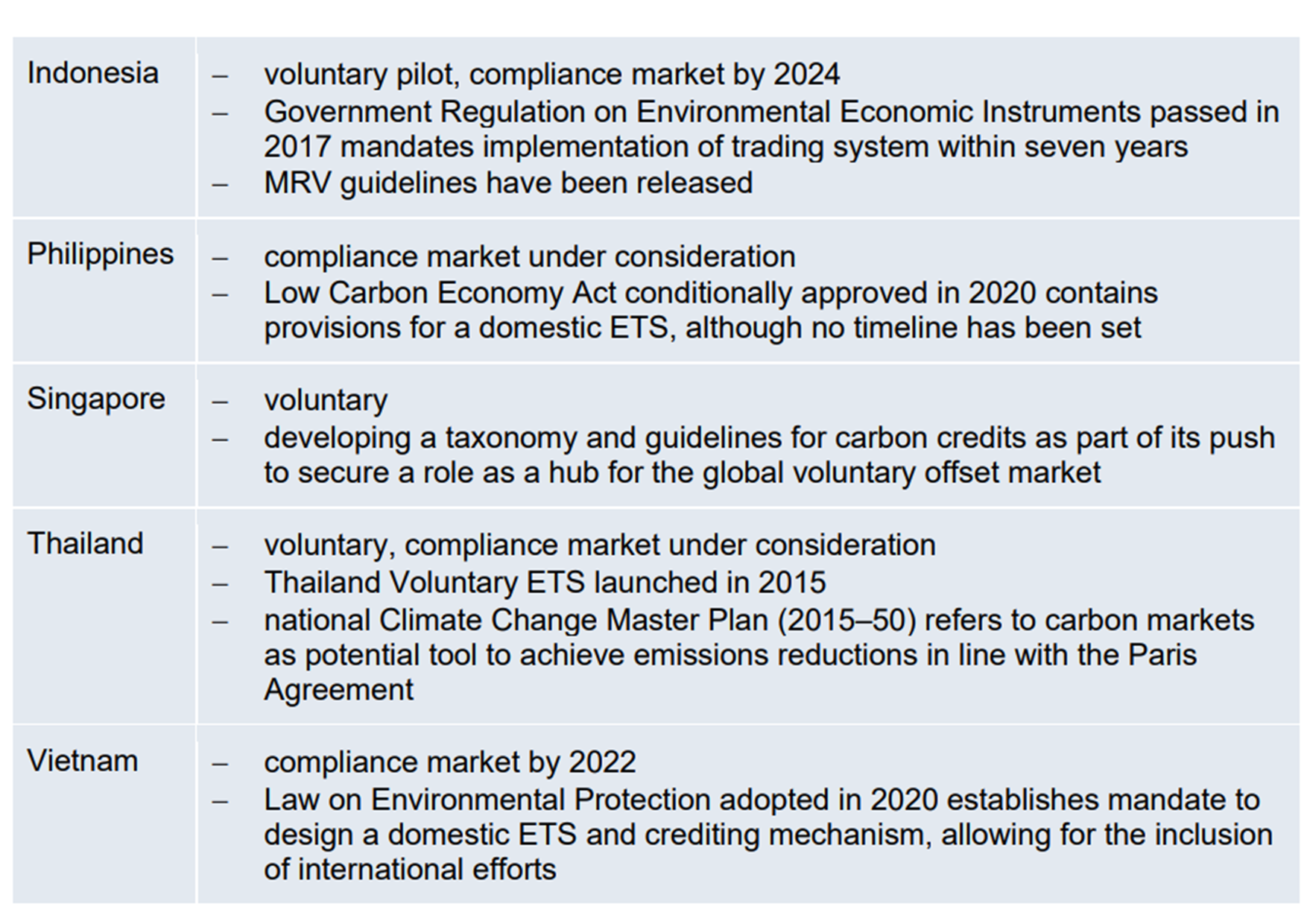
Across ASEAN – a region rich in biodiversity, forests and renewable energy sources such as hydro, solar and geothermal, investments in all of which could generate a significant number of ITMOs – several member states have taken steps to implement both voluntary and compliance markets (see table 1). In March 2021, Indonesia launched a pilot voluntary ETS for the power sector and is planning to start a national compliance system by 2024. Vietnam passed a law in November 2020 to create a national compliance system by 1 January 2022. Legislation to establish a national ETS covering large emitting sectors is under consideration in the Philippines. Thailand is considering establishing a national ETS. These developments follow the establishment of compliance carbon markets elsewhere in the Asia and Pacific, including national ETSs in South Korea, Australia, New Zealand, and Kazakhstan. China launched its own national trading scheme covering more than 2200 coal and gas power plants in February 2021 following a 10-year trial period in seven local pilot carbon markets. In addition, subnational systems exist in Japan (Tokyo and Saitama).

Overview of carbon markets in ASEAN. Source: author’s own compilation. 


As the most mature of the carbon markets in Asia, the Korea ETS (K-ETS) sets an example for future developments in ASEAN. Launched in 2013, K-ETS now covers 73.5% of domestic GHG emissions This system allows financial intermediaries to participate in the secondary market and trade emissions allowances and converted carbon offsets on the Korea Exchange (KRX)19. By switching from physical 'over-the-counter' markets to exchange trading, new market participants do not need to invest in establishing bilateral trading, credit and settlement relationships with incumbents but can instead trade through the exchange as a single point of entry, creating opportunities for a diverse group of market players ClimateSeed provides an example of how an integrated VCM may work. With access to proprietary data and a standardized methodology to monitor the effectiveness of nature-based projects, carbon offset ratings platform Sylvera is able to enhance and standardize the due diligence performed by players like ClimateSeed, allowing for a greater level of transparency and confidence for clients. Furthermore, by relying on its technology and efficiencies of scale, it can – reduce the cost of monitoring the projects on an ongoing basis.


Saturday, December 17, 2022

What is the Current State of Blockchain Technology in the Carbon Market?

 The use of blockchain technology in carbon market trading is still relatively new, and many studies are being conducted around the world to determine the technology’s suitability for improving carbon trading. A 2022 study revealed that companies nowadays are more willing to participate in carbon pilot projects using blockchain technology.

Another study identified 39 organisations that are developing blockchain solutions for carbon markets across two use cases: emissions-trading schemes and voluntary carbon markets. Among them are IBM and Ben&Jerry’s, both of which recently collaborated with blockchain companies to make carbon offsets more accessible to everyday consumers. IBM is also collaborating with Veridium Labs to develop digital tokens to facilitate the trading of carbon credits. 

Poseidon is a pioneer in voluntary carbon markets, focusing on retail integration and pinning carbon credits to everyday purchases. CEO Laszlo Giricz explains: “When we realized that using the Stellar blockchain transactions could be done in three seconds and at such a low cost, we realised we could now transact in grams of carbon. Carbon credits could be incorporated into retail transactions at the point of sale for the first time.”

Other companies and organisations that are using or developing blockchain technology in their carbon credits trading include ClimateTradeAirCarbon Exchange,  Powerledger,  JustCarbonLikvidi,  Phaeton BlockchainCarbonexBlockchain for Climate Foundation.

Although blockchain technology is still in its infancy and early stages of development, it has the potential to be the best technology in the near future for addressing the challenges of transparency in carbon trading

How Can Blockchain Technology Improve Transparency in Carbon Market Trading?

Carbon markets have traditionally been centralised, impenetrable, and illiquid, resulting in very limited market participation. Blockchain has the potential to expand existing carbon markets and create new ones for a wider range of stakeholders, including small businesses and individuals. The technology records transactions publicly and permanently, helping to promote traceability and honesty.

Blockchain technology has the potential to improve carbon market trading in the following ways:

1. Building Consumer Trust and Preventing Greenwashing

One of the greatest challenges in carbon markets trading is the inaccuracy and unreliability of data. Many businesses have fallen victim to greenwashing. However, blockchain technology offers a much more transparent and distributed method of keeping track of transactions, giving consumers a detailed audit record for all the parts of a product across all phases of its lifecycle.

2. Eradicating Double Counting

Blockchain has the potential to remove the possibility of duplicate counting – a situation where two parties claim the same emission reduction or carbon removal – and can strengthen the reliability, which decreases energy usage and will attract the participation of private finance, microfinance, and crowdfunding.

3. Effective Tracking of Carbon Markets

Blockchain can record a carbon credit’s complete journey, from creation through purchase to retirement. With the help of transparent credit tracking made simple by blockchain technology, voluntary markets might be expanded and made more accessible. The potential for aggregating small purchases via a transparent distributed ledger could assist regular consumers in reducing their environmental impacts.

The technology can offer more transparency regarding tracking GHG emissions and make it easier to track and report emission reductions, thereby addressing possible double counting issues. It could serve as a tool to monitor the progress made in implementing the Nationally Determined Contributions (NDCs) under the Paris Agreement, as well as in company targets.

4. Streamline and Accelerate Carbon Trading 

As opposed to either centralised or decentralised networks, the blockchain prevents monopolisation dominance of the system by eliminating the need for middlemen and enabling more streamlined and direct pathways for buying and selling credits. It can reduce the time required for clearance and trade approval by eliminating the requirement for intermediaries such as clearing houses. The use of smart contracts can accelerate the buying and selling of carbon credits by digitalising the negotiation and agreement process.

5. Enhance Carbon Emission Trading

Blockchain technology has the potential to enhance the carbon asset trade system. All the credible information gathered from a blockchain can assist businesses or organisations in identifying their issues and the reasons why they have not been eco-friendly yet. As such, they will find it simpler to define what being eco-friendly means for them and to establish suitable ways of achieving it.

6. Facilitate Clean Energy Trading and Ensure Appropriate Use of Funds

When it comes to finding accurate information about carbon credit, such as validation and verification, there is a credibility problem. Blockchain technology can address that by enabling the creation of systems for peer-to-peer renewable energy trading. Consumers would be able to buy, sell, or trade renewable energy with one another by using tokens or tradable digital assets representing a specific amount of energy production.

7. Enhance Climate Finance Flows

Blockchain technology has the ability to accelerate the development of crowdfunding and peer-to-peer financial transactions in support of climate action, while also ensuring that funding is assigned to projects in a transparent manner. Blockchain will ensure that the revenue generated is used solely to address carbon emission issues and not to fund any alternative political agenda. 

What is the Current State of Blockchain Technology in the Carbon Market?

The use of blockchain technology in carbon market trading is still relatively new, and many studies are being conducted around the world to determine the technology’s suitability for improving carbon trading. A 2022 study revealed that companies nowadays are more willing to participate in carbon pilot projects using blockchain technology.

Another study identified 39 organisations that are developing blockchain solutions for carbon markets across two use cases: emissions-trading schemes and voluntary carbon markets. Among them are IBM and Ben&Jerry’s, both of which recently collaborated with blockchain companies to make carbon offsets more accessible to everyday consumers. IBM is also collaborating with Veridium Labs to develop digital tokens to facilitate the trading of carbon credits. 

Poseidon is a pioneer in voluntary carbon markets, focusing on retail integration and pinning carbon credits to everyday purchases. CEO Laszlo Giricz explains: “When we realized that using the Stellar blockchain transactions could be done in three seconds and at such a low cost, we realised we could now transact in grams of carbon. Carbon credits could be incorporated into retail transactions at the point of sale for the first time.”

Other companies and organisations that are using or developing blockchain technology in their carbon credits trading include ClimateTrade, AirCarbon Exchange, Powerledger, JustCarbon, Likvidi, Phaeton Blockchain, Carbonex, Blockchain for Climate Foundation.

Although blockchain technology is still in its infancy and early stages of development, it has the potential to be the best technology in the near future for addressing the challenges of transparency in carbon trading.