
"....semua makhluk ciptaan Tuhan samada manusia,binatang,tumbuhan, alam semulajadi dan sebagainya,saling perlu memerlukan,saling bantu-membantu kerana mereka berkait,terikat antara satu sama lain dalam satu kitaran yang berhubungan. Justeru, jangan diputuskan ikatan itu, kelak, seluruh kitaran akan musnah..." Ahmad Rais Johari
Tuesday, November 23, 2021


Sunday, November 21, 2021
Saturday, November 20, 2021
Friday, March 5, 2021
Peter Lynch's 25 Golden Rules for Investing
Rule 1: Investing is fun and exciting, but dangerous if you don't do any work.
Rule 2: Your investor's edge is not something you get from Wall Street experts. It's something you already have. You can outperform the experts if you use your edge by investing in companies or industries you already understand.
Rule 3: Over the past 3 decades, the stock market has come to be dominated by a herd of professional investors. Contrary to popular belief, this makes it easier for the amateur investor. You can beat the market by ignoring the herd.
Rule 4: Behind every stock is a company. Find out what it's doing.
Rule 5: Often, there is no correlation between the success of a company's operations and the success of its stock over a few months or even a few years. In the long term, there is a 100% correlation between the success of the company and the success of its stock. This disparity is the key to making money; it pays to be patient, and to own successful companies.
Rule 6: You have to know what you own, and why you own it. "This baby is a cinch to go up" doesn't count.
Rule 7: Long shots almost always miss the mark.
Rule 8: Owning stocks is like having children — don't get involved with more than you can handle. The part-time stockpicker probably has time to follow 8-12 companies, and to buy and sell shares as conditions warrant. There don't have to be more than 5 companies in the portfolio at any one time.
Rule 9: If you can't find any companies that you think are attractive, put your money in the bank until you discover some.
Rule 10: Never invest in a company without understanding its finances. The biggest losses in stocks come from companies with poor balance sheets. Always look at the balance sheet to see if a company is solvent before you risk your money on it.
Rule 11: Avoid hot stocks in hot industries. Great companies in cold, non growth industries are consistent big winners.
Rule 12: With small companies, you are better off to wait until they turn a profit before you invest.
Rule 13: If you are thinking of investing in a troubled industry, buy the companies with staying power. Also, wait for the industry to show signs of revival. Buggy whips and radio tubes were troubled industries that never came back.
Rule 14: If you invest $1000 in a stock, all you can lose is $1000, but you stand to gain $10,000 or even $50,000 over time if you are patient. The average person can concentrate on a few good companies, while the fund manager is forced to diversify. By owning too many stocks, you lose this advantage of concentration. It only takes a handful of big winners to make a lifetime of investing worthwhile.
Rule 15: In every industry and every region of the country, the observant amateur can find great growth companies long before the professionals have discovered them.
Rule 16: A stock market decline is as routine as a January blizzard in Colorado. If you are prepared, it can't hurt you. A decline is a great opportunity to pick up the bargains left behind by investors who are fleeing the storm in panic.
Rule 17: Everyone has the brainpower to make money in stocks. Not everyone has the stomach. If you are susceptible to selling everything in a panic, you ought to avoid stocks and stock mutual funds altogether.
Rule 18: There is always something to worry about. Avoid weekend thinking and ignore the latest dire predictions of the newscasters. Sell a stock because the company's fundamentals deteriorate, not because the sky is falling.
Rule 19: Nobody can predict interest rates, the future direction of the economy, or the stock market, Dismiss all such forecasts and concentrate on what's actually happening to the companies in which you have invested.
Rule 20: If you study 10 companies, you will find 1 for which the story is better than expected. If you study 50, you'll find 5. There are always pleasant surprises to be found in the stock market — companies whose achievements are being overlooked on Wall Street.
Rule 21: If you don't study any companies, you have the same success buying stocks as you do in a poker game if you bet without looking at your cards.
Rule 22: Time is on your side when you own shares of superior companies. You can afford to be patient — even if you missed Wal-Mart in the first five years, it was a great stock to own in the next five years. Time is against you when you own options.
Rule 23: If you have the stomach for stocks, but neither the time nor the inclination to do the homework, invest in equity mutual funds. Here, it's a good idea to diversify. You should own a few different kinds of funds, with managers who pursue different styles of investing: growth, value small companies, large companies etc. Investing the six of the same kind of fund is not diversification.
Rule 24: Among the major stock markets of the world, the U.S. market ranks 8th in total return over the past decade. You can take advantage of the fastergrowing economies by investing some portion of your assets in an overseas fund with a good record.
Rule 25: In the long run, a portfolio of well-chosen stocks and/or equity mutual funds will always outperform a portfolio of bonds or a money-market account. In the long run, a portfolio of poorly chosen stocks won't outperform the money left under the mattress.
Thursday, March 4, 2021
Gann's 28 Trading Rules
The Rules given below are based upon W. D. Gann's experience :
1. Amount of capital to use: Divide your capital into 10 equal parts and never risk more than one-tenth of your capital on any one trade.
2. Use stop loss orders. Always protect a trade when you make it with a stop loss order.
3. Never overtrade. This would be violating your capital rules.
4. Never let a profit run into a loss. After you once have a profit (...), raise your stop loss order so that you will have no loss of capital.
5. Do not buck the trend. Never buy or sell if you are not sure of the trend according to your charts and rules.
6. When in doubt, get out, and don't get in when in doubt.
7. Trade only in active markets. Keep out of slow, dead ones.
8. Equal distribution of risk. Trade in two or three different commodities, if possible. Avoid tying up all your capital in any one commodity.
9. Never limit your orders or fix a buying or selling price. Trade at the market.
10. Don't close your trades without a good reason. Follow up with a stop loss order to protect your profits.
11. Accumulate a surplus. After you have made a series of successful trades, put some money into a surplus account to be used only in emergency or in time of panic.
12. Never buy or sell just to get a scalping profit.
13. Never average a loss. This is one of the worst mistakes a trader can make.
14. Never get out of the market just because you have lost patience or get into the market because you are anxious from waiting.
15. Avoid taking small profits and big losses.
16. Never cancel a stop loss order after you have placed it at the time you make a trade.
17. Avoid getting in and out of the market too often.
18. Be just as willing to sell short as you are to buy. Let your object be to keep with the trend and make money.
19. Never buy just because the price of a commodity is low or sell short just because the price is high.
20. Be careful about pyramiding at the wrong time. Wait until the commodity is very active and has crossed Resistance Levels before buying more and until it has broken out of the zone of distribution before selling more.
21. Select the commodities that show strong uptrend to pyramid on the buying side and the ones that show definite downtrend to sell short.
22. Never hedge. If you are long of one commodity and it starts to go down, do not sell another commodity short to hedge it. Get out of the market; take your loss and wait for another opportunity.
23. Never change your position in the market without a good reason. When you make a trade, let it be for some good reason or according to some definite rule; then do not get out without a definite indication of a change in trend.
24. Avoid increasing your trading after a long period of success or a period of profitable trades.
25. Don't guess when the market is top. Let the market prove it is top. Don't guess when the market is bottom. Let the market prove it is bottom. By folllowing definite rules, you can do this.
26. Do not follow another man's advice unless you know that he knows more than you do.
27. Reduce trading after first loss; never increase.
28. Avoid getting in wrong and out wrong; getting in right and out wrong; this is making double mistakes. When you decide to make a trade be sure that you are not violating any of these 28 rules which are vital and important to your success. When you close a trade with a loss, go over these rules and see which rule you have violated; then do not make the same mistake the second time. Experience and investigation will convince you of the value of these rules, and observation and study will lead you to a correct and practical theory for successful Trading in Commodities.
Tuesday, March 2, 2021
Money Flow Index Trading Indicator
The Money Flow Index (MFI) is a momentum indicator that measures the strength of money flowing in and out of a market. Look for divergence between the Money Flow Index and the current price. If the price moves higher and the MFI moves lower a reversal may be imminent.
Refer figure below. Look for possible market tops when the MFI is above 80. Look for possible market bottoms when the MFI is below 20. This study is very similar to the Relative Strength Index, however, the Money Flow Index includes Price and Volume in the calculation.

Properties
Bars = Number of Bars to use in the calculations.
Average = Number of N periods used in the optional moving average.
Formula
Money Flow = Price * Volume
Money Ratio = Positive Money Flow Sum / Negative Money Flow Sum
Money Flow Index = 100 – ( 100 / ( 1 + Money Ratio))
Monday, March 1, 2021
On Balance Volume indicator(OBV) for Trading
Overview of OBV Indicator
On Balance Volume (OBV) measures buying and selling pressure as a cumulative indicator that adds volume on up days and subtracts volume on down days. OBV was developed by Joe Granville and introduced in his 1963 book, Granville's New Key to Stock Market Profits. It was one of the first indicators to measure positive and negative volume flow. We can look for divergences between OBV and price to predict price movements or use OBV to confirm price trends.
The On Balance Volume (OBV) line is simply a running total of positive and negative volume. A period's volume is positive when the close is above the prior close. A period's volume is negative when the close is below the prior close.

Thursday, February 18, 2021
The 1929 Stock Market Crash
“Those who cannot remember history are condemned to repeat it,” warned philosopher George Santayana. There is no more glaring example than the 1929 stock market crash, which in some ways was eerily similar to the boom and bust cycle that the stock market went through beginning in March 2000.
It wasn’t the Internet that fascinated the nation and helped usher in the roaring 1920s, it was electricity. At the same time, many people became enamored with the stock market. With very favorable margin rates (you could borrow 9 times the amount of your original investment), it seemed as if everyone was in the stock market.
As more and more people entered the market, the prices of stocks went up. (In a way, it was like a huge Ponzi scheme. People paid off what they owed on their original investment with the paper profits they made on their rising stocks.) The attitude of the Coolidge administration was laissezfaire, a French term meaning “letting things be.” The government wanted to let the forces of capitalism work without interference.
As the stock market got shakier and the economy got worse, the new president, Herbert Hoover, realized that something had to be done. The goal was to increase margin requirements (which many considered the main culprit) without causing panic. Unfortunately, the market panicked.
After a series of frightening stops and starts, the market finally crashed on October 24, 1929. Over $10 billion of investors’money was wiped out before noon. Huge crowds of angry and shocked investors packed the visitor’s gallery of the NYSE to watch the debacle. By noon the market was in a “death spiral.” Investors around the world were horrified at the extent of the financial damage.
By October 29, 1929, all the market’s gains from the past year had been wiped out. Eventually, the market fell 89 percent from its 1929 high of 381.
After the crash, economists tried to figure out what had gone wrong. It was obvious that many people had missed the signs the market was overpriced. For example, the P/Es of many stocks were high, well beyond what was considered the P/E safe zone of 15. In addition, the Fed decided to raise interest rates, which many economists considered to be the wrong move. Congress also had a hand in turning what really was a recession into a fullblown depression. For example, during this period it doubled income taxes and raised tariffs on imports and exports.
Another problem was that banks were allowed to operate with few restrictions on how much they could lend. After the crash, many of the banks’ customers had no way of paying back the money they had borrowed, forcing many banks to close. Finally, many people believed that fraud and insider activity was to blame.
After the initial crash, the United States entered a 3-year bear market; the Dow finally bottomed at 41 in 1932. The new president, Franklin Delano Roosevelt (FDR), took a number of unprecedented steps to bring stability and trust to the market, including creating the SEC in 1932. Wall Street was skeptical about letting the government interfere with the private sector, but the steps FDR took eventually helped turn the economy around. However, it took 25 years for the Dow to make it back to 381.
The 1987 Stock Market Crash: Electronic Trading Is Born
Before 1987, the only way you could trade stocks was by calling your stockbroker on the phone (unless you were one of the lucky few who had enough money to buy a seat on one of the stock exchanges).
The weakness of this system was revealed in October 1987, when the U.S. markets crashed, falling by more than 20 percent in one day. Because many investors and institutional investors panicked and tried to sell at the same time, the phone lines jammed or stockbrokers refused to answer their phones.
On more than a few occasions, the floor brokers filled the orders of institutional investors but ignored orders from individual investors. (As you can imagine, many investors lost everything because they sold too late.)
Because of this fiasco, the Nasdaq created a special computerized system called SOES (Small Order Execution System) that allowed traders to place orders electronically and at the most competitive price. The first to take advantage of SOES were day traders, who discovered that they could bypass a stockbroker and send their orders directly to the stock exchange.
This was the beginning of the online trading revolution, but it was only for day traders. It was another 10 years before retail investors were allowed to trade online.
Wednesday, December 30, 2020
The True Nature of Reality
The talk on “The True Nature of Reality” by Allahyarham Bro. Prof. Muhammad Al’Mahdi (founder of the Khalifah Institute) is part of the Weekend Class series of eight lectures conducted in 2004 at the Khalifah Institute.
Part 1:
Part 2:
Islamic Solution to the World”s Problem (Part 1)
Islamic Solution to the World”s Problem (Part 2)
Scientific Proof to the Existence of God (Part 1)
Scientific Proof to the Existence of God (Part 2)
The Creation of the Universe (Part 1)
The Creation of the Universe (Part 2)
The Creation of the Universe (Part 3)
The Laws of Learning (Part1)
The Laws of Learning (Part2)
The Laws of Learning (Part3)
Monday, November 2, 2020
SEJARAH RINGKAS PENERBITAN JURNAL SEJARAH DI MALAYSIA 1846-1966
Jurnal sejarah yang paling awal diterbitkan di negara kita ialah Journal of the Indian Archipelago and Eastern Asia pada tahun 1847. Jurnal ini lebih dikenali sebagai Logan’s Journal yakni nama penerbit dan pengarangnya, James Richardson Logan, seorang wartawan dan peguam di Negeri-negeri Selat. Secara ringkasnya, sebanyak tiga belas jilid jurnal ini telah diterbitkan antara tahun-tahun 1847-1863. Jilid I hingga Jilid IX dikeluarkan antara tahun-tahun 1847-1855 manakala Jilid I (siri baru) hingga Jilid 3 (siri baru) 1856-1859 dan Jilid IV (siri baru) 1863. Selepas tahun 1863, jurnal ini telah terkubur begitu sahaja. Penggerak utamanya, Logan telah meninggal dunia di Pulau Pinang pada tahun 1869.
Sepanjang penerbitannya, purata jumlah edaran adalah di antara 200 hingga 300 naskhah setiap kali keluaran. Dalam pada itu, lebih kurang 50 naskhah telah dilanggan oleh Syarikat Hindia Timur Inggeris untuk kegunaan para pegawainya. Logan’s Journal merupakan salah satu jurnal ilmiah yang terawal di negara kita yang diterbitkan di Negeri-negeri Selat. Rencana-rencana yang dimuatkan dalam jurnal ini ditulis dalam Bahasa Inggeris dan biasanya membincangkan tentang sejarah, kesusasteraan dan etnologi geografi Tanah Melayu, Sabah dan Sarawak.

Seterusnya, jurnal sejarah yang kedua terawal penerbitannya ialah Journal of Eastern Asia yang diterbitkan oleh James Collins pada bulan Julai, 1875. Collins merupakan seorang pegawai British yang berkhidmat di Negeri-negeri Selat dan memegang jawatan Setiausaha dan Pustakawan di Muzium dan Perpustakaan Raffles, Singapura. Collins telah mengikut jejak Logan dalam menerbitkan sebuah jurnal persendirian (suku tahunan) dengan menanggung semua kos pengeluarannya. Tambahan pula, beliau memperolehi sokongan moral dan bantuan khas daripada Gabenor Negeri-negeri Selat, Sir Andrew Clarke dalam usaha menerbitkan jurnalnya. Namun demikian, ianya tidak dapat kekal lama kerana keluaran seterusnya yang dijangkakan diterbitkan pada bulan Oktober, 1875 tidak menjadi kenyataan akibat masalah kewangan dan kekurangan rencana. Selain daripada sejarah, jurnal ini juga memuatkan rencana tentang botani, zoologi, geologi, mineralogi, dan meteorlogi. Semua rencana yang dimuatkan dalam edisi sulungnya adalah dalam Bahasa Inggeris.
Ketiga ialah Journal of the Straits Branch of the Royal Asiatic Society yang mulamula diterbitkan pada tahun 1878 oleh Straits Branch of the Royal Asiatic Society (Persatuan Asia Diraja Bahagian Selat) yang berpusat di Singapura. Pada mulanya, jurnal ini mengandungi pelbagai rencana mengenai sejarah semulajadi, falsafah, geografi, geologi, kesusasteraaan, filologi, sejarah dan etnologi. Kemudiannya, pada 1920an, jurnal tersebut mulai memuatkan lebih rencana bersifat sejarah terutamanya apabila jurnal bertukar nama kepada Journal of the Malayan Branch of the Royal Asiatic Society (1923-1963) pada tahun 1923.
Antara tahun-tahun 1941-1946, penerbitan jurnal telah tergendala akibat pendudukan tentera Jepun di Tanah Melayu. Seterusnya, apabila Semenanjung Tanah Melayu, Singapura, Sabah dan Sarawak digabungkan menjadi Malaysia pada tahun 1963, sekali lagi jurnal ini bertukar nama menjadi Journal of the Malaysian Branch of the Royal Asiatic Society (1964 hingga sekarang). Dari tahun pertama penerbitannya hingga sekarang, jurnal ini telah disunting oleh seorang pengarang yang dilantik khas oleh Persatuan untuk mengendalikan pengurusan jurnalnya. Kemudiannya, akibat beban kerja penerbitan yang terlalu rumit dan bertambah, sebuah sidang editorial diwujudkan untuk membantu pengarang. Pengarang pertama jurnal ini ialah Dr. N. B. Dennys (1878), Setiausaha, Persatuan Asia Diraja Bahagian Selat.
Seterusnya, antara tokoh-tokoh yang pernah menjawat tugas pengarang ialah A.M. Skinner (1879), W. E. Maxell (1883-1887), H. N. Ridley (1890-1893, 1898-1900, 1902- 1907,1909-1911), C. A. Gibson-Hill (1948-1961), Alastair Lamb (1963-1964), Wang Gungwu (1964-1968), S. Arasaratnam (1969-1970), Mubin Sheppard (1971-1994), dan Khoo Kay Kim (1995-1998). Mulai Jilid 71 (2) Disember 1998, tugas pengarang telah diambil alih Dr. Cheah Boon Kheng, Naib Presiden Persatuan Asia Diraja Bahagian Malaysia. Isu terbaru jurnal ini ialah Jilid 73 (2) Disember 2000. Semua rencana yang disumbangkan kepada jurnal ini adalah dalam Bahasa Inggeris.
Jurnal seterusnya ialah Perak Museum Notes (1893-1898) yang diterbitkan oleh Muzium Taiping, Perak. Kemunginan besar orang yang ditugaskan mengelolakan penerbitan Perak Museum Notes ialah Leonard Wray, Kurator Muzium Perak sendiri. Antara tahun-tahun 1899-1904 tidak ada keluaran terbaru daripada jurnal ini. Pada tahun 1905, jurnal ini bertukar nama kepada Journal of the Federated Malay States Museum sempena penggabungan Muzium Perak dan Muzium Selangor. Pada masa yang sama, jurnal ini memulakan nombor siri yang baru. Kemudiannya, jurnal ini telah bertukar imej dan nama lagi kepada Federation Museums Journal apabila Muzium Negara mengambil alih penerbitannya iaitu Jilid 1 & II Siri Baru 1954/1955 yang telah diberikan nombor siri yang baru juga. Sebelum itu, seperti Journal of the Malayan Branch of the Royal Asiatic Society, penerbitannya turut tergendala selama dua belas tahun iaitu antara tahun-tahun 1941-1953 kerana Perang Dunia Kedua dan masalah-masalah tertentu. Pengarang jilid sulung selepas perang ialah G. De G. Sieveking, Kurator Muzium, Persekutuan Tanah Melayu. Kemudiannya, Mubin Sheppard telah mengambil alih tugas pengarang mulai Jilid IV Siri baru 1960.
Dalam pada itu, akibat kesibukan kerja dan bebanan tugas, mulai Jilid VI 1961, Sheppard telah dibantu H. A. Lamb dan Lord Medway dalam kerja-kerja penerbitan jurnal. Kemudiannya, Shahrum bin Yub, Timbalan Pengarah Muzium dengan bantuan Lord Medway telah diberi tanggungjawab menerbitkan jurnal tersebut sehingga tahun 1969. Mulai Jilid XV Siri Baru 1970, Shahrum bin Yub yang kemudiannya menjadi Pengarah Muzium Negara telah mengambil alih tugas pengarang sepenuhnya sehingga tahun 1985. Antara tahun-tahun 1986-1990, jurnal ini tidak diterbitkan sehingga tahun 1991 iaitu Jilid 31 Siri Baru yang mana pengarangnya ialah Haji Mohd Zulkifli bin Haji Abdul Aziz, Ketua Pengarah Jabatan Muzium dan Antiquiti dengan dibantu oleh sebuah sidang pengarang yang terdiri daripada pegawai-pegawai Jabatan Muzium dan Antiquiti. Selepas tahun 1991, jurnal ini mengambil nama baru iaitu Malaysia Mueums Journal dengan terbitnya Jilid 34 Siri Baru, 1998 yang mana Zuraina Majid menjadi pengarangnya.
Isu jurnal yang akan datang ialah Jilid 35 Siri Baru. Pada keseluruhannya, jurnal ini mengandungi rencana mengenai etnologi, antropologi dan arkeologi. Namun demikian, ada juga terselit dalam setiap keluaran rencana-rencana mengenai sejarah. Pada mulanya artikel-artikel dalam jurnal ini ditulis dalam Bahasa Inggeris tetapi menjelang penubuhan Malaysia pada tahun 1963, ia mula mengandungi rencana dalam Bahasa Melayu. Jurnal kelima ialah Sarawak Museum Journal yang diterbitkan pada tahun 1911 oleh Muzium Sarawak. Pengarang pertama jurnal ini merupakan Major J. C. Moulton, Kurator Muzium Sarawak sendiri. Menjelang tahun 1937, Muzium Sarawak telah berjaya menerbitkan 15 jilid jurnalnya. Seperti jurnal-jurnal sejarah yang lain, penerbitannya turut terhenti apabila tentera Jepun menduduki Sarawak. Jurnal ini telah menyambung semula penerbitannya dengan siri baru hanya pada Mei 1949, Jilid 5, no. 1 (Siri baru), no. 16 (Siri lama). Dalam pada itu, antara pengarang-pengarang yang telah mengambil-alih tugas penyuntingan jurnal tersebut ialah Tom Harrison (1949-1965), Tom Harrrison dan Benedict Sandin (1966-1967), Benendict Sandin (1968-1971), Lucas Chin (1972-1991), Peter M. Kedit (1992-1996) dan Sanib Said (1997 hingga sekarang).
Secara tradisinya, jawatan Pengarang jurnal biasanya dipegang oleh Kurator Muzium Sarawak. Sejak Jilid 24 (Siri Lama) 45 (Siri Baru) 1976, pengarang dibantu dalam kerja-kerja penerbitan oleh sebuah sidang pengarang. Dalam pada itu, pada tahun 1992, setelah mengambil alih tugas pengarang jurnal, Peter M. Kedit telah memberi wajah baru kepada jurnal dengan memperkenalkan kulit depan jurnal yang berwarna untuk menceriakan lagi imej jurnal. Secara amnya, jurnal ini memuatkan rencana-rencana tentang sejarah, sejarah semulajadi, arkeologi, etnologi dan lain-lain lagi mengenai Sarawak dan kawasan-kawasan sekitarnya. Jilid terkini jurnal ini ialah Jilid 68 (Siri Lama) 50 (Siri Baru). Selepas Perang Dunia Kedua, jurnal sejarah seterusnya ialah Malayan Historical Journal, the Journal of the Malayan Historical Society yang diterbitkan oleh Malayan Historical Society (Persatuan Sejarah Malaya) pada tahun 1954. Pengarang pertama jurnal ini ialah J. C. Bottoms, Setiausaha Sulit Pesuruhjaya Tinggi British yang mengelolakan penerbitkan jurnal sehingga Jilid 3, no. 1, Julai 1956. Setahun kemudian, pada Julai 1957, Haji Mubin Sheppard telah mengambil alih jawatan Pengarang dan terus menyelenggarakan penerbitan jurnal yang telah diberi nama baru Malaya in History (1957-1962). Ketika menjadi pengarang jurnal, beliau telah memberi wajah baru yakni kulit depan yang berwarna tetapi nombor sirinya telah dikekalkan.
Pada tahun 1963 dengan penubuhan Malaysia, Malaya in History menjadi Malaysia in History (1963-1985). Haji Mubin Sheppard telah bertugas sebagai pengarang selama 13 tahun hingga pengeluaran Jilid 14, no. 2, April 1972. Kemudian tanggungjawab untuk menerbitkan jurnal telah diambilalih oleh Professor Zainal Abidin bin A. Wahid yang telah berjaya mengeluarkan jurnal Malaysia dari segi Sejarah setiap tahun untuk memuatkan rencanarencana sejarah dalam Bahasa Melayu memandangkan sebelum ini Malaysia in History lebih banyak memuatkan rencana-rencana sejarah yang ditulis dalam Bahasa Inggeris.
Sebenarnya, seawal Februari 1961, memandangkan kurangnya terdapat jurnal-jurnal sejarah dalam Bahasa Melayu, Dewan Bahasa dan Pustaka telah bekerjasama dengan Persatuan Sejarah Malaya untuk menterjemahkan beberapa rencana sejarah terpilih untuk dimuatkan dalam sebuah jurnal sejarah. Dengan itu, lahirlah Tanah Melayu dari segi Sejarah, yang pertama kali diterbitkan pada bulan Februari 1961 oleh Dewan Bahasa dan Pustaka untuk Persatuan Sejarah Malaya. Jurnal ini kemudiannya bertukar nama kepada Malaysia dari segi Sejarah. Dengan itu sebenarnya, Malaysia dari segi Sejarah adalah sambungan Tanah Melayu dari segi Sejarah. Yang membezakan kedua-duanya ialah Malaysia dari segi Sejarah diterbitkan sendiri oleh Persatuan Sejarah Malaya yang kemudiannya telah bertukar nama kepada Persatuan Sejarah Malaysia.
Pada 28hb Julai 1978, Prof. Zainal Abidin bin A. Wahid telah menyerahkan jawatan pengarang kepada Prof. Khoo Kay Kim. Pada tahun 1985, selepas Jilid 28, 1985 penerbitan Malaysia in History terpaksa diberhentikan kepada kekurangan sumbangan rencana Bahasa Inggeris. Oleh itu, hanya Malaysia dari segi Sejarah yang dikeluarkan dan keluaran tersebut tidak lagi setebal keluaran-keluaran pada masa dahulu. Pada ketika itulah kemungkinan besar telah berlaku penyatuan jurnal sejarah yang pertama di negara kita kerana kedua-dua jurnal penerbitan Persatuan Sejarah Malaysia, iaitu Malaysia in History dan Malaysia dari segi Sejarah telah digabungkan menjadi satu kerana kekurangan dana penerbitan dan lain-lain masalah. Selepas Prof. Khoo Kay Kim mengundurkan diri sebagai pengarang, jawatan Pengarang telah diambil alih oleh Prof. Dr. Nik Hassan Shuhaimi bin Nik Abdul Rahman. Kini, kedua-kedua jurnal ini telah digabungkan ke dalam satu penerbitan sahaja bertajuk Malaysia dari segi Sejarah sejak tahun 1986. Jilid terkini Malaysia dari segi Sejarah ialah Bil. 28, 2000 yang mana pengarang barunya ialah Prof. Abdullah Zakaria Ghazali.
Jurnal sejarah seterusnya ialah Journal of the Historical Society, University of Malaya, pertama diterbitkan pada tahun 1960. Jurnal ini dterbitkan oleh Persatuan Sejarah Universiti Malaya untuk membolehkan para pelajar mengikuti perkembangan penulisan sejarah yang dikarang para akademik dan rakan mereka. Jurnal ini kemudiannya bertukar nama kepada Jernal Sejarah mulai Jilid IX 1970/1971. Perubahan nama ini selaras dengan perkembangan terbaru dalam dasar pelajaran yang menggunakan Bahasa melayu sebagai bahasa pengantar di universiti-universiti tempatan. Dari Jilid 1, 1960 hingga Jilid V 1966/1967, semua rencana yang dimuatkan dalam jurnal adalah dalam Bahasa Inggeris tetapi mulai Jilid VI 1967/1968 sudah terdapat artikel sejarah yang ditulis dalam Bahasa Melayu.
Pengarang-pengarang jurnal ini semuanya merupakan pelajar-pelajar jurusan Sejarah di Jabatan Sejarah, Universiti Malaya. Antaranya ialah R. Bonney (Jilid 1, bil. 1, 1960), Oh Hong Choon (Jilid 1 , bil. 2, 1961), Gilbert Khoo (Jilid 1, bil. 3, 1962/1963 – Jilid II 1963/1964), Oli Mohamed (Jilid III 1964/1965), Mat Rasip Manap (Jilid IV 1965/1966), Karthar Singh (Jilid V 1966/1967), Xavier Nathan (Jilid VI 1967/1968), Anto Austin D’Cruz (Jilid VII l968/1969), Soosay Nathan K. (Jilid VIII l969/1970), G. Palanivel (Jilid IX 1970/1971), Thomas Mathews (Jilid X 1971/1972), Kassim Abbas (Jilid XI 1972/1973), Abdul Manaf Saad (Jilid XII 1973/1974), Ahmad Zahid Hamidi (Jilid XIII 1974/1975/1976), Sahabudin Mahmud (Jilid XIV 1976/1977), dan Ismail Wadin (Jilid XV 1977/1978). Pada mulanya, kebanyakan artikel sejarah jernal adalah sumbangan para pensyarah dan tutor Jabatan Sejarah, Universiti Malaya tetapi sejak tahun 1971, sumbangan daripada mahasiswa-mahasiswi semakin bertambah.
Pada keseluruhannya, rencana-rencana sejarah yang diterbitkan dalam jurnal ini adalah dalam bidang pengajian sejarah Malaysia. Selepas itu, wujudlah jurnal sejarah, Kedah dari segi Sejarah Kedah in History, terbitan Persatuan Sejarah Malaysia, Cawangan Kedah. Jurnal ini telah mula dikeluarkan pada Jun 1966. Pengarangnya yang pertama ialah James F. Augustin yang terus menerbitkan jurnal tersebut sehingga Jilid 3, no. 1 Jun 1968. Ismail Haji Saleh telah menjadi pengarang jurnal mulai Bil. 7, No. 1, Julai 1976. Pada mulanya, rencana yang dituliskan adalah dalam Bahasa Inggeris tetapi kemudiannya sejajar dengan perkembangan pelajaran negara, ianya telah memuatkan rencana-rencana sejarah dalam Bahasa Melayu juga.
Seterusnya, mulai Jilid 12, Bil. 1, 1995, jurnal ini bertukar nama kepada Cetera serta berwajah baru manakala pengarangnya ialah H. Md. Noor Salleh. Pengarang jurnal menguruskan penerbitan jurnal dengan dibantu oleh staf penyelenggara jurnal yang berkemungkinan besar sama ada merupakan kakitangan Muzium Negeri Kedah ataupun ahli-ahli Persatuan Sejarah Malaysia, Cawangan Kedah. Jurnal sejarah yang kesepuluh ialah Peninjau Sejarah : Journal of the History Teachers’ Assocation of Malaya yang pertama kali diterbitkan pada Julai 1966. Jurnal ini diterbitkan atas kerjasama Persatuan Guru-guru Sejarah Tanah Melayu dan Jabatan Sejarah, Universiti Malaya.
Tujuan utama penerbitannya ialah untuk membolehkan peminat-peminat sejarah tanahair untuk memberi pendapat dan membincangkan soal-soal yang ada kaitan dengan bidang sejarah. Dari penerbitan sulung hingga keluaran terakhirnya, pengarangnya ialah Zainal Abidin b. A. Wahid yang bertugas di Jabatan Sejarah, Universiti Malaya. Namun demikian, pada keseluruhanya sambutan terhadap jurnal berkenaan tidaklah begitu memuaskan kerana jawatan Pengurus Jualan tidak dapat diisikan dengan calon yang sesuai. Ini ditambah dengan masalah jumlah ahli persatuan yang semakin berkurangan tahun demi tahun dan akhirnya jurnal ini terpaksa menghentikan penerbitannya selepas tahun 1968, Jilid 3, no. 2, September 1968. Pada hakikatnya, walaupun jurnal ini dikatakan bersifat dwibahasa tetapi semua rencana yang disumbangkan adalah dalam Bahasa Inggeris.
Monday, October 26, 2020
Portal Pengurusan dan Pengurusan e-Jurnal Smart Manufacturing Research Institute
Alhamdulilah berkat kerjasama pasukan sekreteriat Journal of Applied Engineering Design and Simulation (JAEDS) portal JAEDS fasa pertama telah siap dibangunkan. Portal tersebut boleh diakses melalui url https://jaeds.uitm.edu.my
Saturday, October 10, 2020
Mengisi Masa Dengan Aktiviti Yang Bermanfaat
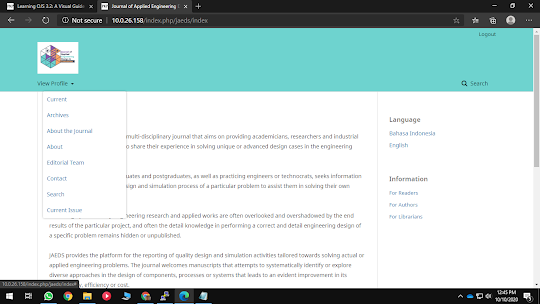
10 Oktober 2020 (10-10-2020) hari ke 4 melalui Perintah Pengawasan dan Pemerhatian dibawah Seksyen 15(1) Akta Pencegahan Dan Pengawalan Penyakit Berjangkit 1988 (Akta 342). Saya memenuhi masa yang terluang dengan membangunkan portal pengurusan journal bertajuk Journal of Applied Engineering Design and Simulation untuk sebuah Pusat Kecemerlangan UiTM iaitu Smart Manufacturing and Research Institute. Portal ini dibangunkan menggunakan platform open sources. Server pembangunan sistem pengurusan journal ini dibina secara virtual di Data Center UiTM. Ia hanya boleh diakses melalui network dalam UiTM sahaja dan saya melakukan kerja-kerja installation dan configuration daripada rumah saya di Kolej Delima secara remote.
Paksa diri untuk faham dan tahu menggunakan CLI Operating System (OS) platform Linux (Ubuntu) dan menggunakan framework Laravel PHP version 7.4.11, web server Apache version Apache/2.4.41 (Ubuntu) dan Database server version 10.3.22-MariaDB-1ubuntu1. Perjalanan masih panjang untuk menyiapkan projek portal pengurusan jurnal ini. Seperkara yang diperakui ialah ia tidak semudah seperti yang disebut.
Friday, October 9, 2020
Penantian Suatu Penyiksaan

Pada 5 Oktober 2020 Menteri di Jabatan Perdana Menteri (Hal Ehwal Agama), Datuk Seri Dr Zulkifli Mohamad Al-Bakri disahkan positif Covid-19. Susulan daripada itu, semua yang hadir dimajlis penyerahan bantuan tersebut diarahkan supaya menjalani Swap Test Covid-19 dan kuarantin selama 14 hari dirumah masing-masing.