Monday, May 2, 2011

Bin Laden is DEAD: Celebrations across America as U.S. special forces shoot dead terror chief in mansion hideaway in Pakistan

Osama Bin Laden has been killed by the U.S. military after a decade-long hunt to avenge the 9/11 attacks, President Barack Obama revealed today.

The leader of al Qaeda was dramatically killed today in a firefight with American special forces in a $1million mansion hideout about 60 miles north of Islamabad in Pakistan.

U.S. military chiefs used facial recognition techniques to identify the slain leader and performed DNA tests, the results of which will be available in the coming days.

In a dramatic statement President Obama said the U.S. military had recovered the body and confirmed to the world he had finally been killed.

Sunday, May 1, 2011

Top 50 Portable Open Source Apps

If you travel frequently, it can be frustrating to have to use a system that doesn’t have your favorite open source software already installed. Fortunately, many of the most popular open source applications come in portable versions that you can take with you on a USB thumb drive or other portable media.

What makes an application portable? These apps can run from any portable device (a thumb drive, CD, DVD, portable hard drive or other device) without needing to be installed directly on the hard drive of the system you're using. They also don't leave behind any files on the host system, and they don't interfere with other software installed on that system.

For this list, we've compiled some of the best portable open source applications available. Some of these were originally designed by the project owner to be portable. Others are open source applications that have been re-packaged for portability by a third party

Several groups, notably PortableApps.com and winPenPack, have created suites of portable open source applications. Others offer directories with many individual portable apps. Because these collections and directories are so helpful, we put them at the top of our list. Other individual portable applications come next, organized by category.

As always, feel free to mention other portable open source applications in the Comments section below.

Collections/Suites

1) PortableApps.com PortableApps.com is probably the best known suite of open-source apps that you can download and run from a USB drive. The basic suite consists of twelve apps, including portable versions of Firefox, Thunderbird, ClamWin, KeePass, PNotes and others. In addition, the site includes a huge directory of portable versions of other software that integrates with the platform. Operating System: Windows.

2) winPenPack While its not as well-known as PortableApps.com, winPenPack also offers dozens of open source apps in portable versions. You can download the apps individually or you can get the Full or the Essential suite. Operating System: Windows.

3) Democrakey If you're worried (or paranoid) about privacy and censorship, Democrakey bundles together open source applications for secure Web browsing, secure e-mail, secure chat, encryption, file shredding and anti-virus. You can download it to your own USB drive from the link above or purchase a USB drive with Democrakey installed from Democrakey.com. Operating System: Windows.

4) Tor Browser Bundle Like Democrakey, the Tor Browser Bundle packages together several apps that you can use from a thumb drive to protect your privacy while surfing. It includes Tor, Vidalia, Polipo, Firefox, and Torbutton. Operating System: Windows.

Directories

5) Portable Apps Directory In addition to the collection of software included in the standard PortableApps.com suite, the site also lists more than one hundred other apps that have been packaged to work from a thumb drive. Choose from accessibility tools, development tools, games, educational apps, multimedia software, Internet software, office productivity tools, security apps and utilities. Note that while all of the apps on this list are free, not all are open source. Operating System: Windows.

6) OS X Portable Applications This site includes twenty-two free portable applications, many of which are open-source, that can be used on any Mac. The list includes Adium, Audacity, Gimp and more. Operating System: OS X.

7) Pendriveapps.com Pendriveapps.com has an exceptionally large library of portable applications, many of which are open source. It provides reviews and downloads for software in dozens of different categories. Operating System: Various.

8) PortableLinuxApps.org This site offers more than 150 apps that can be downloaded to a USB drive and used from any Linux system running Ubuntu 10.04 (Lucid Lynx) 32-bit, OpenSUSE 11.3 (GNOME) 32-bit , or Fedora 12 (GNOME) 32-bit. Well-known titles on the site include the VLC media player, TrueCrypt encryption software, Pidgin instant messaging, LibreOffice and many others. Operating System: Linux.

Audio Player

9) Songbird Similar to iTunes, Songbird helps you organize your music collection, and it plays your audio files. It's also available in a mobile version for Android. Operating System: Windows.

Backup

10) Create Synchronicity When zipped, this extremely lightweight backup utility occupies just 180KB. It offers a simple, very intuitive interface and fast performance. Operating System: Windows, Linux.

Browsers

11)Firefox Portable Any PC you use will likely have a browser installed, but if you bring your own browser with you, you can also get access to your bookmarks, passwords and customization settings. Firefox portable is included in the PortableApps.com Suite or you can download it separately from the link above. Operating System: Windows.

12) X-Chromium If you prefer Google's browser, this app is based on the same open source project that is the basis for Chrome. It also allows you to carry your bookmarks and personalization preferences with you. Operating System: Windows.

13) Qt Web Browser Based on Nokia's Qt framework and Apple's WebKit rendering engine, this browser was designed to be lightweight, secure and portable. It's just 6MB, and it offers a highly customizable interface and a long list of privacy-protection features. Operating System: Linux, OS X.

Compresson Tools

14) PeaZip This helpful archiving tool can create 7 different file types and extracts 129 different file types. It offers encryption and the ability to create self-extracting files, and it comes in a portable version. Operating System: Windows, Linux.

15) Unrar Extract and Recover If you need to extract a lot of RAR archive files and you're not exactly sure what all the passwords are, this tool can help. It "handles password-protected, multi-part and encrypted archives with ease," and it requires no installation. Operating System: Windows, Linux.

Developer Tools

16) GVim Portable This project packages the vim text editor so that you can use it from a thumb drive on any Windows system. Vim is an updated version of the vi text editor for Unix. Operating System: Windows.

17) ATPad This Notepad replacement includes a number of features for developers, like a tabbed interface, line numbering, word wrapping, text coloring and more. It's won a number of awards. Operating System: Windows.

18) Notepad++ Like the regular version of Notepad++, this portable version features a tabbed interface, syntax highlighting, auto-completion, macros, and more. Supported programming languages include C, C++, HTML, ASP, Java, Pascal and CSS. Operating System: Windows.

File Manager

19) TuxCommander This Linux-only file manager requires no installation, so it's completely portable. It offers a tabbed, two-panel graphic interface and support for files larger than 4GB. Operating System: Linux.

Games

20) Big Solitaires 3D Portable This collection includes 40 different popular solitaire card games, including Forty Thieves, FreeCell, Golf, Klondike, Russian, Scarab, Spider, Yukon and others. Choose one of the built-in deck images or load one of your own. Operating System: Windows.

21) PokerTH Portable This classic Texas Hold 'Em style poker game lets you play against up to ten networked or computer-generated players. It offers an attractive and highly customizable interface. Operating System: Windows.

22) Battle for Wesnoth Portable This popular open source turn-based fantasy strategy game offers a range of different sagas to play or you can create one of your own. Both single- and multiple-player options are available. Operating System: Windows.

23) T^3 Portable Play Tetris in 3D! It's simple, familiar and fun. Operating System: Windows.

24) WinBoard Portable Play the standard chess game you know or one of the variants like xiangqi (Chinese chess), shogi (Japanese chess), Makruk, Losers Chess, Crazyhouse, Chess960 and Capabanca Chess. You can play on your own or connect to other players on the Internet. Operating System: Windows.

25) Get Sudoku Portable Stumped by a Sudoku puzzle? Enter the values you know into this app and it will help you keep track of the possible answers for all of the other boxes. Operating System: Windows.

Graphics

26) Gimp Portable Similar to Photoshop, Gimp offers professional-quality photo editing tools. You can use it as a painting program, to re-touch photos and more. Operating System: Windows.

27) Inkscape Portable Inkscape offers professional-quality vector graphics editing, similar to CorelDraw or Illustrator. The features are advanced, but the interface is still relatively easy to use. Operating System: Windows.

Instant Messaging

28) Miranda This lightweight IM client fits easily on a USB drive (or even on an old-school floppy disk). It supports AIM, Facebook, Gadu-Gadu, IAX, ICQ, IRC, Jabber, MSN, Yahoo, and other networks. Operating System : Windows.v

Note Taking

29) The Guide This tool lets you organize your notes in a hierarchical, tree-based format. It's similar to a mind mapper, but not as complex. Operating System: Windows.

Office Productivity

30) LibreOffice Portable This fork of the OpenOffice.org suite allows you to create documents, spreadsheets, presentations, databases, drawings and more that are compatible with Microsoft Word and other office productivity software. Note that this is a larger portable application – 382-582MB. Operating System: Windows.

31) AbiWord Portable If you only need a word processor, AbiWord gives you a more lightweight alternative to a full office productivity suite. It's just 15 MB installed, and it supports Word, WordPerfect and OpenOffice.org file formats. Operating System: Windows.

32) X-OOo4Kids OpenOffice.org for Kids offers a simplified version of OpenOffice.org designed to be used by those aged 7-12. The advantage of this version, even if you're not a kid, is that it loads and runs very quickly and requires very little space on your portable drive. Operating System: Windows.

Operating System

33) Damn Small Linux Just 50MB, Damn Small Linux (DSL) was designed to boot from a USB drive or a business card CD. It's based in part on Debian code and includes applications like Firefox, XMMS, Ted, XPDF and a surprising number of others. Operating System: Linux.

PDF Reader

34) Sumatra PDF This lightweight PDF reader requires just one file, so it's easy to run from a USB drive. It's very fast, thanks in part to a minimalist design with only the most necessary features. Operating System: Windows.

Personal Finance Manager

35) YAPBAM Short for "Yet Another Bank Account Manager," YAPBAM is a simple financial management program that can run from a USB drive. Key features include import and export capabilities, budgeting, alerts and more. Operating System: Windows, Linux, OS X.

Screenwriting

36) Portable Celtx Celtx makes it easier to format text so that it meets the standards for screenwriting submissions. This version runs from thumb drives and other portable devices. Operating System: Windows.

Security

37) TrueCrypt Downloaded more than 14 million times, TrueCrypt can protect your entire hard drive or thumb drive. Check the documentation area of the website for information on how to use portable mode. Operating System: Windows.

38) Portable PGP This Java-based encryption tool lets you encrypt, decrypt, sign and verify text and files. It's easy to use and very lightweight. Operating System: Windows, Linux.

39) Portable KeePass KeePass stores all of your passwords in an encrypted database so that you only have to remember one master password. The portable version lets you take your passwords with you wherever you go. Operating System: Windows, Linux, OS X.

40) ClamWin Portable Take your anti-virus protection with you, with ClamWin Portable. Note that this app doesn't provide real-time scanning or a scheduled system scan capability – you'll need to select files to be scanned manually. Operating System: Windows.

Server Software

41) EasyPHP If you're a PHP developer, you can use EasyPHP to set up a WAMP (Windows, Apache, MySQL and PHP) server on a thumb drive. It also includes de-bugging and development tools like PhpMyAdmin and Xdebug. Operating System: Windows.

42) Z-WAMP Another option for creating a portable WAMP stack, Z-WAMP aims to be lightweight and easy to install. Additional applications included in the package include Adminer, MongoDB Admin, MemCached, SQLite, eAccelerator, and Alternative PHP Cache (APC). Operating System: Windows.

Sticky Notes

43) PNotes Bring your virtual sticky notes with you with PNotes. This app requires no installation and includes features like spoken notes, scheduling, password protection and encryption. Operating System: Windows.

Time Tracking

44) Rachota Just 609 KB, this portable time tracking app offers an intuitive interface and plenty of reporting features. It's Java-based, so it will work on just about any system. Operating System: OS Independent.

To Do List

45) Task Coach This portable scheduling tool gives you the ability to break large tasks into smaller sub-tasks and mark them off when completed. It's also compatible with Outlook and Thunderbird—allowing you to drag and drop tasks from one app to the other. Operating System: Windows, Linux, OS X.

Utilities

46) BleachBit Portable Take this app with you to protect your privacy when using someone else's PC. It cleans up your cache, temporary files, cookies and Internet history, and it includes a shredder to eliminate all traces of erased files. Operating System: Windows.

47) Portable Keyboard Layout If you learned a different keyboard layout or want to try an alternative to the QWERTY keyboard to prevent carpal tunnel and repetitive motion injury, this app is for you. Just plug it into your system and it will transform your keyboard into the one you've set up on your thumb drive. Operating System: Windows.

48) Folder Menu This handy tool makes it easier to jump to your favorite files and folders. It works with Windows Explorer, open/save dialog boxes, or the command prompt. Operating System: Windows.

49) Appetizer Appetizer is a dock-style application launcher for Windows (2000, XP or Vista). It supports the PortableApps.com file format, so it will automatically detect any other portable apps you have on your thumb drive and include them on the dock. Operating System: Windows.

Vulnerability Assessment

50) BackTrack Linux The "most widely adopted penetration testing framework in existence," BackTrack includes a complete Linux distribution with an up-to-date set of tools for penetration testing. Easy instructions for downloading it to a USB drive are included on the site. Operating System: Linux.

(Reference : http://itmanagement.earthweb.com)

The latest numbers of internet users, text messages & more from ITU Statshot.

ICT development has been astonishing in every region of the world over the past five years.

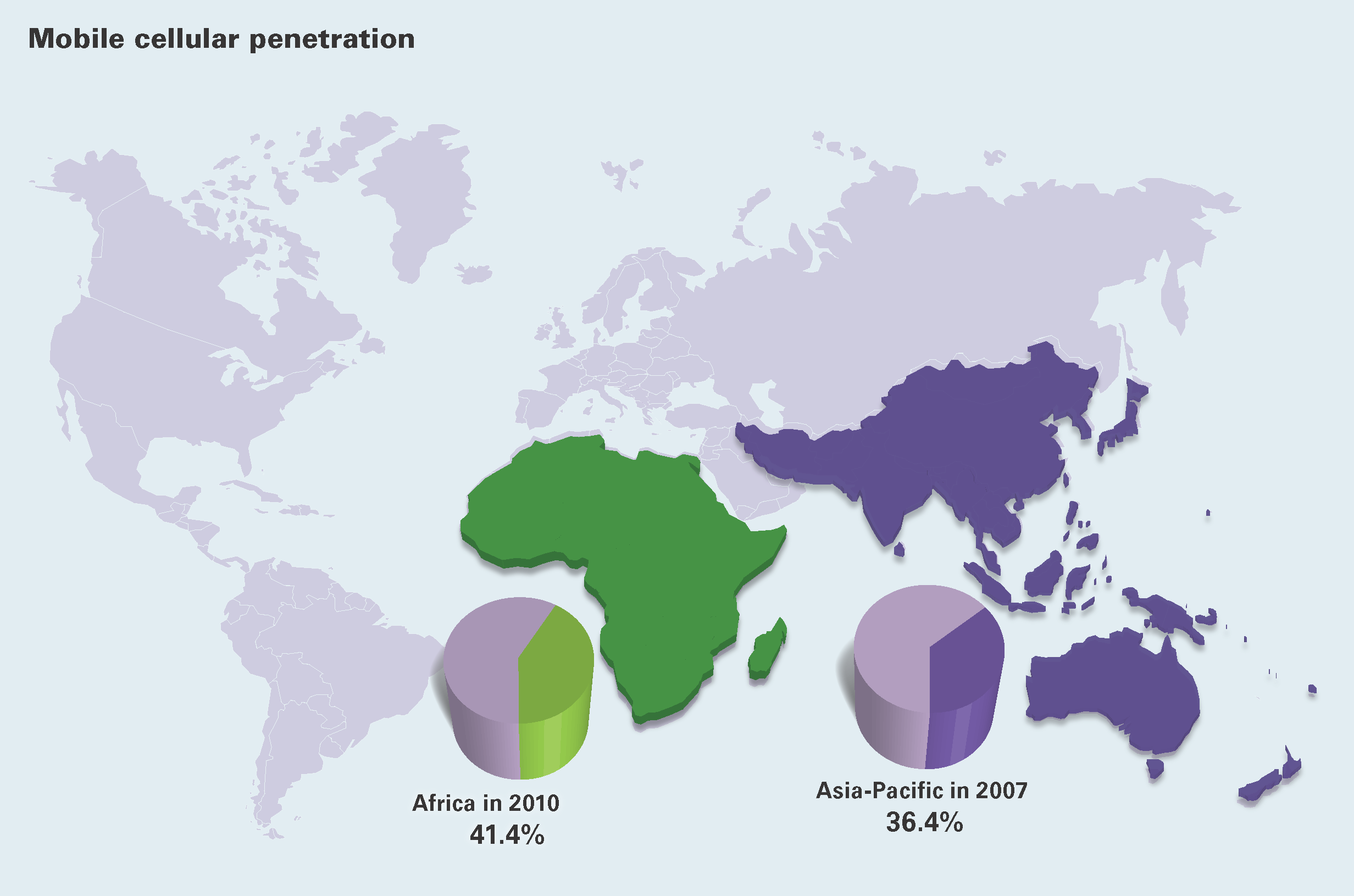
  • In Africa, mobile cellular penetration, at 41.4% in 2010, was higher than it had been in Asia-Pacific three years earlier – where it reached 36.4% in 2007.

    Increased Competition

  • The Commonwealth of Independent States has the highest mobile cellular penetration of any region in the world, reaching over 130% in 2010.
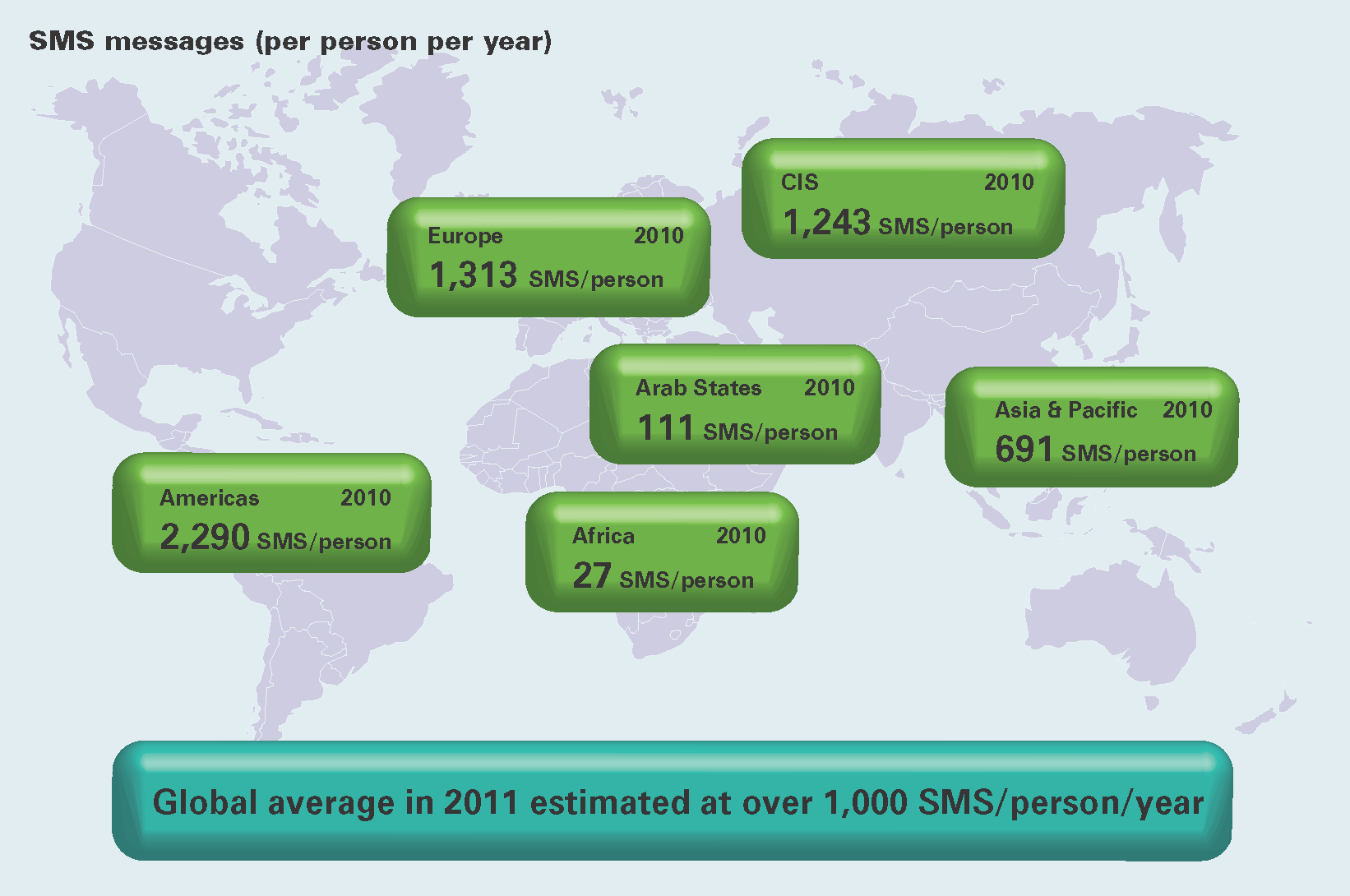
  • 40 billion SMS messages were sent in the Arab States in 2010, up from under 10 billion in 2005.
  • There are more than 400 million Internet users in Europe. With two thirds of the population online, Europe is the region with the highest Internet penetration in the world.
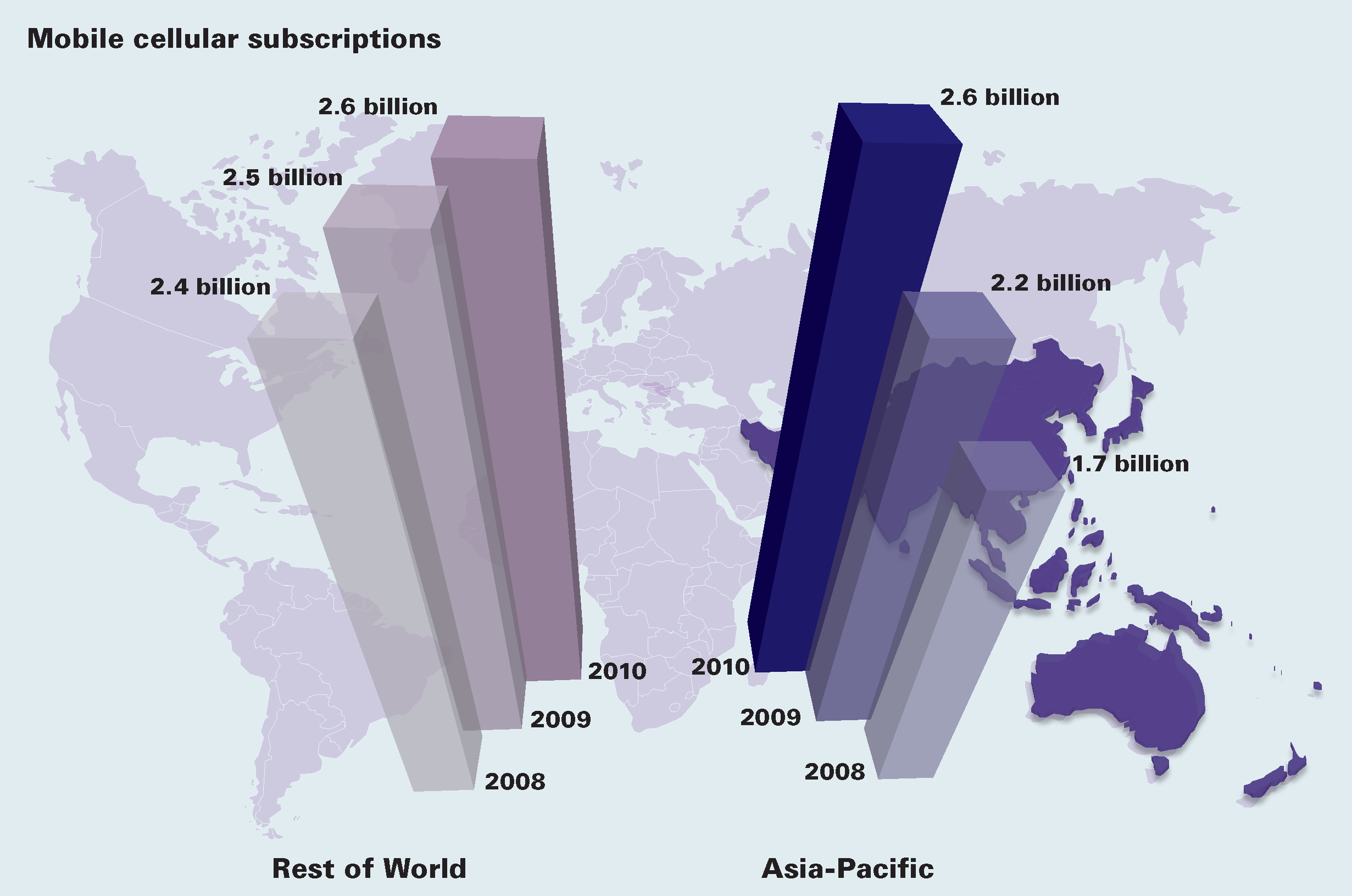
  • Most of 2010’s mobile growth was in Asia-Pacific, which saw the number of mobile cellular subscriptions grow by 490 million (of 630 million globally), to reach 2.6 billion.

    Mobile Cellular Subscriptions

  • For the first time, Asia-Pacific now has over half the world’s mobile cellular subscriptions.
  • In Africa, mobile broadband subscriptions grew almost 15-fold over the last three years – from 2 to 29 million. Despite strong growth, however, Africa remains easily the least Internet-enabled continent, with fewer than one in ten Africans online, and mobile broadband penetration below 4%.
The developing world – catching up…
  • There were as many fixed broadband subscriptions in the developing world in 2010 as there were in the developed world in 2008, just two years earlier (251 million vs 253 million). China alone accounts for around half of all the developing world’s fixed broadband subscriptions.
  • There were more mobile broadband subscriptions in the developing world in 2010 (309 million) than there were in the whole world in 2007 (307 million), just three years earlier.
  • There were almost as many mobile cellular subscriptions in the developing world in 2010 (3.8 billion) as there were in the whole world in 2008 (4 billion), and half a billion more than there were in the developed world in 2007.
  • By 2010, developing world Internet users accounted for 58% of the global total, with 1.2 billion in the developing world, compared to 900 million in the developed world. But with most of the world’s population living in developing countries, only a fifth of people there are online, compared to almost three quarters in richer nations.
Keep texting…
  • At current growth rates, there will be well over a thousand SMS messages sent in 2011 for every person on the planet (there were 2.8 trillion SMS messages sent in 2008; 4.3 trillion in 2009; and 6.1 trillion in 2010).

SMS Messages

Data and analysis in this ITU Statshot are drawn from the ITU World Telecommunication/ICT Indicators database.

Further ICT statistics are available online at ITU’s ICT Eye:
http://www.itu.int/ITU-D/icteye/Default.aspx

ITU also publishes a full range of current statistics and analyses. For further information see:
http://www.itu.int/ITU-D/ict/publications

Saturday, April 30, 2011

The naming of parts: Time for “Linux Inside”?

by Glyn Moody

Names matter in free software. Just think of the number of electrons that have been spilt arguing over whether it's “Linux” or “GNU/Linux”.

The naming of parts came up when I interviewed Linus back in 1996. I had asked him about his relations with Richard Stallman, and this is what Linus said:

I've had some, not very much. At first he wasn't too interested, because Linux was so PC-centric – just two years ago, it didn't run on anything else. And I suspect Richard really dislikes PCs. So he wasn't really interested in that sense. Lately, when it's become obvious how portable it is and how well it works on other architectures too, I think Richard in that sense looks at Linux in a different light.

One problem we've had, well, problem, kind of clash of personalities, is that Linux has gotten so much press and GNU has gotten so little. So for Richard, he's not pragmatic, he really has this idealistic world-view, he'd really like the system to be called GNU/Linux or something like this. Personally I don't think GNU Linux flies as a name, it should be catchy.

But is “Linux” catchy? The fact that few people have heard of it outside the rather specialised world of free software suggests not. Indeed, far more people have probably come across “Ubuntu”, which has taken on the role of the public face of GNU/Linux to a certain extent. That's good, in the sense that it has done valuable work promoting free software to the general public; but it's also unfortunate in that it has pushed the “Linux” name even further into the background.

Some might ask why that is even a problem. After all, does it really matter what the kernel is called? I'd argue yes, for the slightly counter-intuitive reason that Linux is becoming so successful, particularly in two areas: mobile phones and embedded systems.

The rise and rise of Android has made that particularly name a household word – well, in more affluent countries at least, although once cheap Android-based phones start appearing it will become a global brand. Embedded systems, by contrast, often run Linux without anyone being aware of the fact: one of its strengths is that it doesn't crash, so there are no tell-tale Blue Screens of Death (BSOD) to announce its presence to the world. Instead, it just carries on working reliably and invisibly.

The problem, then, is the fact that Linux can be powering more and more of the digital devices that fill our lives and also be behind the international success that is Android, and yet few outside the computer world are aware of the connection.

Imagine, now, a situation where all these growing successes were perceived as part of a single, larger movement: the rise of Linux, and with it the spread of free software. Once people start to realise that many of their most beloved and faithful gadgets have at their heart the same software, they might begin to look a little differently on this “Linux” thing; they might, for example, begin to seek it out in other devices...maybe even on the desktop.

That is, if we could make people aware of just how widely used Linux is in smartphones and consumer electronics, say, it might even kickstart the use of free software in other domains.

So, the question becomes: how might we do this?

The idea of some kind of “Linux Inside” campaign has been raised before, but the situation is rather different now, largely thanks to Android smartphones. These are probably the first mass-market devices running Linux that people in the street are passionate about; this offers a unique opportunity to tap into that goodwill and transfer some of it to Linux.

To do that, we need a neutral organisation to oversee the project – the Linux Foundation is the obvious candidate – not least because Linus is an employee. As well as being widely respected among the open source community, it already has many of the leading companies that use Linux in their products as members. More recently, it has become more active in the embedded sector, which could be invaluable in gaining support for the idea here too.

Those same companies could help fund advertising campaigns to raise people's awareness of “Linux Inside” or whatever brand were chosen. As well as the efficiency of banding together to promote something for their mutual benefit, there's also the fact that they have – and ought to feel – a moral obligation to support something that they use for free. A few judicious remarks by Linus along those lines ought to work wonders, since it would be a PR disaster for major companies to be seen snubbing his polite request for help in this way.

Of course, for the thousands of smaller manufacturers that use Linux in their consumer devices, that may not be such a convincing argument for them to contribute money to the campaign. But, at the very least, it's in their own interests to stick some “Linux Inside” logo on their boxes – after all, it lets them tap into the generic marketing that would be going on around it, as well as allowing them to claim that the software in their otherwise somewhat anonymous products was “official” (provided, of course, that they made available all their source code....).

In a way, the idea behind “Linux Inside” or equivalent is the same as one of the key advantages of open source: that by collaborating and pooling resources, more can be achieved than by working separately. At the moment, the marketing around devices using Linux is fragmented, each manufacturer pushing a proprietary brand that reveals nothing about its underlying connection to Linux. By creating a strong umbrella brand alongside them, manufacturers would be helping the Linux ecosystem of which they form part – and hence helping themselves.

(Reference - http://www.h-online.com)

Friday, April 29, 2011

UM hall damaged by fire

PETALING JAYA: Universiti Malaya's Balai Ungku Aziz caught fire yesterday, with an estimated 80 per cent of its roof destroyed. The fire was believed to have started on the roof of the dental faculty in the hall about 4.50pm and students had to be evacuated. Pantai Fire and Rescue Department chief Hamid Daud said they received a distress call at 4.54pm and arrived there within five minutes. “Three fire trucks with 19 personnel from the Pantai and Taman Desa fire stations took two hours to put out the fire," he said. The cause of the fire and losses are being investigated.

(Reference :http://mmail.com.my)

Thursday, April 28, 2011

Sony's PlayStation Network Disaster: What Happens Next?

By Matt Peckham, PCWorld Apr 27, 2011 7:50 AM

It's been a full week since Sony's PlayStation Network went belly up. For five of those days, the outage appeared to be just what Sony said--an outage. Yesterday all that changed when Sony admitted the "external intruder(s)" that prompted them to take the PSN down on Wednesday, April 20th, had in fact grabbed reams of personal information, and possibly (though unconfirmed) financial data such as credit card info. With upwards of 75 million PSN users affected, some are calling it the largest breach of confidential user information in history. Where does Sony go from here?

Yahoo Sells Delicious To You Tube Founders

Yahoo's Delicious, which was reportedly slated to be shuttered, will live on thanks to YouTube co-founders Chad Hurley and Steve Chen, who have agreed to purchased the site.

“We’re excited to work with this fantastic community and take Delicious to the next level,” said Hurley said in a statement. “We see a tremendous opportunity to simplify the way users save and share content they discover anywhere on the web.”

Yahoo has finally found a buyer for long suffering Delicious. YouTube founders Chad Hurley and Steve Chen have acquired the company, says Yahoo, via a “new Internet company, AVOS.” We’re still gathering details, but here’s the official stuff:

Today YouTube founders Chad Hurley and Steve Chen announced they have acquired the Delicious technology from Yahoo!. They plan to continue the service that users have come to know and love and make the site even easier and more fun to save, share and discover the web’s “tastiest” content.

Providing a smooth transition for users is important to both companies. There will be a transition period where users can elect to sign up for a new account. Users’ public and private bookmarks will be maintained through the transition period and transferred as they are today when it is complete.

As we have said, part of our product strategy involves shifting our investment with off-strategy products to put better focus on our core strengths and fund new innovation. We believe this is the right move for the service, our users and our shareholders and look forward to watching the Delicious technology develop.

(Reference : http://techcrunch.com)

Wednesday, April 27, 2011

Asterisk powers

Asterisk is a complete PBX in software. It runs on Linux, BSD, Windows and OS X and provides all of the features you would expect from a PBX and more. Asterisk does voice over IP in four protocols, and can interoperate with almost all standards-based telephony equipment using relatively inexpensive hardware.

Asterisk provides Voicemail services with Directory, Call Conferencing, Interactive Voice Response, Call Queuing. It has support for three-way calling, caller ID services, ADSI, IAX, SIP, H.323 (as both client and gateway), MGCP (call manager only) and SCCP/Skinny. Check the Features section for a more complete list.

Asterisk needs no additional hardware for Voice-over-IP, although it does expect a non-standard driver that implements dummy hardware as a non-portable timing mechanism. A single (or multiple) VOIP provider(s) can be used for outgoing and/or incoming calls (outgoing and incoming calls can be handled through entirely different VOIP and/or telco providers).

For interconnection with digital and analog telephony equipment, Asterisk supports a number of hardware devices, most notably all of the hardware manufactured by Asterisk's sponsors, Digium. Digium has single and quad span T1 and E1 interfaces for interconnection to PRI lines and channel banks. In addition, single to quad port analog FXO and FXS cards are available and are po***r for small installations. Other vendors' cards can be used for BRI (ISDN2) or quad- and octo- port BRI based upon CAPI compatible cards or HFC chipset cards.

Lastly, standalone devices are available to do a wide range of tasks including providing fxo and fxs ports that simply plug into the LAN and register to Asterisk as an available device.

Tuesday, April 26, 2011

Design Standards Brief Manual for Royal Melbourne Institute of Technology, Australia.

The Royal Melbourne Institute of Technology is one of Australia’s original and leading educational institutions, producing some of Australia’s most employable graduates. As an innovative, global university of technology, with its heart in the city of Melbourne, RMIT has an international reputation for excellence in work-relevant education and high quality research, and engagement with the needs of industry and community.

With more than 70,000 students studying at RMIT campuses in Melbourne, in Vietnam, online, and at partner institutions throughout the world, the University is one of the largest in the country. It has built a worldwide reputation for excellence in professional and vocational education and research. A vibrant alumni community now stretches across more than 100 countries. RMIT is a member of the Australian Technology Network.

The Design Standards Brief –Version 6, August, 2009 – contains the minimum design standards for RMIT University. The Design Standards Brief is the guiding document for building works at the University. The document able to be access at url http://www.rmit.edu.au

(Reference : http://www.rmit.edu.au)

Linux patent suit ruled against Google

A Texas jury has ruled against Google in a suit that alleged some of its use of open source Linux code amounted to patent infringement, something that could have big implications for other companies using Linux technology and other open source systems. In the verdict, delivered last week, the jury decided that Google should pay US$5 million for the infringement.

The suit was filed in June 2009 by a firm called Bedrock Computer Technologies, which also named the likes of Yahoo, MySpace, Amazon, PayPal, Match.com and AOL as defendants in the suit. Bedrock, as was reported when the suit was filed, was founded by a prominent patent reform advocate (the corporation has been accused of being a patent troll) and filed suit against the defendants in question for violation of Patent 5,893,120, detailing "methods and apparatus for information storage and retrieval using a hashing technique with external chaining and on-the-fly removal of expired data".

Since it's the Linux kernel itself, the core of the open source operating system, this could have implications well beyond Google--and even beyond the other defendants in the case, for whom court decisions have not yet been determined.

"Google can easily afford US$5 million if it has to, but this patent infringement case has major implications for the IT industry in general and for Linux in particular," patent and IP activist Florian Mueller wrote on his blog. "The plaintiff identified a portion of the Linux kernel as part of the 'Accused Instrumentalities.' Many companies using Linux have already been required by the patent holder to pay royalties, and many more will now, based on this jury verdict, elect to pay."

A potentially contested turf: the Android mobile operating system, which is Linux-based and continues to grow fast, evolving into many different mutations of a mobile (and now tablet) software architecture.

Mueller points out that not only did Google attempt to declare the patent invalid, but so did Linux software maker Red Hat, which counts several of its clients among the defendants.

"Google will continue to defend against attacks like this one on the open source community," a spokesperson for the company said. "The recent explosion in patent litigation is turning the world's information highway into a toll road, forcing companies to spend millions and millions of dollars defending old, questionable patent claims, and wasting resources that would be much better spent investing in new technologies for users and creating jobs."

(Reference : http://www.zdnetasia.com)

Saturday, April 23, 2011

Skype unleashes VoIP calls over 3G for Android

The latest version of Skype for Android includes some security updates that make it more secure, however the "meat and potatoes" of the new version allows for greater VoIP (Voice over Internet Protocol) call functionality over a 3G connection should the contingency arise to WiFi in the U.S., no matter the network. Still no word on when Skype will let users make video-to-video calls.

However until at the time, Android users can now join in with other mobile devices and platforms in making Skype to Skype VoIP calls over 3G and eating up data usage on their mobile plans during conserving those precious calling minutes for

(Reference : http://www.appscout.com)

Tuesday, April 19, 2011

Momentum Around Asterisk Intensified by Digium in 2010

Strong growth in the use of Asterisk and substantial technical advances in the product has marked a successful end of the year for Digium, Inc, Diamond Sponsor of ITEXPO (News - Alert) East. Apart from releasing a major upgrade; the use of Asterisk has expanded to 170 countries. Asterisk is open source telephony software created by Digium. The company is also the primary sponsor of this software.

A new open source project, Asterisk (News - Alert) SCF has also been announced by the company in late October. Over the past year, contributions from the open source community have matched Digium’s investment in Asterisk. Asterisk has received code from over 9,800 people to date. This includes more than 200 people who worked on Asterisk 1.8 which was released in October. The increase in momentum is evident from the over two million downloads of the software in 2010. Users of Asterisk include developers, resellers, integrators and systems administrators.

An ordinary computer is converted into a communication server with Asterisk. IP PBX (News - Alert) systems, VoIP gateways, conference servers and other communication applications can be powered with this communication server. Asterisk is being used to create standards-based, feature-rich communications systems in more than 170 countries by small businesses, large enterprises, call centers, carriers and governments.

The communication systems are being created at a fraction of the cost of proprietary systems. According to Digium (News - Alert), billions of minutes of phone calls around the world are being handled by Asterisk running over one million servers.

In a press release, Bryan Johns, community director of Digium, said, “Asterisk has made an indelible impression on the voice communications industry in the 11 years since it was released. Its appeal keeps growing as businesses look for the value, flexibility, standards compliance and the technical superiority that result from the contributions of thousands of talented and visionary software developers.”

Johns added that the company is proud to sponsor Asterisk. The company is also proud of the Asterisk community, which currently has 73,000 registered members. The company has released Asterisk 1.8 this fall as it continues its focus on Asterisk development. A new open source project in Asterisk SCF has also been created by Digium, added Johns.

Friday, April 8, 2011

Enterprise WAN Router Buyer's Guide by Drew Robb

The router market is an interesting space. It is split into two broad categories: enterprise Wide Area Network (WAN) routers and branch routers. This article focuses on the former category. Enterprise WAN routers are used to communicate to and from head office to branches. Sitting in the main data center, WAN routers are part of the network backbone, dealing with transaction and processing oriented traffic. As such, they need high bandwidth capacity. "Enterprise WAN routers sit at the hub, while the branch offices are like the connecting spokes," said Dell'Oro Group routers analyst, Shin Umeda.

While generally separate from the switches that connect user devices to the network, some modern switches have also taken on some routing functions. However, they remain largely separate. Switches connect users to the Local Area Network (LAN) while routers transmit data across the WAN.

Primary features

What are the main features that users should be looking for in an enterprise WAN router? Umeda said that the most important point is to match user bandwidth requirements to the device. Some WAN routers, after all, can be relatively small with a few interfaces. The simplest come with two connections - one to the WAN and one to the LAN. This might be good enough for a small organization, but limits performance and lacks flexibility. Larger routers, of course, have far more ports and can deal with a wider range of services that are attempting to connect to the WAN? Such services might include a low-speed electrical circuit like a T1 line, a Fiber Optics circuit connecting to a carrier network, or Ethernet up to 10 Gigabit Ethernet (10GbE).

"Pay attention to the type of connectivity you require during the selection process," said Umeda. "Most decent routers are highly configurable based on the type of ports you need." Connecting to the LAN side, though, is relatively straightforward. That typically requires Ethernet ports in the range of 100 Mb or 1 Gb.

Voice only, data only or both is a question that has to be answered. The days of data only networks appear to be dwindling, but not everyone has jumped onto the Voice over IP (VoIP) bandwagon. It would be wise to check with the CIO to determine if VoIP is on the horizon. If so, plan ahead. It doesn't make any sense to buy a fresh set of data only networking products only to have to replace them a year later when the VoIP rollout commences.

Umeda calls attention to another factor in router selection: what kind of connection you have to the branch, which determines what features are needed in the WAN router. If many branches are present with slow connections, for instance, that influences the amount of bandwidth and type of WAN router that should be purchased. Take the case of an ATM-type financial transaction. This will probably need a high level of security via VPN capabilities. Not all WAN routers include such functionality. Further, if the WAN router connects to the public Internet, some kind of firewall and security features are a wise investment. Many routers fold these features into their routers for a little extra money.

As a rule of thumb, Umeda said to start with bandwidth. How much capacity do you need and how much can a specific router support? This determines how much you should pay. Huge expensive routers might give a tremendous amount of bandwidth but why buy them if you will never take advantage of it. Correct sizing, then, is key. Another decision is whether to opt for a single-vendor or multi-vendor set up.

"Some services work better when you utilize a single vendor at both ends, while with others there is no difference at all," said Omeda.

Finally, the Dell'Oro analyst mentions management. Some organizations require a high level of centralized management of devices, while others have a more distributed infrastructure. The kind of IT organization in place can determine whether a more expensive WAN router is needed at head office (replete with state-of-the-art management functions) or if a less expensive router will suffice.

Vendor Battle

While Cisco remains the major force in enterprise WAN routers, its dominance is less than in other areas. Cisco leads the field with a 60 percent share in 2010 followed by Juniper Networks with 22 percent, Chinese company Huawei with12 percent and Brocade with 4 percent according to Dell'Oro. While Huawei isn't that well known in North America, that will change over time. But for now, it mainly sells in China and even then primarily to service providers.

"We haven't seen much shift in market share numbers over the past three years," said Umeda.

However, the total size of the market has shrunk. It was $700 million each year from 2006 to 2008 and crashed to $400 million in 2009. This year it rebounded a little to half a billion. But Umeda doesn't expect it to top its 2008 total any time soon.

(Reference : http://www.enterprisenetworkingplanet.com)

Thursday, April 7, 2011

Schools Begin Moving Unified Communications to the Cloud by David Nagel

Public K-12 school districts have begun shifting their unified communications solutions over to the cloud. In fact, according to new research released this week, a quarter of them either have done so already or are in the process of doing so.

The research is the latest installment in the annual CDW-G Unified Communications Tracking Poll. For the 2011 report, O'Keeffe & Co. surveyed 900 IT professionals across sectors, including higher education and K-12. All participants were involved in unified communications for their organizations at the decision-making level.

Cross-Sector Findings
The survey found that, on the whole, UC adoption has doubled since the previous year's poll. A full 16 percent of all organizations have "fully implemented" unified communications, up from 8 percent in 2010 and 6 percent in 2009 (with a margin of error of ±3.2 percent). The remainder are in the process of implementing UC (18 percent), planning a UC implementation (33 percent), or assessing a possible UC implementation (33 percent).

Among the specific technologies that had been deployed at the time of the survey were:

  • VIdeoconferencing (69 percent);
  • IP telephony (66 percent);
  • Mass notifications (63 percent);
  • Unified messaging (62 percent); and
  • Presence (47 percent).

All were up from previous years except presence and mass notification, which were statistically flat (within the poll's 3.2-point margin of error) between 2010 and 2011.

The report also showed that 76 percent of those organizations that have completed their UC implementations have experienced a return on investment that "met or exceeded" their expectations, up 5 percent from the 2010 report.

"Across industries, organizations are embracing 'anytime, anyplace' access to information to boost productivity. They also continue to look for opportunities to use budget dollars more effectively," said Christine Holloway, vice president of converged infrastructure solutions at CDW, in a statement released to coincide with the report. "Unified communications delivers on both of those objectives."

Findings for K-12 Education
In K-12 public education specifically, 19 percent of respondents indicated their organizations had fully implemented unified communications. Owing to the large margin of error for sector-specific findings in the report (8 points), that's statistically flat from last year's 13 percent figure. The percentage of campuses in the process of implementing UC (26 percent) was also statistically flat from 2010's figure of 18 percent. Those districts that reported they were planning for an implementation (21 percent) was down significantly from the previous year (30 percent in 2010). The percentage of districts reporting they were still just assessing the benefits of unified communications, 34 percent, was statistically flat from last year.

Among K-12 public education institutions, 4 percent reported they've have deployed cloud-based UC solutions. Another 21 percent said they're in the process of deploying a cloud-based solution, and 46 percent reported they are at least evaluating a cloud-based UC solution.

According to the report, the top UC features cited by respondents in the K-12 public education sector included:

  • Access to work e-mail and voicemail via smart phone;
  • The ability to send mass notifications via phone and e-mail; and
  • The ability to receive voicemail and e-mail.

The top benefits cited by K-12 participants included:

  • Increased productivity;
  • Reduction of operating costs; and
  • Reliable communications.

The 2011 Unified Communications Tracking Poll was conducted in February 2011. Forty-three percent of respondents were top IT leaders, including CIOs and directors; 38 percent were IT supervisors, specialists, or engineers; 11 percent were telecom supervisors, specialists, or engineers; and 8 percent were telecom directors or managers.

In higher education, 44 percent came from institutions with fewer than 2,500 students; 27 percent represented institutions with 2,500 to 9,999 students; and 29 percent came from school districts with 10,000 or more students.

The full report is publicly available now. Further details can be found here.

Tuesday, April 5, 2011

How the University of ADELAIDE manage their ICT - something to learn from them

ICT Principles
These ICT governance principles were agreed at a joint meeting of the University Information and Communications Technology Committee, the University Information and Communications Technology Architecture Committee, and the University Information and Communications Technology Investment Committee held on 16 June 2009. The principles constitute a reference model by which new ICT initiatives can be assessed for their alignment with the University's ICT ethos. Principles are a tool to help make more informed decisions - they are meant to guide rather than mandate.There is a set of over-arching ICT guiding principles that provide guidance on the key motivators that influence IT decision making together with more detailed sets of IT architecture and investment principles.

ICT Guiding Principles

The strategic direction of, and the decisions made by, the University Information and Communications Technology Committee on behalf of The University of Adelaide will be guided by the following principles. Information and Communications Technology (ICT) at the University of Adelaide will;

G1. Enable the University's core business - excellence in research and teaching. G2. Deliver a rich, engaged student and staff ICT experience. G3. Promote operational efficiency. G4. Ensure systems are robust and agile. G5. Ensure information and systems are secure. G6. Manage ICT as an investment.

ICT Investment Principles

The Investment Principles are necessarily aligned with the guiding principles but provide more guidance on investment.

I1. ICT investments must positively contribute to the achievement of the University's vision and goals as outlined in the Strategic Plan. I2. When considering potential ICT investments, the full life cycle costs and implications including licencing, infrastructure, skills and resources will be considered. I3. ICT investments will be assessed on the basis of the return on investment they offer. It is recognised that the potential returns are not just financial, and in some cases qualitative assessment of non-financial benefits will be required. I4. Individual ICT investments must demonstrate alignment with the overall University ICT strategy. I5. The potential business risks associated with ICT investments must be assessed and appropriate mitigation strategies identified prior to investment approval.


ICT Architecture Principles

The Architectural Principles are necessarily aligned with the guiding principles but are more focussed/detailed on Business, Application, Data and Technology architectures.
Business Architecture Principles

B1. The Enterprise Architecture is based on a design of services which mirror real-world activities which comprise the University business processes. B2. A partnership will be cultivated between the various Faculties and business units and ITS, in order to work together towards the attainment of the University's strategic goals. B3. IT investments will be aligned with the strategic goals through a planning and architecture process to implement appropriate enterprise solutions. Hence the architecture, (i.e., the business, information, application, and technology models and principles) will guide the design, implementation, and management of technology assets based on business needs. B4. Business processes and associated IT solutions will be sufficiently modularised and flexible, allowing greater agility and rapid implementation of changes to business rules and processes to facilitate emerging opportunities and evolving needs. B5. Business processes, data and supporting applications will have documented owners, who will be responsible for defining the associated business requirements (e.g., access, validation, maintenance, etc.)


Data Architecture Principles

D1. Information is a corporate asset which should be captured, stored and managed in a way that will allow appropriate levels of sharing across the enterprise. All primary data will be captured once only at the point of creation, and stored and managed to enable appropriate levels of sharing and access. D2. Timely, accurate and complete decision support information will be made available to authorised users through standard tools. D3. Applications will access data through defined interfaces (i.e., through data service brokers rather than directly at the data storage interface) using standard data base and file management facilities.

Application Architecture Principles

A1. When deciding on architectures to implement, the preference will be to leverage and reuse existing solutions, second to purchase new package solutions, and thirdly to build custom solutions. A2. Implementation of applications used across the enterprise is preferred over the implementation of duplicate or similar applications for particular groups. A3. Future applications will be delivered via the Intranet and Internet as web based applications, preferably deployed through key Portals. A4. Application programs, whether purchased or developed internally, will be architected to separate business rules from application logic and provide modular, reusable functionality. A5. Implementation of applications will be managed through defined roadmaps which cover the full application lifecycle.

Technology Architecture Principles T1. The University will be agile, proactive and innovative in its use of technology to provide services T2. Technological diversity is controlled based on a defined set of standards and policies to ensure that IT services are efficient, sustainable, robust and secure.


Tuesday, March 29, 2011

Delivering high-performance networking to the mass market

From scientific research labs to petrochemical corporations, users of high-performance computing (HPC) clusters are constantly looking for ways to increase interconnect throughput in order to maximize cluster performance. Increasingly, Gigabit Ethernet (GbE) interconnect solutions offer a compelling option for many organizations. The potential for reducing infrastructure costs, converging network technologies and simplifying IT management has led organizations in a range of fields to adopt GbE solutions for their HPC environments. As network hardware vendors continue to improve throughput and reduce latency of these solutions, GbE could continue to attract more and more new customers.

For more than a decade, Force10 Networks has been working with IBM to deliver high-performance GbE networking solutions for HPC. Today, Force10 is collaborating with IBM to provide end-to-end 40 GbE solutions for HPC environments while bringing the benefits of high-performance networking to mass markets.

IBM AND FORCE10 HELP CREATE ONE OF EUROPE’S MOST POWERFUL SUPERCOMPUTERS 

Combining solutions from IBM and Force10 enabled Germany’s Jülich Supercomputing Centre (JSC) to build one of the most powerful supercomputers in Europe and the world. The organization operates a 294,912-core IBM® System Blue Gene®/P environment with Force10 ExaScale E1200i switches to help scientists and researchers solve complex problems and produce detailed models. The switches provide a transparent, high-speed interconnect with the storage system in a dense architecture. With this configuration, the supercomputer—named JUGENE—can provide a net storage capacity of 4.3 PB at an aggregated bandwidth of 66 GB per second.

“We needed a communication switch which was capable of taking over 200 10 GbE ports,” says Klaus Wolkersdorfer, head of the HPC systems division at JSC. “Only the Force10 switch was capable of doing this.” Since the initial deployment in 2007, JUGENE has expanded to more than 800 10 GbE ports.

With a peak performance of 1 petaFLOPS, JUGENE provides HPC users with substantially greater performance than the previous system, all while retaining a small footprint and controlling energy consumption. Given the performance of the system, it is not surprising that JUGENE is attracting new users to JSC from all across Europe.

FORCE10 OFFERS END-TO-END 40 GBE SOLUTIONS

Performance improvements in networking hardware are spurring continued adoption of GbE for HPC. Building on the success of 10 GbE, Force10 and other vendors are introducing products that can deliver even greater bandwidth. While the cost of 100 GbE products could put them out of reach for some organizations, 40 GbE solutions can help many organizations strike an optimum balance between performance and price.

To meet the rising demand for these high-bandwidth solutions, Force10 recently introduced the S-Series S4810 10/40 GbE top-of-rack switch, a high-density 48-port 10 GbE switch with four 40 GbE uplinks. The company also announced a new 40 GbE line card for its ExaScale core switch/router. These 40 GbE products will soon be offered for IBM System Blue Gene/P environments. In addition, a 40 GbE line card will be supported on IBM Intelligent Cluster™ integrated solutions and HPC clusters based on IBM System x® iDataPlex® servers.

“The new Force10 products enable organizations to achieve end-to-end, core-to-edge 40 GbE connectivity,” says Arpit Joshipura, chief marketing officer at Force10. “By combining these 40 GbE products with powerful IBM systems, organizations gain the performance and throughput they need for solving complex problems plus the density and energy-efficiency for controlling costs.”

Because the Force10 ExaScale switch remains at the core of the networking solution whether organizations are using 1, 10 or 40 GbE, organizations can migrate to 40 GbE solutions from earlier platforms while minimizing the upheaval to the network. Tools provided through the Force10 Open Automation Framework can help organizations simplify device management and switch provisioning so they can benefit from high-performance networking without added management complexity.

IBM AND FORCE10 OPEN HPC TO NEW USERS AND USE CASES

By pairing dense, high-performance, end-to-end GbE networking solutions with IBM System x servers, Force10 and IBM are helping to bring the power of HPC to a broader audience. Organizations that might not have used HPC in the past can assemble clusters of cost-effective industry-standard servers and capitalize on speeds of 10 Gbps—and now 40 Gbps—for a wide range of HPC applications.

High-performance GbE networking also creates opportunities that reach beyond traditional HPC use cases. Some organizations could take advantage of 40 GbE throughput to integrate resources from multiple data centers and build high-performance private clouds, opening a new world of possibilities for HPC.


Konvensyen Kebangsaan Gerakan Paralimpik Negara Sedekad 2011-2020 (GPN2010-2020)

Majlis Paralimpik Malaysia (MPM) dengan kerjasama Kementerian Belia dan Sukan (KBS)dan Universiti Teknologi MARA (UiTM) telahpun menganjurkan satu Konvensyen Gerakan Paralimpik Negara Sedekad (GPN2010)di Hotel World Youth, Ayer Keroh, Melaka pada 25 hingga 27 Mac 2011 yang lalu. Tujuan konvensyen ini ialah untuk meneruskan perjuangan Orang Kurang Upaya (OKU) untuk sedekad lagi dengan mendapatkan pandangan orang ramai agar program Gerakan Paralimpik Negara Sedekad Kedua (GPN2020) menemui sasarannya. Buat pertama kalinya saya menjadi peserta konvensyen ini.

GPN2020 adalah satu program Majlis Paralimpik Malaysia untuk menentukan atlet OKU akan mencapai status atlet cemerlang setanding dengan atlit negara maju yang lain. Untuk menjadi negara maju kerajaan seharusnya memberikan hak sama rata antara atlet biasa dengan hak atlet OKU.Perkara-perkara seperti kejayaan atlet OKU tidak mendapat liputan media cetak dan elektronik sepertimana liputan yang diberikan kepada atlet biasa adalah contoh dimana atlet OKU masih terpinggir berbanding atlet biasa. Skim Kemenagan untuk atlet OKU juga tidak setimpal dengan atlet biasa. Ada atlet OKU yang menjadi juara dunia tidak diberi liputan dan ganjaran sewajarnya. Inilah yang akan diperjuangkan oleh MPM untuk sedekad yang akan datang.

MPM juga akan memperjuangkan supaya satu Akta dibuat untuk MPM sepertimana yang telah diperuntukkan kepada Majlis Olimpik Malaysia (MOM) dan Majlis Sukan Negara Malaysia (MSN). MPM juga akan cuba membina Akademi Paralimpik bukan hanya untuk atlet Malaysia sahaja tetapi diiktiraf oleh International Paralympic Committee (IPC) bagi atlet luar negara berlatih atau belajar disini. Blue Print GPN2020 adalah sasaran utama konvensyen ini.

Berdasarkan pemerhatian saya, saya berpendapat konvensyen ini berjaya dan semua resolusi yang diputuskan dalam konvensyen ini perlu dikemukakan kepada pemimpin negara dan perlu diberikan perhatian satu per satu. Tahniah kepada Dekan Fakulti Sains Sukan, UiTM dan Rekreasi kerana menjadi pengerak utama menjadi moderator dan fisilitator sepanjang konvensyen berlangsung.

(Gambar sepanjang konvensyen0 GPN2010/20)

Tuesday, February 15, 2011

Pengajian tinggi ke arah transformasi negara - Datuk Seri Hj.. Mohamed Khaled Nordin

DALAM konteks negara kita Malaysia, sektor pengajian tinggi merupakan faktor kritikal dalam mentransformasi negara melalui sumbangan pengeluaran modal insan yang berkualiti. Kita perlu bersama menjayakan transformasi kerajaan, transformasi ekonomi dan seterusnya menggalas amanah Rancangan Malaysia Kesepuluh (RMKe-10) dan Model Baharu Ekonomi (MBE) dengan meningkatkan keupayaan pengetahuan dan inovasi negara.

Bagi menentukan agar Malaysia berjaya menjadi negara maju berpendapatan tinggi dan mempunyai peranan penting dalam ekonomi global, satu-satunya pilihan kita ialah menggerak aktifkan semua potensi, kemahiran dan bakat seluruh rakyat Malaysia. Apabila kita sedar bahawa negara China dan India mampu melahirkan empat juta graduan setahun, negara kita yang kecil ini tidak mungkin dapat meminggirkan potensi setiap seorang anak Malaysia dan mengabaikan bakat anak-anak muda kita.

Kita mesti memastikan setiap orang, tidak kira latar belakang etnik, agama, ekonomi dan daerah mendapat peluang bukan sahaja dalam menguasai ilmu di bidang pendidikan, tetapi juga melibatkan diri dalam program-program yang mengetengahkan bakat dan potensi mereka di mana ianya selari dengan konsep keterangkuman.

Universiti pada dekad ini, arah tujunya banyak dipengaruhi dan ditentukan oleh proses globalisasi dan kuasa pasaran. Semua ini menuntut pengorbanan dan pembaharuan malah keberanian melakukan rejuvenasi, mengembali dan menyuburkan semula budaya akademia sebenar dalam universiti.

Sebagai sebuah organisasi yang berteraskan pendidikan, universiti harus menjadi medan di mana semua idea dan pemikiran dapat diperdebatkan secara ilimiah dan terbuka, dan juga memberi ruang kepada idealisme positif berkembang memandangkan komitmen mencari kebenaran sememangnya mendasari kewujudan sesebuah universiti.

Selain itu, komitmen yang tinggi terhadap kecemerlangan dan kepelbagaian juga perlu diperkukuhkan. Tiada kejayaan yang bermakna jika sesuatu itu tidak mencapai tahap kecemerlangan.

Oleh itu, kecemerlangan harus membudaya dan dibudaya terutamanya dalam kalangan masyarakat universiti. Pengurusan universiti mesti peka yang mereka adalah institusi yang mengurus pekerja berilmu dan pendekatan pengurusan perlulah memenuhi aspirasi ini.

Mereka mesti membangunkan budaya bekerja secara berkumpulan, mampu menguruskan bakat yang ada dan bersedia serta terbuka dalam soal peralihan kuasa kepemimpinan. Dalam menjayakan hasrat kerajaan agar ada nilai dalam perbelanjaan (value for money), semua peruntukan yang diberikan kepada universiti mesti diuruskan sebaik mungkin, telus dan impaknya mesti dirasakan.

Pimpinan utama universiti perlu mempunyai visi dan misi yang jelas, memahami budaya dan kehendak universiti masing-masing, mempunyai kesungguhan dan semangat, dan berlumba-lumba untuk meningkatkan kemajuan prestasi dan kreadibiliti universitinya. Kesemua pemimpin terutama Naib Canselor mestilah mampu menonjolkan kepemimpinan akademik yang berupaya mendapat penghormatan, menjadi rujukan, dan mendapat sanjungan ahli akademik yang lain.

Dalam masa yang sama, Naib-naib Canselor mesti mampu membangun dan menjalinkan jaringan dan hubungan intelektual termasuk di peringkat antarabangsa terutamanya dalam usaha mengumpul dana bagi mengukuhkan pendapatan dan kedudukan kewangan universiti.

Pendek kata, Naib Canselor dan kepemimpinannya mesti berani melagang perubahan untuk memastikan universiti mereka mampu bersaing dalam mendapatkan pelajar paling berbakat, menjadi fakulti paling tersohor dan mendapat geran penyelidikan paling ternama.

Sudah sampai masanya pemimpin utama di universiti memainkan peranan yang lebih luas dari lingkungan universiti masing-masing terutamanya bagi universiti penyelidikan untuk menjayakan peranan yang lebih global sifatnya.

Sehubungan dengan itu, sebahagian universiti kita juga mesti memiliki pengiktirafan antarabangsa jika kita ingin mengekalkan daya saing Malaysia. Sektor pengajian tinggi terutamanya di peringkat universiti, sudah menjadi perkara universal. Bila kita bercakap mengenai Universiti Oxford atau Harvard, kita tidak melihatnya sebagai sebuah universiti milik negara atau bertaraf kebangsaan semata-mata tetapi mereka dilihat sebagai universiti milik antarabangsa yang diiktiraf dunia.

Oleh itu, universiti kita harus berani mengambil cabaran untuk meningkatkan kedudukan masing-masing di peringkat antarabangsa. Naib-naib Canselor dan pasukan kepemimpinannya mestilah bersedia mengorak langkah untuk meletakkan universiti mereka sebagai entiti yang memiliki pengiktirafan antarabangsa melangkaui lingkungan kebangsaan atau negara.

Justeru, saya ingin menyeru agar kedudukan dan pencapaian universiti diukur berasaskan kepada sama ada mereka kekal 'Relevant' (relevan), 'Referred' (dirujuk) dan 'Respected' (dihormati). Dan ukuran 3R ini mestilah diasaskan kepada tiga (3) peringkat persekitaran yang mengelilinginya iaitu di peringkat kebangsaan, serantau dan juga global.

Setiap universiti perlu berusaha membangun dan mencapai kedudukan itu secara berperingkat. Dan ukuran tersebut pula perlu diasaskan kepada hubungan dan peranan setiap universiti dengan semua pemegang taruhnya iaitu kerajaan, pelajar, industri dan masyarakat, di mana setiap pemegang taruh akan melihat dan menilai setiap institusi kita sama ada ia kekal relevan, dirujuk dan dihormati.

Mungkin bagi memenuhi keperluan ini, maka setiap universiti perlu untuk membangunkan niche area mereka masing-masing lantaran terus menjadikannya sebagai satu kekuatan. Kalau bidang tujahan kita adalah dalam pengurusan atau keusahawanan atau pengurusan dalam kewangan Islam atau perubatan tropikal, kita mesti yakin dan tahu di tahap manakah kita berada dalam jangkauan status universiti kita, adakah kita telah diterima dan diiktiraf di peringkat kebangsaan, serantau dan global, atau universiti kita masih tidak mencapai mana-mana peringkat yang diikitiraf.

Ruang lingkup dan sumber persediaan kita tidak harus bersifat terlalu kecil sebaliknya mestilah melangkaui ruang lingkup yang besar agar kita dapat bergerak dan bertindak dengan berkesan di kesemua peringkat.

Tidak dinafikan, universiti pada hari ini, bukanlah semata-mata menjadi menara gading dan gedung ilmu tetapi ia juga sepatutnya menjadi tempat penjana tenaga masyarakat yang dinamik, sentiasa membangun dan maju. Bagi memperkukuhkan lagi peranan dan kedudukan universiti untuk memimpin masyarakat dan negara, kementerian akan memperkenalkan satu lagi Projek Agenda Kritikal (Critical Agenda Project-CAP) iaitu Program Pemindahan Ilmu (Knowledge Transfer Programme, KTP), menjadikan jumlah CAP di bawah Pelan Strategik Pengajian Tinggi Negara (PSPTN) kepada 23 kesemuanya.

Selain dari menjayakan usaha pemindahan ilmu, bersesuaian dengan kesejagatan kerjaya ahli akademik, mereka perlu digalakkan untuk terlibat dengan mobiliti untuk menyumbang kepakaran kepada sektor-sektor perkhidmatan awam yang lain sama ada melalui kaedah peminjaman, berkhidmat secara pentadbiran dan sebagainya.

Bagi menjayakan mobiliti akademik ini, beberapa perkara perlu diberikan penekanan, antaranya pengurusan universiti perlu membina dasar baharu yang mendukung "peranan ahli akademik untuk pembangunan negara".

Kepimpinan universiti perlu mempunyai pemikiran terbuka serta mempercayai bahawa sumber akademik yang bernilai universal, perlu dimanfaatkan untuk pembangunan negara dalam kerangka pelan mobiliti akademik yang baharu.

Walaupun penting bagi ahli akademik untuk menjalankan tugas asas di institusinya, mereka perlu digalakkan menyumbang merentasi fakulti/institusi, universiti atau agensi luar (kerajaan mahupun swasta) berasaskan kepakaran dan keupayaan mereka. Justeru, konsep pelantikan bersama (double-triple, multi appointment) boleh dikaji dan dipertimbangkan.

Selain itu juga, bagi mengiktiraf tenaga akademik yang terlibat dalam mobiliti akademik ini, penilaian tahunan, penghormatan, kenaikan pangkat dan penilaian pencapaian perlu mengambil kira keseluruhan sumbangan mereka di semua peringkat di luar fakulti selain universitinya.

Hari ini misalnya, terdapat ramai tenaga akademik daripada IPTA khususnya, dipinjamkan untuk mengisi jawatan-jawatan terbuka atau open post di pelbagai kementerian dan jabatan, sama ada di dalam atau di luar negara. Peminjaman mereka pastinya berasaskan kepada kemampuan dan kepakaran yang dimiliki oleh mereka, justeru itu, kementerian dan jabatan-jabatan yang terlibat amat menghargai kesediaan dan komitmen mereka untuk bersama-sama menggembleng tenaga membantu negara dalam kapasiti yang berbeza.

Kepulangan mereka nanti ke IPTA masing-masing iaitu selepas tempoh peminjaman tamat, diharapkan pengiktirafan dan kedudukan yang bersesuaian wajarlah diberikan kepada mereka dengan mengambil semangat kerangka mobiliti akademik yang akan kita perkenalkan ini.

Seperti yang kita semua sedia maklum, kerajaan telah memperkenalkan konsep cross-fertilization di mana beberapa ahli akademik boleh dilantik berkhidmat di pelbagai kementerian dan agensi dan saya berhasrat untuk melihat pengalaman mereka dapat dimanfaatkan oleh kerajaan dan swasta dan pengalaman baharu itu pula dapat di bawa pulang semula ke universiti masing-masing. Universiti hendaklah bersedia menerima mereka dalam kapasiti baharu sesuai dengan pengalaman dan pengiktirafan yang telah diberikan.

Justeru, universiti diminta meneliti semula perkara ini agar bakat mereka dapat dimanfaat di pelbagai peringkat untuk membantu negara, serta dalam masa yang sama dapat mengekalkannya untuk kembali berkhidmat dengan universiti apabila kemudiaan kelak.Jika ini gagal dilaksanakan, saya bimbang universiti akan kehilangan lebih ramai bakat pada masa hadapan dan hasrat negara untuk perkongsian ilmu tidak akan tercapai.

Thursday, February 10, 2011

The Twelve Principles of Agile Software

  • Our highest priority is to satisfy the customer through early and continuous delivery of valuable software.
  • Welcome changing requirements, even late in development. Agile processes harness change for the customer's competitive advantage.
  • Deliver working software frequently, from a couple of weeks to a couple of months, with a preference to the shorter timescale.
  • Business people and developers must work together daily throughout the project.
  • Build projects around motivated individuals. Give them the environment and support they need, and trust them to get the job done.
  • The most efficient and effective method of conveying information to and within a development team is face-to-face conversation.
  • Working software is the primary measure of progress.
  • Agile processes promote sustainable development. The sponsors, developers, and users should be able to maintain a constant pace indefinitely.
  • Continuous attention to technical excellence and good design enhances agility.
  • Simplicity--the art of maximizing the amount of work not done--is essential.
  • The best architectures, requirements, and designs emerge from self-organizing teams.
  • At regular intervals, the team reflects on how to become more effective, then tunes and adjusts its behavior accordingly.